Chatbot conversion rate is the share of chatbot conversations that end in a tracked business outcome: a captured lead, a booked appointment, a signed case or a sale. The number only means something once you pick the outcome, the window and the traffic it is measured on. Then the rate depends on three things you control: how fast the bot responds, how well the conversation is built, and what happens to the lead after the chat ends. We build and run chatbots, AI follow-up and the CRM behind them for local service businesses, so the whole path from first message to booked appointment is handled by one team.
TL;DR
- Chatbot conversion rate = conversations that reach your goal ÷ conversations started × 100. Define the goal first: booked appointment, qualified lead, signed retainer.
- Published “average” rates vary wildly because each source measures a different goal on different traffic. Your own baseline matters more than any benchmark.
- In a controlled field experiment, a chatbot converted ad clickers at 0.85% against 0.15% for a static landing page.
- A chat lead is only worth what happens next. Speed of follow-up, CRM tracking and appointment booking decide whether a conversion becomes revenue.
- We deliver this done-for-you: chatbot, AI follow-up, CRM and booking under one roof.
Table of Contents
- What chatbot conversion rate actually measures
- What is a good chatbot conversion rate?
- Chatbot versus web form: what a controlled test found
- What moves the number
- How to track chatbot conversions in your CRM
- Testing changes without fooling yourself
- Use cases for local service businesses
- Where MediaBloom fits
- Our perspective
- FAQ
- Sources
What chatbot conversion rate actually measures
A conversion is whatever your business counts as a win. The formula is simple:
Chatbot conversion rate = (conversations that complete the goal ÷ total conversations started) × 100
The goal depends on the bot’s job:
- Lead capture bot: name plus phone or email collected, and the lead qualified.
- Booking bot: appointment confirmed on the calendar.
- Ecommerce bot: purchase completed.
- Law firm intake bot: a qualified inquiry that moves to a signed retainer.
Example: your website chatbot starts 400 conversations in a month. 48 end with a confirmed estimate appointment. Your chatbot conversion rate is 12%.
The same logic is behind the general conversion rate formula. The chatbot version just changes the denominator from visitors to conversations.
Four rates people mix up
When a vendor or report quotes “the” chatbot conversion rate, check which of these it is:
| Metric | Numerator | Denominator |
|---|---|---|
| Chat engagement rate | Visitors who start a chat | Visitors shown the chat |
| Chat-to-conversion rate | Chat users who convert | Chat users |
| Site conversion rate | Visitors who convert | All eligible visitors |
| Chat-assisted conversion share | Conversions that followed a chat | All conversions |
A bot can have a modest engagement rate and a strong chat-to-conversion rate, or the reverse. Reading one without the other tells you little. If you pay an agency or partner on a share of conversions, the definition of “conversion” belongs in the contract. Revenue share marketing agreements show why that wording matters.
Set the window and the attribution rule
Three decisions make the number repeatable:
- Goal event. One primary outcome, tracked in your CRM or calendar, not a vague “engaged” flag.
- Attribution window. How long after the chat a booking still counts. A same-week window suits a roofing estimate. A signed legal case or an insurance policy takes longer.
- Role of the chat. A chat can open the relationship, assist a later conversion or only answer a support question. A post-purchase delivery question did not create the sale. Count each role separately.
What is a good chatbot conversion rate?
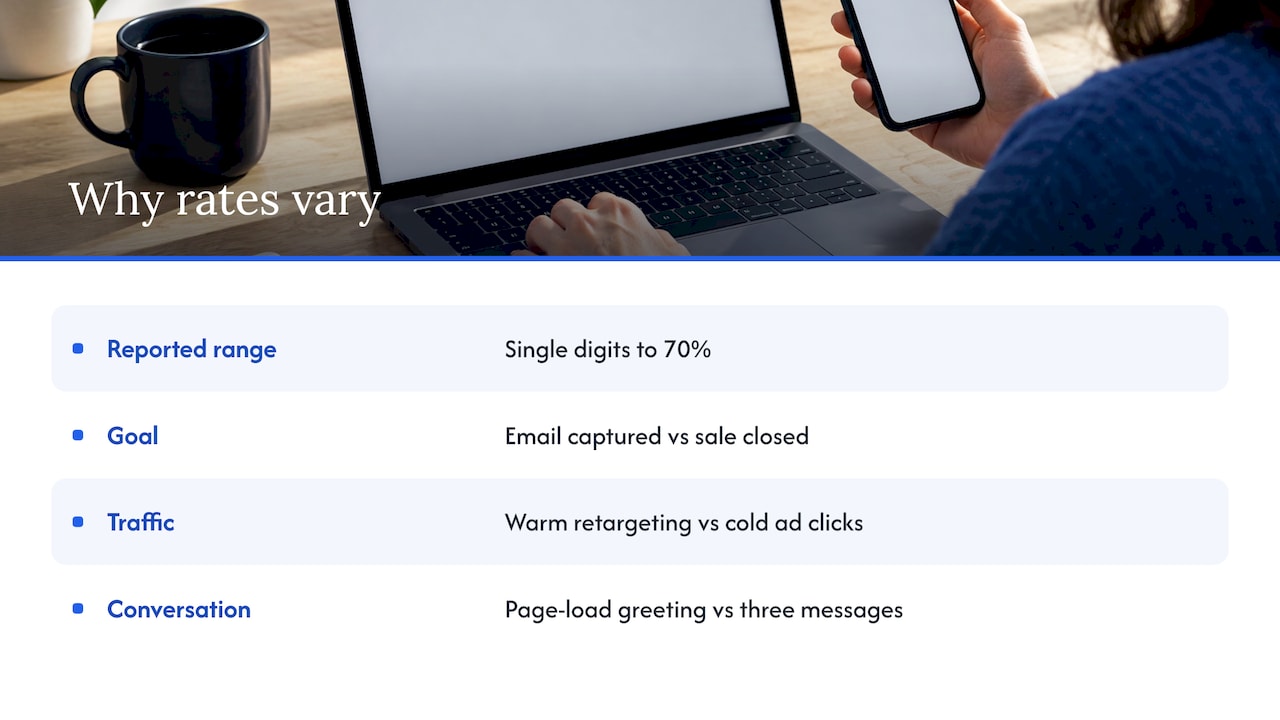
You will see figures from single digits to 70% in rankings for this keyword. The spread is not a sign that some bots are ten times better. It reflects different goals (a email captured versus a sale closed), different traffic (warm retargeting versus cold ad clicks) and different definitions of a “conversation.” A bot that counts every page-load greeting as a conversation will show a low rate. A bot that counts only visitors who typed three messages will show a high one.
So treat any published average as a rough orientation. Your benchmark is your own prior performance on the same traffic, with the same goal event. Before you launch a bot, measure what your contact form does today. After, compare like for like.
Academic work backs the caution. A January 2026 systematic review of 30 empirical studies found personalization, responsiveness, availability and problem-solving ability to be the most examined chatbot features tied to satisfaction, engagement and purchase intention. The same review notes that most studies rely on intention-based measures rather than observed transactions, so evidence on actual conversion is thinner than the marketing around it. That is exactly why your own tracked data should be your yardstick.
Chatbot versus web form: what a controlled test found
The cleanest comparison available is a field experiment published in the Journal of Business Research and summarized by Science of Money. It sent ad clickers either to a chatbot or to a static landing page:
| Test | Chatbot | Static landing page |
|---|---|---|
| Conversion rate, 9,500+ ad clickers | 0.85% (42 conversions) | 0.15% (7 conversions) |
| B2B trial signup, nearly 6,800 users | 18 leads | 5 leads |
The study also gathered 17 expert interviews. They pointed to three reasons for the chatbot’s edge: perceived responsiveness, a conversation that feels customized, and trust in the messaging platform’s security. The same study found chatbots are less suited to highly complex purchases beyond first contact.
Two lessons for a local business owner:
- Rates here are low in absolute terms because the traffic was cold ad clicks. Cold paid traffic converts at a fraction of what warm traffic does. The useful number is the ratio, not the percentage.
- The advantage came from the experience of getting an immediate, tailored reply. A bot that only mimics a form in a chat window does not capture it.
That is also why ad traffic and chat belong together. If you pay for clicks, the first seconds after the click decide the result. Our Facebook and Instagram ads are built to book meetings, and the chat or AI follow-up that catches the lead is set up as part of the same system. For Messenger specifically, see how Facebook Messenger lead automation is set up.
What moves the number
Speed and availability
Responsiveness is the one factor every source agrees on. A lead who submits a form at 9 p.m. and hears back the next afternoon has often called someone else. A chatbot answers at once, at any hour. A voice agent or text follow-up can then continue the conversation when the visitor leaves the page. We cover the economics in our guide to calculating the ROI of responding to every new lead in under a minute, and you can run your own numbers in the new lead AI setter ROI calculator.
A conversation built for one outcome
A bot that tries to answer every possible question converts worse than one built to move a specific visitor to a specific next step. Practical rules:
- Ask the qualifying question that matters first (service needed, ZIP code, urgency, type of incident), then offer times.
- Put the booking calendar inside the chat. Every extra click loses people.
- Keep messages short and written the way your front desk talks.
- Hand off to a person for situations the bot should not handle.
Disclosure and trust
A Marketing Science randomized experiment on outbound calls (Luo, Tong, Fang and Qu, 2019), as reported by MarketSplash, showed how much framing matters. A bot that was not identified up front closed at 23.7%. The same bot disclosing itself before the conversation closed at 4.8%, and 56.3% of people who heard the upfront disclosure hung up within five seconds. That was a cold-call setting with lending offers, not a website chat where visitors opted in by typing. The takeaway for chat is about the opening line: lead with value and a useful first question, not with a script about what the bot is. Follow any disclosure rules that apply to your state and industry.
Fit with the purchase
Simple, high-intent actions suit bots: book an estimate, request a quote, check eligibility, get a callback. Complex decisions need a human after first contact. Design the bot to qualify and book, and let your team close.
How to track chatbot conversions in your CRM
A conversion that lives only inside the chat tool cannot be tied to revenue. The tracking routine:
- Create one conversion event per goal in the CRM: “appointment booked,” “qualified lead,” “retainer signed.”
- Tag every contact with its source (chat, form, call, ad campaign) so you can compare channels on the same basis.
- Log timestamps: first message, first human or AI reply, appointment time. Speed becomes measurable.
- Track the stages after booking: show-up, quote sent, job won or case signed. A booking that never shows is not a win.
- Review transcripts monthly for leads marked not a fit and for conversations where visitors dropped off, then fix the question where they leave.
The weak point in most small-business setups is the link between bot and CRM. Leads captured in chat sit unassigned, nobody follows up, and the conversion rate looks poor when the bot did its job. This is the failure our CRM automation and GoHighLevel setup addresses: pipelines, automations and follow-up arranged so no lead slips through.
Judge lead quality, not just volume
A higher chat conversion rate that fills the calendar with unqualified people is not an improvement. Compare chat leads against form leads on show rate, close rate and revenue per lead. Score leads on behavior, such as visiting the pricing page, asking about cost or returning to the site, not only on whether they filled in every field.
Testing changes without fooling yourself
When you change the greeting, the first question or the booking step, test it properly:
- Split traffic at random before visitors choose whether to chat, so the groups are comparable.
- Pick one primary metric and an observation window before you start.
- Run the test across normal business cycles, including weekends and busy and slow weeks. A roofing company in Florida sees a different mix of leads after a storm than in a quiet month.
- Keep enough volume. A 400-conversation month cannot reliably show a one-point change. Make bigger changes, or run longer.
- Count assisted revenue carefully. A sale that followed a chat is not necessarily a sale the chat caused.
Use cases for local service businesses
Home services: roofing, HVAC, plumbing
Homeowners with a leak or a dead AC want an answer now. The chat goal is a booked estimate or service visit. The track-and-compare metric is booked appointments per 100 chats, then show rate. Pair the bot with Speed to Lead AI so a form fill or ad lead gets an immediate text or call, not a voicemail.
Personal injury and MVA law firms
The goal is not a chat transcript. It is a signed retainer. Intake chat and AI follow-up can gather the basics and book the consultation, and AI for law firms covers intake automation and case qualification. For firms that want to pay only when the result lands, our pay-per-signed-case program works on signed retainers, not leads. Decisions about what intake may say or promise are for your own counsel and bar rules, not for a chatbot vendor.
Insurance agencies
Quote requests and renewal questions arrive after hours. A chat that collects the basics and books a call keeps the lead warm. See our AI customer service for insurance agencies.
B2B and SaaS
Here the conversion is a demo or trial. Our pages on B2B lead generation chatbots and chatbots for SaaS websites describe the setups.
Where MediaBloom fits
Most businesses do not lack a chat widget. They lack the system around it: ads sending traffic to the right place, a bot that qualifies, follow-up by text and voice, a CRM that records every step and someone who books the appointment. MediaBloom is a Tampa, Florida agency that has helped 300+ businesses since 2022, with a 4.8-star Google rating. Our chatbots are one part of that system. We build the ads, the AI agents and the CRM, and our team books the appointments, so you track one conversion rate from first click to booked job rather than reconciling three vendors’ dashboards. Campaigns go live in days.

If your chat leads are not turning into appointments, start with Speed to Lead AI or talk to us through mediabloom.us.
Our perspective
We treat chatbot conversion rate as a symptom, not a target. When the number is low, the cause is usually upstream or downstream of the bot: ad traffic that was never qualified, a slow reply after the chat ends, or a CRM where the lead sits with no owner.
That is why we build the whole path. The ads bring the right people. The AI agent answers in seconds, by chat, text or voice. The CRM records the outcome. Our setters book the appointment. One partner owns the result, so nothing falls between vendors.
For law firms, we went one step further: firms pay only for signed retainers, not leads. The metric that matters is the one that pays the bills, and the same standard applies to every business we serve.
MediaBloom
FAQ
Is 2.5% a good conversion rate?
It depends on the goal and the traffic. On cold paid clicks, low single-digit and even sub-1% rates are normal, as the field experiment above showed. On warm traffic and booking bots, you would expect more. Compare against your own form or landing page on the same traffic.
How do I calculate chatbot conversion rate?
Divide the conversations that reached your goal by total conversations started, then multiply by 100. If 48 of 400 chats ended in a booked appointment, the rate is 12%. Define the goal and the attribution window before you calculate.
Do chatbots convert better than forms?
In one controlled field experiment, yes: 0.85% versus 0.15% among ad clickers. The advantage came from fast, tailored replies. A bot that only repeats the form’s fields will not capture it.
How do I raise my chatbot conversion rate?
Answer faster, ask one qualifying question first, put the calendar inside the chat and make sure every lead is tracked and followed up in the CRM. Test one change at a time with randomly split traffic.
Sources
- IACIS systematic review: the role of AI-powered chatbots in customer service
- Science of Money: chatbots outperform traditional landing pages in B2B lead generation
- MarketSplash: conversational marketing statistics