Caller ID reputation is the score carriers and analytics engines assign to your phone number based on how it behaves, and it decides whether recipients see your business name or “Spam Likely.” The immediate move is simple: run a multi-carrier check on every active DID, turn on monitoring, and correct any dialing behavior that looks automated. If a number is already flagged, remediation is possible, but it starts with fixing the cause, not just filing a dispute.
TL;DR:
- Phone numbers with high call volume, rapid dialing, or frequent short calls are more likely to be flagged and require behavioral correction to improve reputation.
- Registering caller ID information and maintaining consistent area codes helps strengthen identity signals but does not prevent behavioral flags from appearing.
- Ongoing monitoring of answer rates, call durations, and complaint reports can detect reputation issues early before they lead to a “Spam Likely” label.
- Only the carrier or analytics vendor can remove a flag, and fixing underlying dialing practices is essential before filing disputes that may take days or weeks to resolve.
- Incorporating reputation management and pacing controls into dialing systems, especially through AI-powered platforms, reduces the risk of reputation damage due to volume spikes.
Table of Contents
- What Caller ID Reputation Actually Measures
- Why Reputation Directly Affects Your Bottom Line
- What Triggers a Caller ID Flag
- How to Check and Monitor Your Numbers
- How to Get a Flagged Number Fixed
- Preventing the Next Flag Before It Happens
- The Weekly Monitoring Routine That Catches Problems Early
- When to Bring in a Reputation Management Vendor
- MediaBloom’s Take: Reputation Monitoring Belongs in the Dialing Stack
- A Different Way to Protect Your Connection Rates
- Sources
- FAQ
What Caller ID Reputation Actually Measures
Caller ID reputation is not the same as caller ID identity. Identity confirms who is legally authorized to use a number. Reputation is a behavioral score that carriers and third-party analytics vendors calculate based on how that number is actually used, and it can change daily. STIR/SHAKEN attestation verifies you’re authorized to use a number and helps prevent spoofing, but it does not stop a legitimate number from earning a “Spam Likely” tag if it dials aggressively. Labels get applied by the terminating carrier or its analytics vendor, not by you, and they can differ by network. A number might show clean on one carrier and flagged on another the same afternoon.
Why Reputation Directly Affects Your Bottom Line
A flagged number does not just look bad. It stops connecting. Answer rates on labeled numbers frequently drop significantly, compared to notably higher rates on trusted numbers, and that gap compounds fast across a call center dialing hundreds of leads a day. The warning signs usually show up before the label does: answer rate erosion, more calls ending in under five seconds, and hangups mid-greeting. Teams that wait for the visible “Spam Likely” tag before reacting have already lost weeks of connection performance. Watch answer rate as your leading indicator, because labels often appear after performance has already declined.
What Triggers a Caller ID Flag
Most flags trace back to a combination of behavior and identity gaps rather than a single cause. Carriers and analytics engines weigh both:
- Volume spikes: a sudden jump in outbound calls from one DID read like a robocall pattern.
- High call velocity: dialing many numbers in rapid succession within a short window.
- Short call durations: a high percentage of calls under 6 to 10 seconds signals hangups or answering-machine detection abuse.
- Low answer rates: consistently low pickup suggests recipients already distrust the number.
- Missing or inconsistent CNAM: no registered caller name makes a number look anonymous.
- Area code mismatches: dialing from a number whose area code doesn’t match your business region.
- Consumer complaint reports: user-submitted spam reports and honeypot hits feed directly into analytics vendor scoring.
How to Check and Monitor Your Numbers
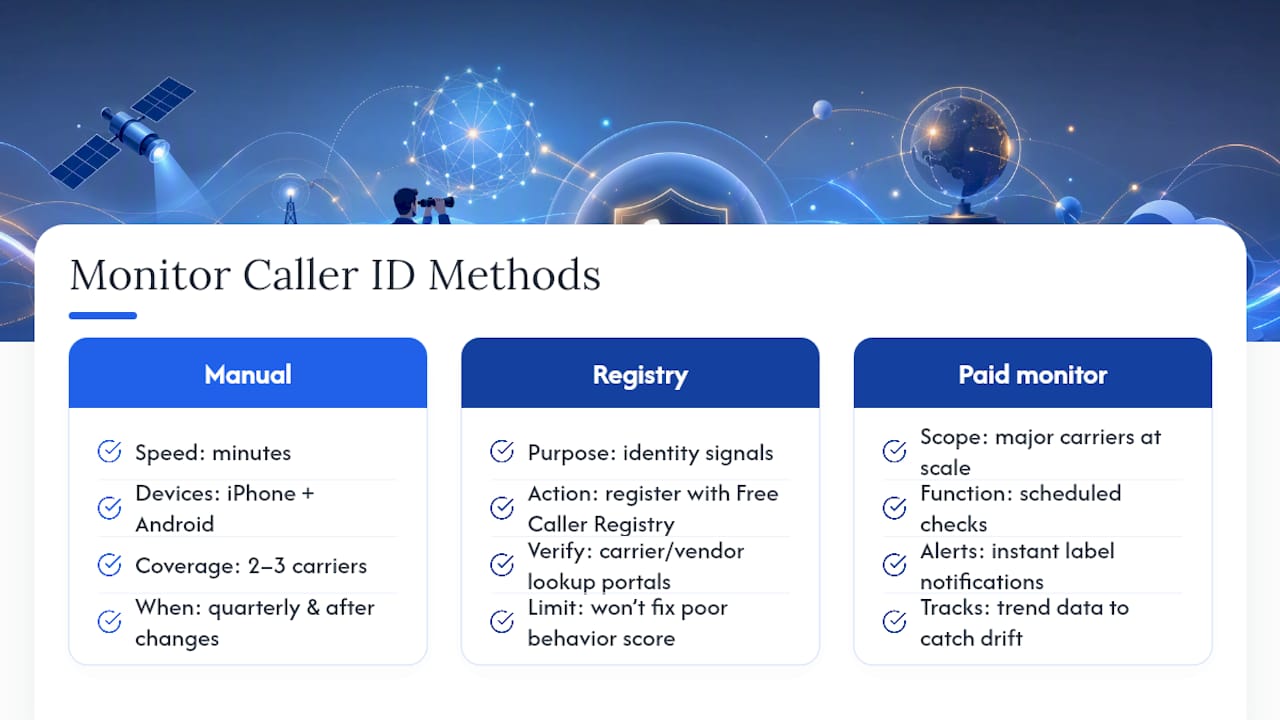
A manual check takes minutes and catches obvious problems fast. Call your business DID from an iPhone on one carrier and an Android phone on another, ideally spanning two or three carrier networks, and note what displays: your business name, “Spam Likely,” “Scam Likely,” or nothing at all. Do this quarterly at minimum, and after any change to your dialing platform or number provider.
For identity signals, register with the Free Caller Registry and check listings through carrier or vendor lookup portals. Registration strengthens identity data but does not override a poor behavioral score on its own.
For ongoing caller ID validation at scale, paid monitoring services check your numbers across major carriers on a schedule, alert you the moment a label appears, and track trend data so you catch drift before it becomes a full flag. This is the layer most call centers skip until after their first reputation crisis, and it’s the one that would have caught the problem earlier.
How to Get a Flagged Number Fixed
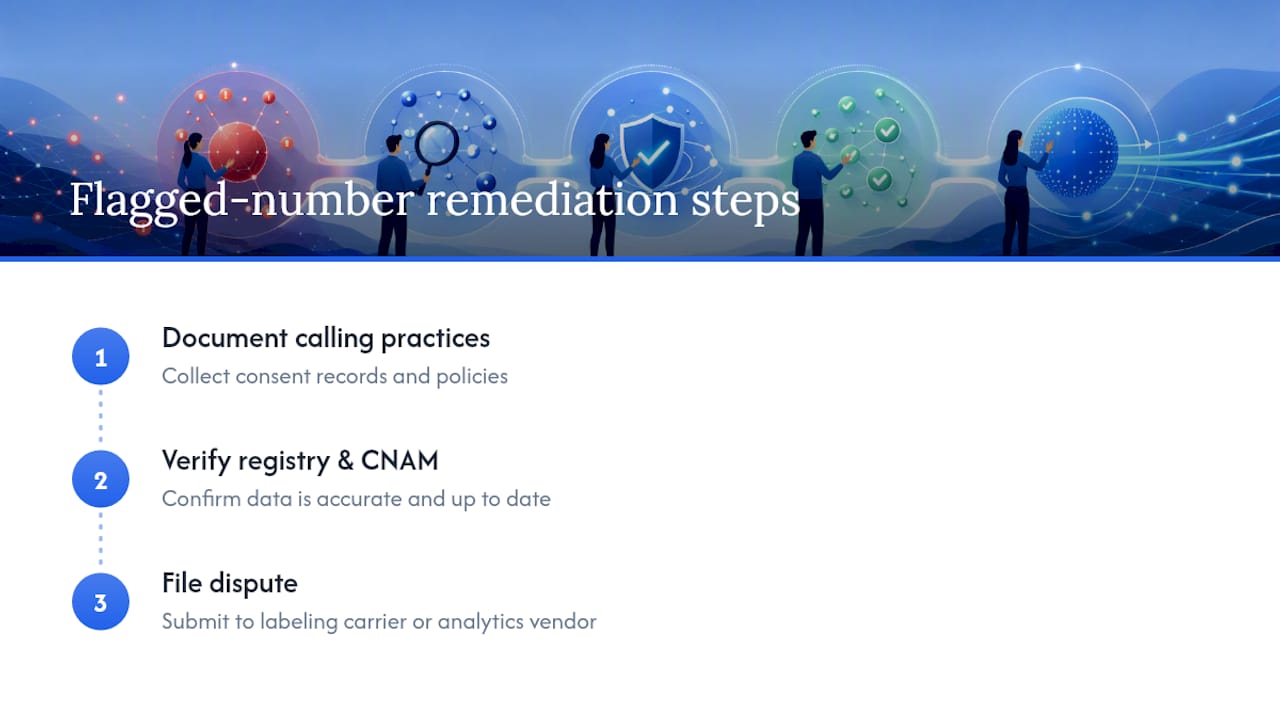
Only the labeling carrier or its analytics vendor can remove a flag. You cannot force removal as the originating provider, no matter how legitimate your business is. Realistic remediation follows three steps: document your calling practices and consent records, confirm your registry and CNAM data are accurate and current, then file a dispute directly with the carrier or vendor responsible for the label.
Timelines vary widely. Some carriers respond within days; others take weeks or longer, especially when evidence is incomplete. Filing a dispute without fixing the underlying dialing behavior that caused the flag is close to pointless. The label often returns within days if volume, velocity, or answer rate problems persist.
Preventing the Next Flag Before It Happens
Prevention beats remediation every time, and it starts with your authentication layer. Secure A-level STIR/SHAKEN attestation with your provider and keep your robocall mitigation database filing current. Register your CNAM or branded caller ID so recipients see your business name instead of a bare number, and keep the area code consistent with where your business actually operates.
Dialing hygiene matters just as much as identity. Limit call velocity per DID, rest numbers periodically instead of running them at max volume continuously, and avoid rotating through a large pool of DIDs to dodge a flag. That tactic burns through numbers faster than it protects reputation.
Pro Tip: Validate your call list against known disconnected and honeypot numbers before every campaign. One hit on a honeypot number can tank a clean DID’s reputation score within a single day.
The Weekly Monitoring Routine That Catches Problems Early
Treat caller ID reputation like any other operational KPI: track it on a schedule, not just when someone complains.
- Check per-DID answer rate daily. A significant drop in answer rate for outbound business lines is your early warning.
- Track average call duration. A rising share of sub-10-second calls points to hangups or spam-detection triggers.
- Log complaint counts from carrier feedback loops and app-based reporting tools weekly.
- Set alert thresholds so any DID cross your answer-rate or duration line triggers an immediate review, not a monthly one.
- Log every remediation request and carrier response in one place, so you know what’s pending and what’s already been resolved.
When to Bring in a Reputation Management Vendor
Number reputation management platforms handle monitoring, registry registration, and carrier or analytics vendor advocacy on your behalf. They speed up the dispute process and centralize tracking across dozens or hundreds of DIDs, which matters once manual checks become impractical. What they can’t do is guarantee immediate removal. Behavior correction on your end remains mandatory regardless of who files the dispute.
The decision usually comes down to volume and internal bandwidth, as described in our step-by-step guide for SMBs on managing online reputation. A team running a handful of numbers can manage checks manually. A call center running high-volume outbound across dozens of DIDs, with tight SLAs on connection rates, generally can’t afford to wait on an unmanaged process.
MediaBloom’s Take: Reputation Monitoring Belongs in the Dialing Stack
Reputation problems usually start upstream, in the dialing logic itself. Outbound programs that spike volume without pacing controls are the ones that get flagged fastest, and case work like the Vision Law engagement shows what changes when monitoring and pacing get built into the outreach process instead of bolted on after a flag appears. The same pattern held in the Paradise Builders rollout: alerts paired with dialing limits prevented the spikes that usually trigger a label.
The lesson generalizes. Pair reputation alerts with automated velocity caps, and audit your dialing program’s reputation exposure before a flag forces the conversation.
— MediaBloom
A Different Way to Protect Your Connection Rates
An alternative to running dialing operations blind is a platform where volume spikes and velocity mismatches are controlled to prevent unnoticed drops in answer rate. Instead of layering a separate monitoring tool on top of a dialing system that has no pacing controls, Some platforms build compliant outreach behavior into the system itself, using AI voice agents that manage call velocity, spread volume intelligently, and support compliant dialing practices from the start.

That matters because reputation damage is almost always a symptom of dialing behavior your team can’t see in real time. Mediabloom’s cold outbound campaigns combine AI voice agents, chatbots, and CRM-connected automation so lead volume scales without the velocity spikes that get numbers flagged. If your outbound program is growing and you want dialing behavior that protects your connection rates instead of quietly wearing them down, request a demo and get an audit of how your current setup handles pacing and monitoring.
Sources
- Caller ID Reputation and “Spam Likely” Labels Explained
- Call blocking (FCC)
- Number Reputation Management (Bandwidth)
FAQ
How can I check the reputation of my phone number?
Call your business number from phones on two or three different carrier networks and note what displays on the recipient’s screen. For ongoing caller identification security, register with the Free Caller Registry and use a monitoring service that checks your numbers across carriers on a schedule.
Why can’t you trust caller ID?
Caller ID shows the number a caller wants displayed, but that number can be spoofed unless STIR/SHAKEN attestation verifies it. Even a verified, legitimate number can still get flagged as spam based purely on behavioral scoring, so the display name alone never confirms trustworthiness.
Does *57 actually work?
Calling a trace with your carrier for malicious or threatening calls doesn’t identify a spoofed caller in real time or improve your own number’s caller ID reputation. It’s a law enforcement reporting tool, not a reputation fix.
Does *67 actually work?
Hiding your outbound caller ID from the recipient’s display does not affect how carriers or analytics vendors score your number’s underlying reputation. Many carriers and businesses block or deprioritize calls with blocked caller ID, which can hurt answer rates further.
How long does it take to fix a flagged number?
Remediation timelines range from a few days to several weeks or longer, depending on the carrier and how quickly you correct the underlying dialing behavior. Filing a dispute without fixing volume, velocity, or answer rate problems usually results in the flag returning.