B2B appointment setting is the process of researching, qualifying, and scheduling sales meetings so closers only take conversations worth their time. Revenue teams use it to protect the calendar of their most expensive resource: the account executive. Done right, it turns cold prospect lists into a steady flow of qualified meetings; done wrong, it floods your pipeline with no-shows and wasted demos.
TL;DR:
- Prioritizing qualification metrics over volume reduces no-shows and improves overall pipeline quality.
- Consistently verifying contact data and maintaining fresh lists sharply increases connection and held meeting rates.
- Implementing two-step confirmation sequences significantly decreases meeting no-shows and enhances meeting reliability.
- Automation platforms like Mediabloom unify voice, chat, and sequencing tools to accelerate lead generation without extensive ramp-up.
- Outsourcing appointment setting offers rapid results and flexibility for new markets, while in-house teams benefit from deeper product knowledge and long-term costs.
Table of Contents
- What B2B Appointment Setting Actually Involves
- Why Appointment Setting Is Worth Fixing Now
- The Step-by-Step Appointment-Setting Process
- Best Practices and the Toolset That Actually Matters
- In-House vs. Outsourced: Which Model Fits Your Team
- Compliance Basics for US Outbound Calling
- Measuring What Matters: KPIs, Benchmarks, and Fixes
- How Mediabloom Applies This Playbook With AI
- Mediabloom’s Take: The Mistakes We Fix Most Often
- See What AI-Powered Appointment Setting Looks Like in Practice
- Sources
- FAQ
What B2B Appointment Setting Actually Involves
Appointment setting sits between prospecting and closing, but it is not the same as either one. Prospecting builds the list. Closing runs the deal cycle to signature. Appointment setting is the connective work in between: identifying the right person, starting a conversation, confirming they meet basic criteria, and locking a meeting on the AE’s calendar.
The people who do this work vary by company size and budget. Some organizations hire dedicated appointment setters or sales development representatives (SDRs) who own outbound calling, email, and LinkedIn outreach full-time. Others contract agencies that run this as a managed service. A growing number use AI voice agents and chatbots to handle the repetitive parts of the sequence, from first contact to scheduling, while humans handle exceptions.
Regardless of who or what is doing the work, the core responsibilities stay consistent:
- Research the account and contact before any outreach, not after a reply.
- Execute outbound touches across the channels the buyer actually uses.
- Ask qualifying questions that filter out poor fits before they reach an AE.
- Book the meeting directly on the calendar, confirm it, and hand off context.
- Log every interaction in the CRM so the AE inherits a full picture, not a cold lead.
The distinction matters for staffing decisions. A team that conflates appointment setting with closing tends to overload AEs with unqualified meetings, which is the single fastest way to burn out a sales floor and tank morale. Separating the functions, whether through headcount, an outsourced partner, or automation, keeps each role focused on what it does best.
Why Appointment Setting Is Worth Fixing Now
Appointment setting is not busywork bolted onto the front of the funnel. It is the mechanism that determines how much of an AE’s week gets spent selling versus chasing. Experts advise that appointment setting should prioritize fit and qualification over volume, because a quality-driven approach to booking meetings increases conversion rates and protects AE productivity far more reliably than adding more dials to the sequence.
The numbers that should drive your strategy: Teams that filter for tight ICP fit and real intent signals before booking see meaningfully higher meeting-to-opportunity conversion than teams optimizing purely for meeting count. Chasing volume inflates the top of the funnel while starving the middle, since AEs end up running discovery calls that should have been disqualified in the first five minutes.
Three ROI levers matter more than any others once a program is running:
- Held meeting rate. A booked meeting that no-shows generates zero pipeline value and costs the AE a slot they could have used elsewhere.
- Meeting-to-opportunity conversion. This tells you whether qualification criteria are working or whether setters are booking anyone who answers the phone.
- AE time reclaimed. Every hour an AE does not spend prospecting or chasing unqualified leads is an hour spent advancing deals already in motion.
Forrester’s research on evolving B2B buying behavior points to growth teams restructuring around coordinated, cross-channel operations rather than siloed outbound. That shift is exactly why appointment setting has become a distinct discipline instead of a task buried inside a generalist sales role.
The Step-by-Step Appointment-Setting Process
A predictable meeting cadence does not happen by accident. It comes from a sequence that is built once, tested, and refined. Here is the operational flow that works across most B2B verticals, from SaaS to professional services.
1. Define your ICP and build enriched lists
Start narrower than feels comfortable with lead generation strategies that grow your NJ & NV business. An ideal customer profile (ICP) built on firmographics alone (industry, headcount, revenue) misses the signals that actually predict buying intent, like recent funding, leadership changes, or technology adoption. Layer intent data on top of firmographics before you build the list, not after the first round of outreach fails.
2. Verify contacts before you spend a single touch
Bad data kills more appointment-setting programs than bad scripts. Verified direct dials and current work emails are foundational; without accurate contact data, even a well-designed cadence collapses at scale. Run every list through a verification pass and strip anyone with a bounced email or disconnected number before outreach begins.
3. Sequence channels in the right order
Coordinated, multi-channel cadences consistently beat single-channel outreach. Modern sequences typically combine phone, email, and LinkedIn across multiple touches rather than relying on cold calling alone. Service-provider data suggests sequencing outreach so email and LinkedIn touches land before the first call, since prospects answer more often when they already recognize the name.
A sample 10-to-14-day cadence for a mid-market B2B account:
- Day 1: Personalized email referencing a specific trigger event (funding, hire, product launch).
- Day 2: LinkedIn connection request with a one-line note, no pitch.
- Day 4: First call attempt, voicemail if no answer.
- Day 5: Follow-up email referencing the voicemail.
- Day 7: LinkedIn message with a relevant resource or insight.
- Day 9: Second call attempt at a different time of day.
- Day 11: Breakup email that creates gentle urgency without pressure.
- Day 14: Final call attempt before moving the contact to a nurture track.
4. Qualify fast, not deep
Setters are not AEs, and they should not try to run full discovery. A practical filter borrows from BANT but leans on the two criteria a setter can actually assess in a five-minute conversation: Need and Timeline. Budget and full authority usually require a real discovery call, but a setter can still screen for budget signals indirectly, asking about current spend on a comparable solution or whether a project has been greenlet for this fiscal year.
5. Schedule and confirm, then confirm again
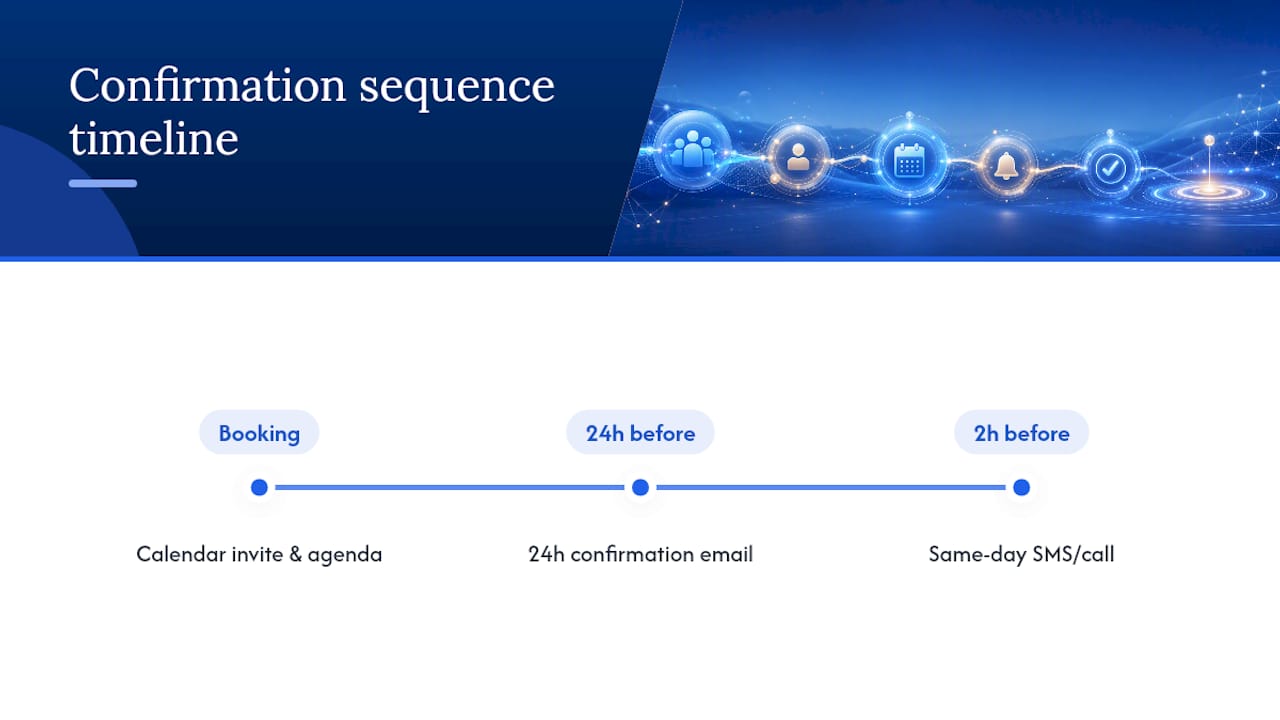
The single biggest lever for reducing no-shows is a double-confirmation sequence. Pairing an initial confirmation with a second reminder closer to the meeting date measurably improves held meeting rates compared to a single confirmation email sent right after booking. A solid confirmation flow looks like: immediate calendar invite with a clear agenda, a confirmation email 24 hours out, and a same-day SMS or call reminder two hours before the meeting.
6. Hand off with context, not just a name
An AE walking into a meeting cold is almost as bad as an AE walking into an unqualified one. The handoff package should include the qualifying answers captured, the trigger event that prompted outreach, any objections raised during the sequence, and a one-line summary of what the prospect said they wanted to discuss.
Pro Tip: Build your handoff notes as a fixed template inside your CRM, not a free-form field. AEs skim faster when the same five fields appear in the same order every time, and setters fill them out faster too.
Best Practices and the Toolset That Actually Matters
The tools matter less than most vendors want you to believe. What matters is whether the categories are covered and whether they talk to each other.
- Contact data provider. Supplies verified direct dials and work emails, refreshed on a schedule rather than pulled once and never updated.
- CRM. The system of record for every touch, qualifying answer, and handoff note; if it is not logged here, it does not exist for reporting purposes.
- Sales engagement platform. Automates and sequences multi-channel touches so setters are not manually tracking who gets which email on which day.
- Dialer. Determines call quality, local presence, and, critically, compliance posture for mobile numbers.
- Scheduler. Removes the back-and-forth of finding a mutual time slot and syncs directly to the AE’s calendar.
Personalization inside the sequence is what separates a booked meeting from a deleted email. A subject line referencing a specific trigger event outperforms a generic pitch every time, but personalization only works if the underlying data is clean. Stale titles, outdated company names, and bounced emails erode trust in the first ten seconds of any touch.
The volume trap is the most common failure mode in appointment setting. It looks like success on a dashboard (dials up, emails sent up, meetings booked up) while held meeting rate and meeting-to-opportunity conversion quietly decline. Protect against it by capping list size to what your qualification process can actually vet, not what your dialer can technically call in a day. A tool like Mediabloom’s AI cold outbound platform can help enforce that discipline automatically, since automated qualification logic filters out poor fits before a human ever sees the record.
It is almost always the cheapest fix.*
In-House vs. Outsourced: Which Model Fits Your Team
The decision usually comes down to three variables: how fast you need meetings on the calendar, how much internal bandwidth you have to manage a new function, and how much control you need over messaging and data.
Outsourcing tends to fit when:
- You need meetings booked within weeks, not quarters, and cannot wait for a hiring cycle.
- Your team has no existing infrastructure for dialers, sequencing tools, or list verification.
- You want to test a new market or vertical before committing headcount to it.
Building in-house tends to fit when:
- Your sales motion is complex enough that setters need deep product knowledge to qualify effectively.
- You already have SDR infrastructure and just need to refine the process, not build it from zero.
- Long-term cost per meeting matters more than speed to first meeting.
Timeline expectations should be realistic either way. Operational teams report that predictable, steady-state cadence typically appears after several weeks to a few months of optimization, as scripts get refined, targeting tightens, and channel mix adjusts based on what is actually converting. Anyone promising mature performance in the first two weeks is setting you up for disappointment.
A hybrid model often works best for growing teams: outsource or automate the initial volume and qualification layer, then bring the highest-value segments in-house once you understand which messages and channels convert. This phased approach lets you validate the playbook before committing to permanent headcount.
Compliance Basics for US Outbound Calling
The FTC’s Telemarketing Sales Rule (TSR) governs telemarketing broadly, and while B2B calls carry certain exemptions, TCPA and state-level rules still create real exposure when outreach touches mobile numbers.
The single biggest risk in modern outbound is autodialing mobile numbers without express consent. State-level mini-TCPA laws vary widely, and mobile autodialing remains the most common source of legal exposure for B2B teams that assume their business-to-business status covers them completely. It does not, automatically, once a personal mobile number is involved.
Practical controls that reduce exposure:
- Configure dialers for manual or preview dialing on mobile numbers rather than full autodialer behavior.
- Enforce timezone restrictions so calls never land outside acceptable calling hours in the recipient’s location.
- Maintain an internal do-not-call list and process opt-outs immediately, not at the end of the week.
- Disclose call recording where required and document consent language used in scripts.
- Escalate to legal or compliance counsel before expanding into a new state or adding a new autodialing tool.
Measuring What Matters: KPIs, Benchmarks, and Fixes
Three primary KPIs tell you almost everything: booked meetings (raw volume), held meeting rate (percentage that actually happen), and meeting-to-opportunity conversion (percentage that turn into real pipeline). Track all three together, because anyone in isolation hides the real story.
Secondary metrics diagnose why the primary numbers move:
- Connection rate reveals whether the problem is data quality or messaging.
- Touches to book shows whether your cadence is too short or too long for your ICP.
- No-show reasons, logged consistently, point directly at confirmation-sequence gaps.
Report weekly during the first two months of any new program, then shift to biweekly once patterns stabilize. When a metric underperforms, fix in this order: data first, then message, then timing. A weak connection rate almost always traces back to bad contact data, not a bad script.
How Mediabloom Applies This Playbook With AI
Mediabloom builds the operational sequence above into a single platform instead of five disconnected tools. AI voice agents handle inbound and outbound calling, AI chatbots qualify leads across chat and SMS, and omnichannel automation keeps email, voice, and messaging synchronized on the same cadence logic described earlier in this article.
- Voice agents run the qualification questions in real time and route only fit-matched conversations to the calendar.
- Chatbots capture and qualify inbound leads the moment they land on a site, closing the gap between interest and booking.
- CRM integrations across 600+ platforms mean handoff notes populate automatically instead of relying on manual entry.
- Compliance settings, including TCPA-aware dialing controls, run in the background so setters do not have to police every call manually.
Companies including Miracle Ear and 1-800 Accountant have used this approach to generate more than 10,000 monthly leads through the platform. It fits teams that want the multi-channel discipline this playbook demands without staffing a full appointment-setting function from scratch, and it works particularly well for SaaS and services companies whose ICP shifts often enough that manual list-building becomes a bottleneck.
Mediabloom’s Take: The Mistakes We Fix Most Often
Most appointment-setting programs we look at share the same three problems, and none of them are exotic.
Volume over fit. Teams chase dial counts and email sends instead of protecting a tight ICP, which floods AEs with meetings that go nowhere. Tightening the qualifying filter almost always beats adding more outreach.
Stale contact data. Lists built once and never refreshed quietly poison every metric downstream, from connection rate to held meeting rate. Verification is not a one-time setup step. It is ongoing maintenance.
No real confirmation cadence. A single “see you Thursday” email is not a confirmation strategy. Programs that add a second reminder closer to the meeting consistently hold more of what they book.
Three fixes solve most of this: cut list size to match your actual qualification bandwidth, put contact verification on a recurring schedule, and build a two-touch confirmation sequence into every booked meeting by default. If you fix nothing else this quarter, fix the confirmation sequence first. It is the cheapest change with the fastest visible payoff.
— MediaBloom
See What AI-Powered Appointment Setting Looks Like in Practice
Reading about a playbook and watching one run are two different things. Mediabloom is the alternative to hiring and training a full SDR team from scratch: the platform runs voice agents, chatbots, and omnichannel sequencing as one connected system instead of five tools you have to stitch together yourself.

Businesses using this approach have generated over 10,000 monthly leads without the ramp time a new SDR hire typically requires, because the qualification logic, confirmation sequences, and CRM handoffs described throughout this article run automatically from day one. That matters most for teams that need meetings on the calendar in weeks, not after a full hiring and training cycle.
If you want to see how this plays out for real companies, review the Mediabloom appointment-setting case studies for outcomes across different industries, including the My Legal Coach case study. When you are ready to see it applied to your own pipeline, request a demo through Mediabloom’s platform page and walk through your ICP, channels, and current booking process with the team.
Sources
- Why B2B Appointment Setting Should Be Part Of Your Sales Strategy (HubSpot)
- Complying with the Telemarketing Sales Rule (FTC)
- How appointment setting works: step-by-step process guide (Touchstone Communications)
FAQ
What Is B2B Appointment Setting?
B2B appointment setting is the process of researching, qualifying, and scheduling sales meetings between a company’s sales team and prospective business buyers, so account executives spend their time only on qualified conversations.
What Does B2B Setting Mean in Sales?
In a sales context, “B2B setting” refers to the appointment-setting function within business-to-business sales: outreach, qualification, and scheduling aimed at another company’s decision-makers rather than individual consumers.
What Does a B2B Appointment Setter Do?
An appointment setter researches target accounts, runs outbound touches across phone, email, and LinkedIn, asks qualifying questions to confirm fit, and books meetings directly onto an account executive’s calendar with handoff notes attached.
Is B2B Cold Calling Legal?
B2B cold calling is generally legal in the United States, and the FTC’s Telemarketing Sales Rule includes exemptions for many business-to-business calls, but TCPA rules and state-level laws still create risk when calls reach mobile numbers without proper consent.
How Long Does It Take to See Results From Appointment Setting?
Most programs, whether in-house or outsourced, reach a predictable meeting cadence after several weeks to a few months as targeting, scripts, and channel mix get refined based on real conversion data.