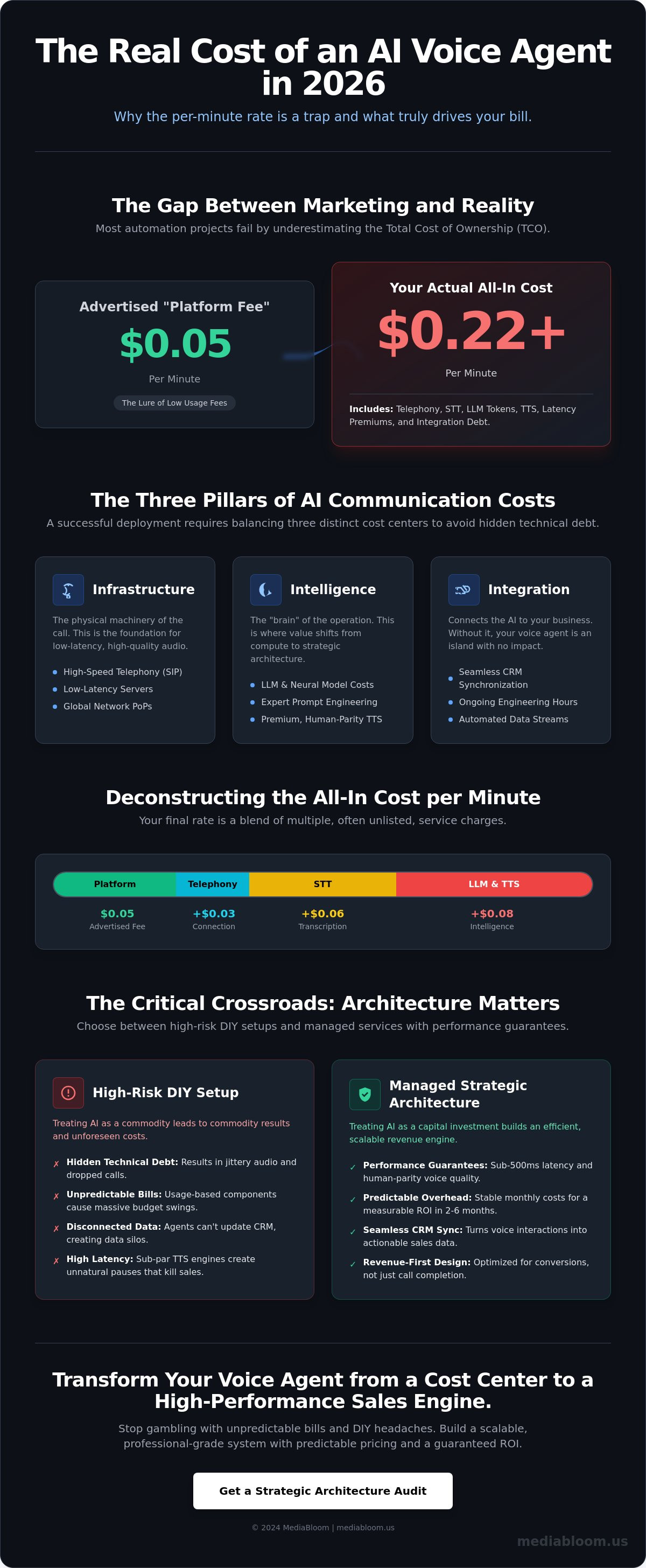
In 2026, the real cost of an AI voice agent isn't the per-minute rate you see on a landing page. It's the hidden technical debt of an unoptimized architecture. Many executives are lured by advertised platform fees as low as $0.05 per minute, only to find their actual ai voice agent pricing ballooning to $0.22 per minute once speech-to-text, LLM tokens, and telephony are factored in. This gap between marketing and reality is where most automation projects fail. You need a system that scales without breaking your budget or your CRM workflow.
You're looking for a predictable sales engine, not a series of unpredictable usage bills and custom logic hurdles. We'll show you how to master the complex landscape of AI voice costs and build a high-performance operation that actually drives revenue. This guide provides a clear breakdown of total cost of ownership, strategies for seamless CRM synchronization, and the path to achieving human-parity voice quality. You'll learn how to deploy sophisticated automation that delivers a measurable ROI within two to six months while maintaining a stable, predictable monthly overhead.
Key Takeaways
- Master the three-pillar economic framework of Infrastructure, Intelligence, and Integration to eliminate hidden technical debt.
- Navigate the 2026 shift in ai voice agent pricing toward performance-based models that prioritize revenue outcomes over simple SaaS subscriptions.
- Evaluate the critical trade-offs between high-risk DIY setups and managed service models that offer strategic architecture and performance guarantees.
- Quantify the "Zero Ramp Time" dividend to understand how AI scalability creates a massive ROI advantage over traditional human BPO teams.
- Implement a revenue-first architecture that transforms automated voice interactions into a high-performance sales engine rather than a peripheral cost center.
The Economics of AI Voice Agents: Beyond the Per-Minute Rate
Usage fees are a vanity metric. If your $0.05-per-minute bot loses a $5,000 lead because of high latency or a robotic tone, the pricing is irrelevant. In 2026, sophisticated ai voice agent pricing models focus on the total cost of ownership (TCO). This includes the architecture required to make every second of a call profitable. You aren't just buying software; you're investing in a digital workforce that requires a robust, three-pillar foundation. Choosing the lowest bid often leads to technical debt, resulting in jittery audio and disconnected data streams that frustrate prospects.
A professional, high-energy sales agent requires more than just a raw API connection. It demands a system designed for conversion. Understanding ai voice agent pricing requires looking at the full stack, from the neural processing power to the CRM synchronization that keeps your sales pipeline moving. When you treat AI as a commodity, you get commodity results. When you treat it as a strategic architect of your revenue, you build a system that scales without limits.
To better understand how these cost components translate to real-world deployment, watch this helpful video:
The Three Pillars of AI Communication Costs
Successful deployment relies on balancing three distinct cost centers. Infrastructure covers the physical machinery of the call, including high-speed telephony, SIP trunking, and low-latency servers. Intelligence represents the brain of the operation. This is where Intelligent agent technology leverages Large Language Models to make split-second decisions during a sales pitch. Finally, Integration involves the engineering hours required to sync these agents with your CRM. Without seamless integration, your voice agent is an island, unable to update lead statuses or trigger follow-up emails automatically.
Why 2026 Pricing Models Have Evolved
The market has moved past the era of generalist bots. Today, specialized neural models trained specifically for high-pressure sales environments command a premium, yet they deliver higher efficiency. Token optimization has reduced the raw cost of compute, but the value has shifted toward expert prompt engineering and strategic architecture. This move favors performance-based pricing where businesses pay for outcomes rather than just uptime. Forward-thinking firms now treat their AI voice agents as capital investments. They prioritize reliable results over the variable, unpredictable billing cycles of the past. The goal is no longer to find the cheapest minute, but to build the most efficient revenue engine.
Breaking Down the AI Voice Agent Cost Components
Every high-performance sales engine has a bill of materials. To understand ai voice agent pricing, you must look past the subscription fee and analyze the individual components that drive conversion. Telephony is your entry fee. Whether you utilize SIP trunking or standard providers like Twilio or Telnyx, you're paying for the raw connection. However, the true investment lies in the synthesis and intelligence layers. A bargain-bin setup might save pennies on the minute, but it will cost you thousands in lost opportunities when the voice sounds synthetic or lags during a critical rebuttal.
Building a system that actually closes deals requires human-parity features. This includes emotional intelligence and the ability to handle interruptions naturally. These capabilities aren't standard; they require advanced logic layering and premium processing power. If you're ready to bypass the trial-and-error phase and build a professional-grade system, you can connect with our team to audit your proposed architecture.
Voice Synthesis and Latency Premiums
Silence kills sales. In a live conversation, sub-500ms latency is the gold standard. Achieving this speed requires premium Text-to-Speech (TTS) engines and high-compute servers. While standard TTS is affordable, it often lacks the emotional resonance needed to build trust. Premium voice cloning and emotionally-aware synthesis engines carry a higher cost but eliminate the "uncanny valley" effect. Furthermore, the logic required for "interruptibility"—allowing the agent to stop and listen when a prospect speaks—adds a layer of complexity to your ai voice agent pricing that DIY platforms often overlook.
Intelligence and Logic Layering Costs
The "brain" of your agent is fueled by Large Language Models (LLMs). The cost here is determined by token consumption. A short appointment-setting call uses fewer tokens than a long-form qualifying session. To ensure accuracy, most enterprise-grade systems utilize Retrieval-Augmented Generation (RAG). This allows the agent to pull from a custom, industry-specific knowledge base in real-time. Managing this logic layer requires rigorous QA to prevent hallucinations. You aren't just paying for the model; you're paying for the "hallucination insurance" that comes from a well-engineered prompt and a structured data environment.
- Telephony: The foundational cost of routing and connecting calls via SIP or API.
- Intelligence: The variable expense of LLM tokens and specialized sales logic.
- Synthesis: The premium paid for human-like tone, inflection, and low-latency response.
- QA & Testing: The essential investment in logic validation to ensure brand-safe interactions.
Comparing Pricing Models: Pay-As-You-Go vs. Managed Professional Services
Executives often question the logic of setup fees when entry-level platforms offer access for a nominal monthly fee. It's a common trap. The reality of ai voice agent pricing is that you either pay for the expertise upfront or pay for the failure later through lost leads and technical debt. A $50-a-month subscription provides a tool, not a solution. To build a high-performance sales engine, you need an architect who understands how to bridge the gap between raw AI capability and your existing revenue operations.
The "Pay-As-You-Go" model appeals to those prioritizing low upfront costs, but it carries significant technical risk. Your team becomes the troubleshooting department. Every hour spent tweaking prompts or fixing API disconnects is an hour stolen from your core business strategy. Without professional oversight, these systems often remain siloed, failing to deliver the seamless experience your prospects expect. Choosing a managed service means choosing reliability over a series of expensive experiments.
The DIY Platform Trap
Low entry costs mask the high price of internal labor. Prompt engineering is a specialized skill; it's not something your marketing manager should learn on the fly. When an unoptimized agent delivers a robotic, disjointed experience, it does more than just miss a sale. It damages your brand's reputation. This technical debt compounds quickly when you realize your AI doesn't talk to your sales stack. Lead leakage becomes inevitable because the bot isn't connected to a custom CRM automation system that captures every data point in real-time.
The Strategic Architect Advantage
Managed services replace uncertainty with a strategic framework designed for ROI. You aren't just paying for minutes; you're paying for a "done-for-you" implementation that guarantees performance. This approach ensures that your voice agents are part of a larger ecosystem, including managed lead nurturing solutions that keep prospects engaged across multiple channels. By investing in professional architecture, you stabilize your acquisition costs. You gain a predictable, scalable workforce that operates with precision. It's the difference between a peripheral tool and a foundational component of your business growth.
- Predictability: Managed services offer fixed costs for setup and optimization, preventing bill shock.
- Expertise: Access to professional prompt engineers and automation architects who understand sales psychology.
- Integration: Seamless connection to your existing CRM and lead nurturing pipelines to prevent data silos.
- Scalability: The ability to ramp up volume instantly without hiring or training new internal staff.
Calculating ROI: The True Cost of Human vs. AI Sales Operations
Measuring ai voice agent pricing by the minute is a tactical error. Strategic leaders measure by the conversion. A 10-person human BPO team represents a high-friction, high-cost engine that suffers from inevitable performance plateaus. When you transition to an automated sales force, you aren't just cutting software checks. You're eliminating the structural inefficiency of human labor. AI delivers a level of precision and persistence that no manual team can replicate, transforming your outbound operations from a variable expense into a predictable revenue machine.
The math changes when you factor in 100% lead coverage. A human team misses calls during lunch breaks, shift changes, and weekends. AI doesn't. It provides an immediate response to every inquiry, capturing the 50% of sales that typically go to the first vendor to respond. This instant engagement, paired with automated lead nurturing, creates a compounding effect on your ROI. You stop paying for "attempts" and start paying for outcomes. If you're ready to see the specific numbers for your business, you should request a custom ROI audit from our architecture team.
Step 1: Quantifying Human Overhead
Fully burdened labor costs are the silent killers of enterprise margins. Beyond the base salary, you must account for benefits, taxes, office infrastructure, and the massive cost of management. Turnover is another hidden drain; every time an agent leaves, you lose weeks of productivity to recruiting and retraining. Then there's the "slop" factor. Industry data suggests that human calling efficiency often suffers from a 20-30% drop-off due to fatigue and manual data entry errors. These micro-losses aggregate into a massive opportunity cost that stunts your growth.
Step 2: Projecting the AI Efficiency Dividend
AI provides an "Infinite Scalability" dividend that humans simply can't match. You can ramp from 100 calls a day to 100,000 calls instantly without hiring a single person. There's no training period and no learning curve. Every agent is a top performer from second one. The impact on your pipeline velocity is immediate because data flows into your CRM in real-time, triggering follow-up sequences without delay. The AI Efficiency Dividend is the revenue gained from 100% lead engagement at 1/10th the human cost. This shift allows your remaining high-level human talent to focus exclusively on closing qualified deals rather than chasing cold leads.
- Zero Ramp Time: Deploy specialized sales logic across your entire operation in minutes, not months.
- Infinite Scalability: Handle massive lead spikes without increasing your management overhead.
- Persistent Performance: Maintain peak conversion energy 24/7/365 without fatigue or downtime.
- Data Integrity: Ensure every call is logged and every CRM field is updated with 100% accuracy.
Strategic Deployment: Why MediaBloom is the Architect of Scalable AI Voice
MediaBloom doesn't just sell software. We engineer revenue operations. While other providers focus on the raw ai voice agent pricing of a single call, we focus on the infrastructure that makes every call profitable. You need a partner who handles the technical complexity of AI voice agents so your team can focus on closing deals. We don't build simple bots. We construct high-energy sales engines designed for scalability and operational excellence. This is the transition from a cost-center to a profit-center with a custom AI workforce.
Our "Revenue First" approach ensures every automation serves a specific financial goal. By combining voice technology with sophisticated CRM automation and ad management, we create a closed-loop system. This isn't a peripheral tool. It's a foundational component of your business architecture. We eliminate the friction between lead generation and lead conversion by building the brain behind your entire sales operation.
Beyond the Voice: Our Integrated Sales Ecosystem
Automation works best when it's synchronized across every channel. We combine voice agents with targeted Email Marketing Services to create a multi-touch automated journey. When a lead interacts with an ad, the voice agent calls instantly, and the CRM triggers a personalized follow-up sequence. This custom workflow maximizes lead value. It allows you to scale sales volume without increasing your headcount. We ensure your AI generated leads are nurtured through a system that never sleeps and never misses a beat.
Your Next Steps to AI Mastery
Auditing your current sales stack is the first step toward implementation. We analyze your existing CRM and lead flow to identify where ai voice agent pricing models offer the highest return on investment. Our roadmap moves rapidly from strategy to high-energy deployment. This ensures you aren't stuck in a cycle of endless testing or technical debt. We handle the prompt engineering, the logic layering, and the API integrations. You simply reap the rewards of a perfectly tuned sales machine. Ready to see the future of sales in action? Watch the demo and witness human-parity AI driving real revenue.
- Strategic Integration: We connect your voice agents directly to your CRM to ensure zero lead leakage.
- Multi-Channel Nurturing: Every voice call is supported by automated email and chatbot follow-ups.
- Scalable Architecture: Our systems are built to handle thousands of concurrent calls with zero latency.
- Results-Driven Execution: We focus on conversion rates and ROI, not just technical uptime.
Architecting Your Future Sales Advantage
The transition from manual labor to an automated sales engine is no longer a luxury; it's a competitive necessity. You've seen that ai voice agent pricing is fundamentally about the quality of your architecture rather than just raw usage fees. By prioritizing human-parity voice quality and seamless CRM integration, you eliminate technical debt and lead leakage. You've moved beyond the DIY platform trap and identified the massive ROI dividends of a digital workforce that scales infinitely without fatigue or downtime.
MediaBloom provides the technical mastery and strategic vision required to turn these possibilities into a high-performance reality. We specialize in end-to-end sales pipeline automation that transforms your outbound operations into a predictable profit center. Stop managing high-friction human overhead and start deploying a system designed for precision and conversion. The infrastructure for your next stage of growth is ready for activation. It's time to secure your position as a leader in the automated economy.
Build Your Automated Sales Workforce with MediaBloom today. It is time to lead your industry with the most efficient revenue engine ever built.
Frequently Asked Questions
How much does an AI voice agent cost per month on average?
Average monthly costs vary based on call volume and architectural complexity. For a business processing 5,000 to 10,000 minutes per month, expected costs typically range between $350 and $1,200. This total depends on whether you utilize a bundled provider or a custom "bring-your-own-key" architecture. Total ai voice agent pricing must account for all sub-components to avoid unpredictable billing cycles.
Is there a setup fee for custom AI voice agent development?
Professional implementations require setup fees to cover strategic architecture and deep CRM synchronization. While DIY platforms might offer a $50 monthly subscription, these tools lack the custom logic and integration required for enterprise-grade sales operations. Managed service fees ensure your agent is built on a "Revenue First" foundation rather than a generic template that fails to convert.
How does AI voice agent pricing compare to hiring a human BPO?
Automated systems provide a massive cost advantage over traditional human-operated services. A full-time human agent can cost between $3,000 and $4,000 per month. In contrast, an AI voice system handling similar call volumes typically costs only 10% to 30% of that human overhead. This allows you to scale outbound volume instantly without increasing your management burden or office footprint.
Are there hidden fees in usage-based AI pricing models?
Hidden fees frequently exist in "bring-your-own-key" models where advertised rates only cover the platform fee. You must also account for the costs of Speech-to-Text (STT), Large Language Models (LLMs), and Text-to-Speech (TTS). These components can add $0.06 to $0.19 per minute to your baseline expenses. Transparent ai voice agent pricing should always factor in telephony routing and concurrency scaling to ensure a predictable TCO.
Can I lower my AI voice agent costs by using different LLMs?
Choosing the right model layer can optimize your operational expenses significantly. Utilizing efficient models like GPT-4o-mini for routine qualifying tasks while reserving specialized sales models for high-stakes rebuttals lowers token consumption. This strategic approach ensures you pay for intelligence only where it drives the highest conversion value, maintaining a lean and efficient digital workforce.
What is the ROI of an AI voice agent for a sales-heavy business?
Most mid-sized businesses achieve a measurable return on investment within 2 to 6 months of deployment. The primary driver is 100% lead coverage. By eliminating missed calls and ensuring instant response times, you capture revenue that human teams often lose due to fatigue or scheduling constraints. This persistent performance creates a compounding effect on your bottom line.
Do I have to pay for AI voice agent minutes if the customer hangs up immediately?
Billing structures depend on the specific provider and telephony configuration. Many platforms utilize per-second billing but may include a minimum call duration or connection fee. It's essential to audit your provider's policy on short-duration calls to ensure your billing aligns with your actual lead engagement patterns and doesn't inflate your monthly overhead.
Does MediaBloom offer custom enterprise pricing for high-volume callers?
We develop tailored solutions for high-performance sales operations that require massive scale. MediaBloom focuses on building scalable infrastructure that meets the demands of high-volume enterprise callers while maintaining human-parity quality. Our approach prioritizes predictable monthly overhead and performance-based outcomes. You can contact our team to discuss a strategic architecture built for your specific revenue goals.