AI cold calling means using voice agents built on speech-to-text, language models, and text-to-speech to run outbound sales calls at scale. It fits best as a qualification and appointment-setting layer, not a closer replacement, and it works within a hard boundary: the FCC’s 2024 ruling treats AI voices as artificial or prerecorded under the TCPA, which means consent and disclosure are mandatory.
TL;DR:
- AI cold calling offers significant cost savings and consistent script adherence but struggles with complex, multi-stakeholder conversations.
- Compliance requirements under FCC and state laws demand prior consent, DNC scrubbing, immediate opt-out, and AI-disclosure at call start, increasing operational complexity.
- The technology relies on a four-part pipeline: telephony, speech-to-text, language model reasoning, and text-to-speech, requiring under 800 milliseconds for natural flow.
- Hybrid approaches with AI handling volume and initial qualification, combined with human closers for complex conversations, maximize ROI and legal safety.
- Rigorous testing, careful scripting, and compliance monitoring are essential before scaling AI cold calling campaigns to avoid legal and reputation risks.
Table of Contents
- What AI Cold Calling Does Well, and Where It Doesn’t
- What TCPA and FCC Rules Mean for AI-Generated Calls
- How Does AI Cold Calling Work Technically?
- What to Look for in an AI Calling Platform
- How to Pilot AI Cold Calling Without Getting Burned
- How to Measure ROI on an AI Calling Pilot
- How MediaBloom Approaches Compliant AI Cold Calling
- What We’ve Learned Deploying AI Voice Agents
- Get a Compliant AI Calling Program Running
- Sources
- FAQ
What AI Cold Calling Does Well, and Where It Doesn’t
AI voice agents win on economics and consistency. A single agent can dial a large volume of numbers daily, maintain compliance disclosure consistency, and operate reliably because of a bad commute. That combination makes AI a strong fit for qualification, appointment reminders, list re-engagement, and initial outreach where the goal is booking a meeting, not closing a contract.
The weak spots show up fast when the conversation gets complicated. Multi-stakeholder deals, layered objections, and open-ended discovery still favor a trained human rep who can read tone and improvise. An AI Cold Calling 2026 test of 1,000 calls found meeting rates from connected calls ranging from 6.4% to 22.1% depending on the industry and script quality, which tells you the tool works, but only when the job matches its strengths.
- Cost per dial drops sharply compared with a human SDR team.
- Script adherence stays perfect across every single call.
- Coverage extends to evenings and weekends without overtime.
- Discovery-heavy or emotionally charged conversations still need a human.
- A flawed script or a dirty list gets scaled instantly, multiplying both complaints and legal exposure.
Pro Tip: Before scaling any campaign, run 50 to 100 calls manually reviewed for tone and compliance. A bad script at 10,000 dials is a very different problem than a bad script at 100.
What TCPA and FCC Rules Mean for AI-Generated Calls
The FCC’s February 2024 Declaratory Ruling settled a question that had been murky for years: AI-generated voices used in outbound calls count as “artificial or prerecorded” voices under the TCPA. That means most AI cold calls to consumers require prior express consent, the same threshold that applies to any prerecorded telemarketing message.
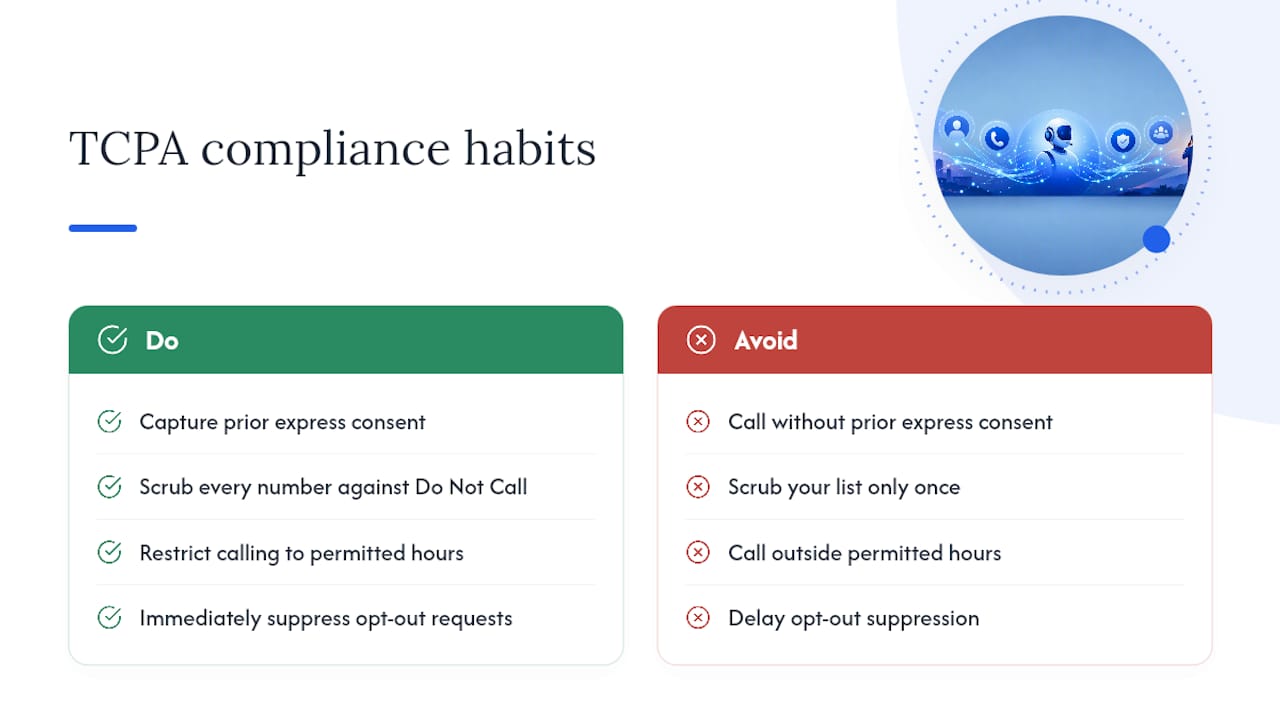
Practical compliance comes down to five habits. Capture prior express consent, in writing where the call type requires it. Scrub every number against the Do Not Call registry before each call batch, not just once when the list is built. Restrict calling to permitted hours. Route opt-out requests to immediate, automated suppression. Disclose that the caller is using AI at the start of the conversation.
Federal Register documentation on the underlying rulemaking shows the FCC actively considering stricter disclosure mandates and detection requirements going forward, which is a strong signal that 2026 compliance postures should lean conservative rather than wait for enforcement clarity.
State rules add another layer, since several states impose consent or disclosure requirements stricter than federal law. Log every consent timestamp and opt-out request. If a dispute ever surfaces, that record is the entire defense.
TCPA penalties run $500 to $1,500 per violation, and that exposure compounds with volume. FCC data on AI-related robocall exposure makes clear that per-call risk scales linearly. Ten thousand dials against a bad list isn’t ten thousand times the risk on paper. It’s ten thousand separate opportunities for a complaint or a lawsuit.
Legal analysis of the post-Duguid landscape confirms that even calling systems that don’t meet the narrow autodialer definition still fall under prerecorded-voice liability once AI generates the voice. List hygiene and a conservative pilot aren’t just best practice. They’re the difference between a scalable channel and a legal liability.
How Does AI Cold Calling Work Technically?
The pipeline behind a natural-sounding AI call has four moving parts, and understanding them explains why some vendors sound robotic while others sound almost human.
- Telephony and dialing. The system places the call through a carrier-integrated dialer, often with number rotation built in to avoid spam-likely flagging.
- Streaming speech-to-text. As the prospect talks, streaming STT converts speech to text in real time, word by word rather than waiting for a full sentence.
- Language model reasoning. An LLM processes that text against a branching script, decides how to respond, and pulls the next line or question.
- Text-to-speech output. The response gets converted back to voice and played into the call, ideally before the prospect notices a gap.
That whole loop needs to complete in under roughly 500 to 800 milliseconds to preserve natural turn-taking. Cross that threshold and prospects start talking over the agent or hang up, assuming a dropped call or a bad connection.
Outbound calling adds controls that inbound systems don’t need: a consent filter that blocks the dial before it happens, a per-call DNC check rather than a one-time list scrub, pacing logic that spaces calls to avoid carrier spam flags, and disposition logic that writes the outcome straight to the CRM.
The most reliable production setups right now are hybrid. The AI agent handles the opening, qualifies interest, and books or transfers live to a human the moment the conversation gets complex. That handoff point is where most of the actual ROI lives.
What to Look for in an AI Calling Platform
Vendor claims are easy to make and hard to verify on a demo call. Test these criteria before signing anything.
Compliance features should be non-negotiable at the top of the list: automatic DNC scrubbing on every batch, auditable consent capture with timestamps, automated opt-out handling that suppresses a number instantly, and built-in AI disclosure language at the start of each call.
Integration depth determines whether the tool fits your stack or becomes a side project. Look for two-way CRM sync, calendar booking that writes directly to a rep’s calendar, SMS and email fallback for prospects who won’t answer a call, and clean analytics export.
Call quality and safety separate a usable platform from a liability. Ask about branching script depth, live-transfer latency to a human agent, and what carrier or spam-mitigation measures are built in, since a flagged number kills connect rates regardless of script quality.
Operational transparency is the piece teams underrate until they need it. You want granular reporting down to the call level, full transcript access for every conversation, clear call dispositioning, and a stated retention policy for recordings and data.
- Compliance: DNC scrubbing, consent logs, opt-out automation, AI disclosure
- Integrations: CRM sync, calendar booking, SMS/email fallback, analytics export
- Quality: branching scripts, human transfer, latency guarantees, spam mitigation
- Transparency: transcripts, dispositioning, retention policy
How to Pilot AI Cold Calling Without Getting Burned
A safe rollout follows a sequence, not a leap.
- Classify your list first. Tag every contact as CAN_CALL_AI, CAN_CALL_MANUAL, or CANNOT_CALL based on consent status, then run that classification past legal review before dialing anything.
- Narrow the target. Pick one ICP segment and one use case, such as re-engaging a stale lead list, rather than launching across every campaign at once.
- Build the script with disclosure built in. Write branching paths for the two or three most common responses, and open every call with a clear AI disclosure line.
- Run a small randomized test. Split a few hundred contacts between AI and your existing process, run it for one to two weeks, and listen to a sample of actual call recordings, not just the summary metrics.
- Enforce operational rules live. Calling hours, immediate opt-out writes to your suppression list, and disposition sync all need to work correctly before you scale past the pilot.
- Review weekly and set escalation triggers. Track connect rate, meeting rate, and complaint volume every week, and define in advance what result pauses the campaign versus what result earns a bigger budget.
Pro Tip: Treat week one as a listening exercise, not a results exercise. The AI cold calling checklist from industry practitioners is right that a bad script scaled to 10,000 dials creates ten thousand problems, not one.
How to Measure ROI on an AI Calling Pilot
The math is straightforward once you track the right numbers. Add up telephony costs, STT/LLM/TTS platform fees, and any per-minute vendor charges, then divide by meetings booked to get your true cost per appointment.
The core KPIs to track every week:
- Dials placed and calls connected
- Conversations lasting 30 seconds or longer (a rough proxy for genuine engagement)
- Qualified leads generated
- Meetings booked and live transfers completed
Published field results give a useful benchmark range. The 1,000-call test mentioned earlier found connect rates generally range within single-digit to mid-teens percentages, with cost per appointment varying by industry and script maturity. That spread matters: it means your specific vertical and script quality drive outcomes far more than the platform choice alone. Set your ROI timeline at 60 to 90 days, and define upfront what connect rate or meeting rate would trigger a pause rather than a scale decision.
How MediaBloom Approaches Compliant AI Cold Calling
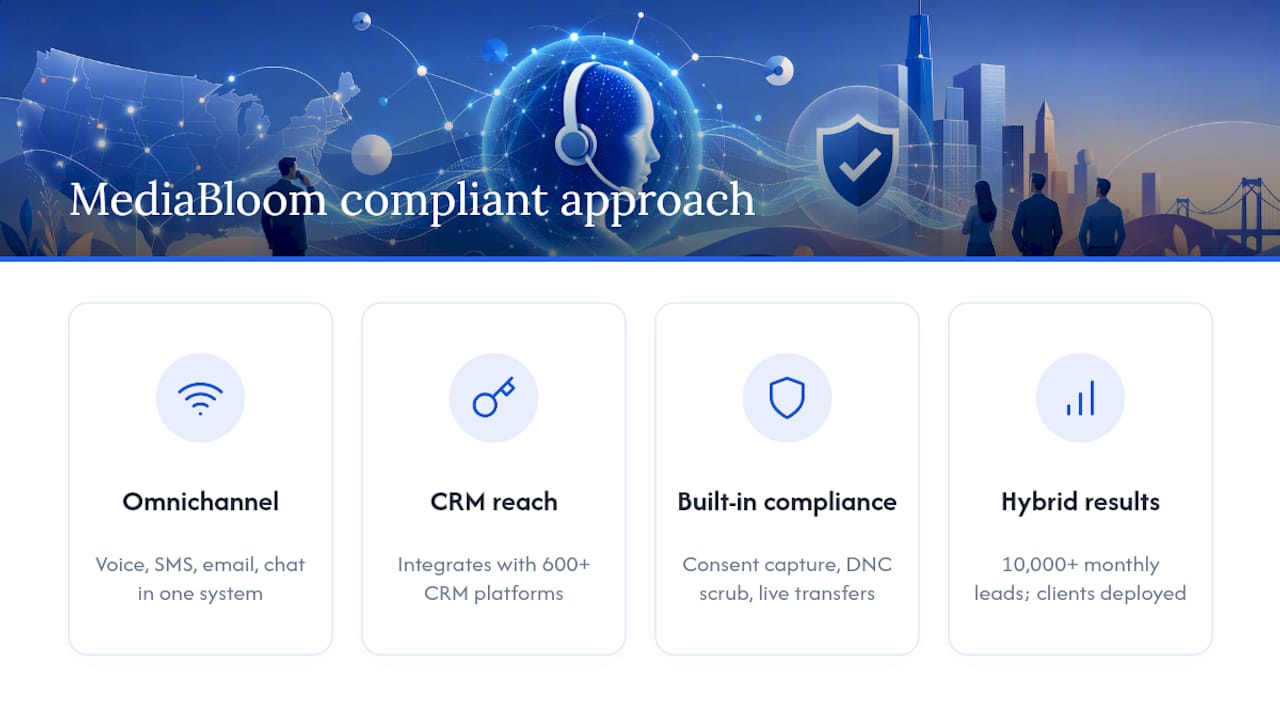
MediaBloom’s platform runs AI voice agents, chatbots, and omnichannel automation, including voice, SMS, email, and chat, inside a single system connected to CRM integrations across 600-plus platforms. Compliance sits at the operational core: consent capture, per-call DNC scrubbing, and live-transfer workflows are built into the calling flow rather than bolted on afterward.
Companies including Miracle Ear and 1-800 Accountant have deployed the platform to generate over 10,000 monthly leads, pairing AI qualification with human closers at the transfer point. That structure reflects the hybrid model this article recommends throughout: AI handles volume and consistency, humans handle judgment.
What We’ve Learned Deploying AI Voice Agents
Fix the process before you fix the technology. A weak qualification script or a stale list will underperform on any platform, and teams that blame the AI usually skipped the diagnostic step. Start small, measure honestly, and resist the urge to scale before the numbers earn it.
Keep a human closer in the loop for anything beyond a scheduled meeting. The strongest programs treat AI as the opening act, not the whole show, and pair aggressive automation with equally aggressive compliance discipline.
— MediaBloom
Get a Compliant AI Calling Program Running
If you’re weighing whether to build this pipeline in house or partner with a platform that already has consent capture, DNC scrubbing, and live transfer built into the calling flow, some platforms offer this hybrid model, with AI handling qualification and booking, humans handling the close, without spending months wiring the components together yourself.

MediaBloom’s cold outbound campaigns solution is built specifically for teams that need pipeline generation without the compliance guesswork, and the Fifth Avenue Leads case study shows what a deployed program looks like end to end. For a closer look at how AI qualification pairs with human sales capacity, MediaBloom’s guide on sales team efficiency breaks down the handoff model in practice. If your outbound program fits the SaaS motion specifically, the AI outbound and SDR solution for SaaS companies covers the operational specifics for that segment. Request a demo to see the consent, disclosure, and transfer workflow running on your own list.
Sources
The FCC’s 2024 Declaratory Ruling is the primary authority on AI voices under the TCPA. The Federal Register notice details proposed disclosure rules. Practitioner analysis covers post-Duguid litigation risk, and the 1,000-call vendor test supplies field benchmarks referenced throughout.
This article is general information, not a substitute for advice from a qualified lawyer. Consult a qualified legal professional about your own circumstances before acting on anything here.
- FCC confirms TCPA applies to AI technologies that generate human voices
- Implications of Artificial Intelligence Technologies on Protecting Consumers from Unwanted Robocalls and Robotexts (FCC documents)
- TCPA in the AI era (practitioner notes)
- How to create an AI cold-calling agent (2026 guide)
FAQ
Is It Illegal to Cold Call Using AI?
Not automatically, but the FCC’s 2024 ruling requires prior express consent and disclosure for AI-generated voice calls in most telemarketing contexts, and calling without that consent creates real TCPA liability.
What Is the AI Tool for Cold Calling?
Several platforms build outbound AI voice agents, and MediaBloom is one option that pairs AI voice calling with omnichannel automation, CRM integrations, and built-in compliance controls like consent capture and DNC scrubbing.
Is Cold Calling Dead in 2026?
No. AI has changed how it’s executed, not whether it works.
Can I Talk to AI Like a Phone Call?
Yes. Modern AI voice agents use streaming speech-to-text, language models, and text-to-speech to hold real-time conversations, with response latency under roughly 500 to 800 milliseconds needed for the exchange to feel natural rather than robotic.