AI chatbot pricing in 2026 spans from free starter tiers to $500,000-plus custom builds, and the gap comes down to one variable: pricing model multiplied by monthly conversation volume. A small support team on a flat SaaS plan might pay $50 a month, while an enterprise routing 200,000 conversations monthly could justify a seven-figure custom deployment. Before signing anything, run your own volume numbers through the estimation steps below.
TL;DR:
- Cost-effective chatbot solutions for small businesses typically range from free to $500 a month, with limited features and conversation caps.
- Mid-market deployments usually cost between $500 and $5,000 monthly, offering advanced features like multilingual support and sentiment analysis.
- Custom enterprise builds can exceed $500,000 in the first year, especially for companies with complex compliance and workflow needs.
- Pricing models vary from per-resolution, usage-based, per-seat, flat subscription, to fully custom, significantly impacting overall costs based on conversation volume.
- Total ownership costs often include implementation, API usage, integration, hosting, monitoring, and compliance, adding 30 to 50% to vendor sticker prices.
Table of Contents
- How Much Does an AI Chatbot Cost by Business Size?
- What Are the Main AI Chatbot Pricing Models?
- What Costs Are Hiding in Your Total Cost of Ownership?
- Should You Build, Buy, or Extend an Existing Platform?
- How Do I Estimate My Chatbot Budget Step by Step?
- What Fees Do Chatbot Vendors Leave Out of Their Pricing Page?
- What Questions Should You Ask Every Chatbot Vendor?
- How MediaBloom Approaches Pricing for Lead Generation and Appointment Setting
- Can I Cancel or Get a Refund on an AI Chatbot Subscription?
- How Do Traffic Spikes and Scaling Affect Chatbot Costs?
- How Do Popular AI Chatbot Vendors Compare on Price?
- How Much Does Multilingual Support or Sentiment Analysis Add to the Price?
- Author’s Perspective: Aligning Procurement and IT on Pricing Model Selection
- Want Pricing Bundled With Results Instead of Line Items?
- Sources
- FAQ
How Much Does an AI Chatbot Cost by Business Size?
Vendor pricing pages rarely tell you what you’re actually buying. The dollar figure only makes sense once you match it to a capability tier and a conversation volume.
Starter and SaaS entry tiers run from free to $99 a month. These plans typically cap monthly conversations, limit integrations to a handful of apps, and offer canned flows rather than true natural language understanding. A solo consultant or a five-person shop answering FAQs on a website fits here comfortably.
The SMB band sits between $50 and $500 a month. At this level you get CRM integrations, basic lead qualification, and multichannel deployment across web chat and SMS. A basic FAQ bot in this range typically costs $500 to $5,000 to build and $20 to $500 a month to operate, depending on how much customization the vendor charges for upfront.
Mid-market pricing climbs to $500 to $5,000 a month. The jump comes from higher conversation ceilings, sentiment analysis, multilingual support, and dedicated account management. Production support bots in this tier run $10,000 to $50,000 to build with $200 to $5,000 in monthly operating costs, a range that reflects the difference between a chatbot that answers “where’s my order” and one that resolves billing disputes.
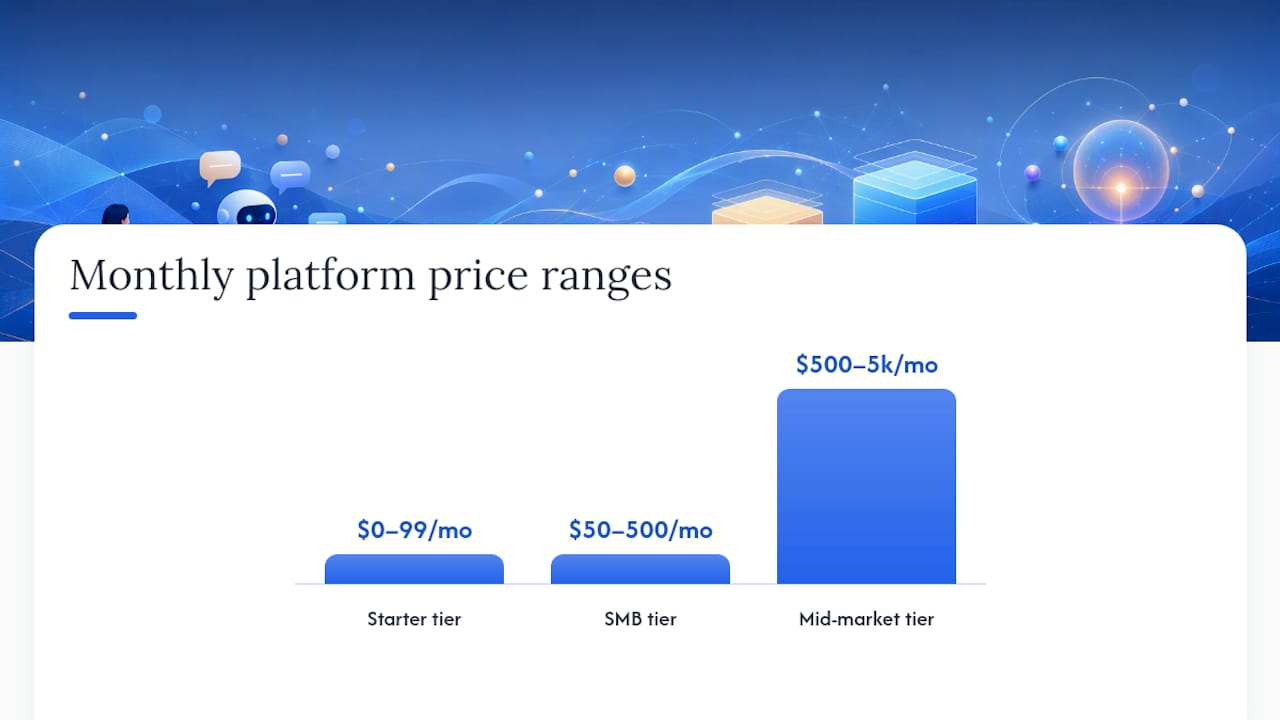
Enterprise and custom builds start around $30,000 in year-one platform costs and can exceed $500,000, according to Alice Labs’ 2026 enterprise chatbot analysis. Enterprise assistants with deep compliance and workflow requirements often land at $50,000 to $300,000-plus to build.
Three quick scenarios show how this plays out:
- A 10-person insurance agency handling 2,000 chats a month: SMB tier, roughly $200 to $400 monthly.
- A regional healthcare network handling 40,000 patient inquiries a month: mid-market to low enterprise, $3,000 to $15,000 monthly.
- A national retailer processing 500,000 seasonal conversations: custom build territory, six figures in year-one TCO.
What Are the Main AI Chatbot Pricing Models?
Vendors bill you five different ways, and the model matters more than the sticker price. Two vendors quoting “$0.50 per conversation” and “$299 flat” can produce wildly different annual bills once your volume swings.
- Per-resolution pricing charges only when the bot successfully resolves a query without human handoff. It sounds fair, but it can perversely punish a well-tuned bot: the better it performs, the more resolutions it logs, and the higher the bill climbs.
- Per-conversation or usage-based pricing charges per session regardless of outcome, which makes forecasting easier but rewards high chat volume even when many sessions go unresolved.
- Per-seat pricing charges by the number of human agents or admins using the platform, a model borrowed from help desk software that fits teams more focused on internal tooling than raw conversation throughput.
- Flat or tiered subscription pricing bundles a conversation cap into a fixed monthly fee, which is one of five dominant models in the current market and the easiest to budget against.
- Custom/owned builds mean you pay for development and infrastructure instead of a subscription, giving you full control over the model and data pipeline.
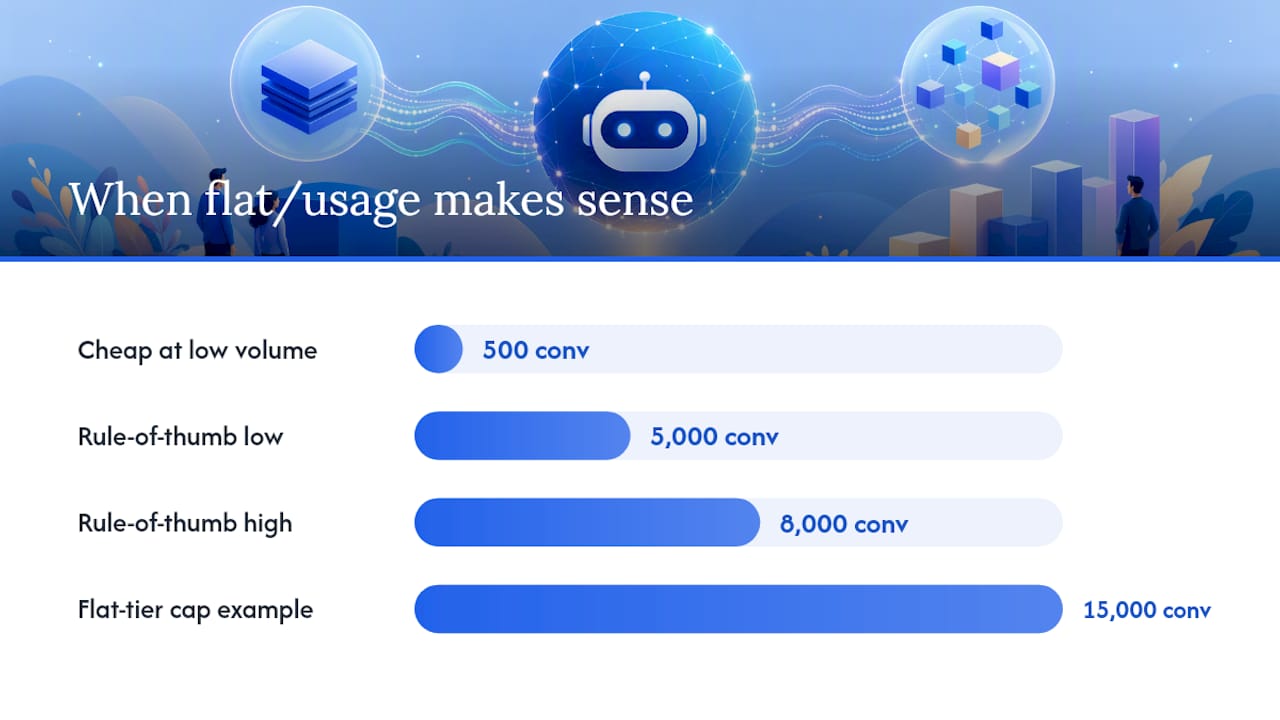
Here’s the math that trips people up. A flat-tier competitor at $999 a month covering up to 15,000 conversations costs less than half that, even though its sticker price looks higher on a landing page.
Pro Tip: Ask every vendor to quote your actual monthly volume in dollars, not just their rate card. A rate that looks cheap at 500 conversations can double at 5,000.
As a rule of thumb, flat or usage-based plans make sense below roughly 5,000 to 8,000 monthly conversations. Past that, model the custom-build breakeven before renewing another annual contract.
What Costs Are Hiding in Your Total Cost of Ownership?
The number on a vendor’s pricing page is rarely the number you’ll pay. Total cost of ownership includes the least nine line items, and most buyers only budget for one or two.
- License or platform fees: the recurring subscription, typically $50 to $5,000+ monthly depending on tier.
- LLM/API costs: usage-based fees to OpenAI, Anthropic, or similar providers, billed per token or per call.
- Implementation: setup, flow design, and testing, often a one-time fee of $2,000 to $50,000+.
- Integrations: connecting your CRM, help desk, or e-commerce platform, sometimes bundled, often billed separately.
- Data prep and retrieval-augmented generation (RAG): cleaning and indexing your knowledge base so the bot answers accurately.
- Infrastructure and vector database hosting: the storage layer that powers semantic search for custom builds.
- Monitoring and QA: ongoing review of conversation logs to catch hallucinations or drift.
- Maintenance: updates as your product, policies, or integrations change.
- Compliance: TCPA, HIPAA, or SOC 2 requirements that add legal review and audit costs.
Hidden costs across these categories, particularly integration work, vector database hosting, and data prep, often add 30 to 50% on top of raw API costs. Internal engineering time is frequently the largest single line item, exceeding the licensing fee itself once you factor in the hours spent on integration and tuning, per Alice Labs’ cost breakdown.
A useful normalization metric is cost per resolved conversation. Fully loaded, AI resolution can run $0.15 to $0.80 per conversation versus $4 to $12 for a human agent, which is the number finance teams should actually track instead of the monthly invoice total.
Should You Build, Buy, or Extend an Existing Platform?
Speed and control pull in opposite directions, and the right answer depends on your conversation volume more than your engineering headcount.
A SaaS chatbot typically goes live in 6 to 12 weeks. Buy-and-extend platforms, where you license a base product and customize it with your own integrations, usually take 8 to 16 weeks. A fully custom build runs 3 to 18 months, depending on scope and compliance requirements.
- SaaS: fastest to deploy, lowest upfront cost, least control over the model and data pipeline.
- Buy-and-extend: moderate timeline, moderate cost, good middle ground for companies with specific integration needs but no desire to own infrastructure.
- Custom build: slowest and most expensive upfront, but full ownership of data, model behavior, and long-term unit economics.
The crossover math favors custom builds more than it did two years ago. LLM API costs fell 40 to 60% year-over-year between 2023 and 2025, which shifted the breakeven point to lower volumes than most 2023 projections assumed. A company processing 100,000 conversations a month at $0.50 per conversation on a SaaS plan pays $50,000 monthly, or $600,000 a year. A custom build with $200,000 upfront and $8,000 monthly in infrastructure and API costs pays for itself in under five months at that volume.
Before committing, check that you have: a clear volume forecast for the next 18 months, an internal engineering team that can own ongoing maintenance, and a compliance requirement that a SaaS vendor can’t meet out of the box. If two of the three are missing, buy rather than build.
How Do I Estimate My Chatbot Budget Step by Step?
Most vendor calculators oversimplify the math. Build your own estimate with four steps and you’ll walk into negotiations with numbers no sales rep can talk you out of.
- Measure your baseline. Count monthly conversation volume and your fully loaded cost per human-handled conversation, typically $4 to $12 per conversation.
- Choose a deflection assumption and pricing model. A well-implemented bot realistically deflects 40 to 65% of eligible conversations. Multiply deflected volume by your chosen vendor’s per-conversation or per-resolution rate to get monthly AI cost.
- Add one-time and recurring costs. Include implementation fees, integration work, and monthly infrastructure or maintenance charges on top of the platform fee.
- Calculate annualized TCO and payback. Divide your total year-one cost by the monthly savings from deflected conversations to find your payback period in months.
That’s 10,000 conversations deflected monthly, saving $60,000 a month in labor costs. At $0.60 per resolved conversation, the AI cost is $6,000 monthly. Net monthly savings: $54,000. Against a $40,000 implementation fee, payback lands under one month, before ongoing platform fees are factored in.
What Fees Do Chatbot Vendors Leave Out of Their Pricing Page?
Sticker prices rarely include everything you’ll be billed for. Watch for overage charges once you exceed your monthly conversation cap, per-integration setup fees that aren’t disclosed until contract signing, and professional services hours billed separately from the subscription.
- Overage fees for conversations beyond your plan’s cap, sometimes billed at a much higher per-unit rate than your base tier.
- Integration fees for CRMs or help desks not included in the “standard” package.
- Professional services hours for onboarding, flow design, or custom training data.
- Data residency or compliance add-ons for HIPAA, TCPA, or GDPR requirements.
Negotiate before signing, not after. Ask for pilot terms with a defined exit point, a capped overage window instead of pure per-unit billing, and a list of integrations included at your tier versus billed separately.
Pro Tip: Get every verbal promise about “included” integrations or support in writing in the order form itself, not just the sales deck.
What Questions Should You Ask Every Chatbot Vendor?
A pricing conversation without a standard question list produces answers you can’t compare across vendors. Bring this list to every RFP or sales call.
- What is the exact pricing model, and what counts as a billable unit?
- What happens when we exceed our monthly conversation cap?
- Which integrations are included versus billed as add-ons?
- Do we get direct API access, or only the vendor’s interface?
- Where is our data stored, and does that meet our compliance needs?
- Is there a cap on training data or knowledge base size?
- What does vector database hosting cost at our expected volume?
- What support SLA applies, and does it change by tier?
- How are change orders and custom feature requests priced?
- What are the exit terms if we cancel mid-contract?
Record every answer in a shared spreadsheet with columns for vendor name, model type, and dollar estimate at your actual volume. That’s the only way finance can compare quotes apples to apples.
How MediaBloom Approaches Pricing for Lead Generation and Appointment Setting
Some vendors use AI to bundle voice agents, chatbots, and sales automation into one platform rather than pricing each channel separately. Instead of stacking license fees, API costs, and integration invoices from separate vendors, buyers may evaluate one outcome-bundled cost tied to leads generated and appointments booked. That shift changes the procurement conversation from “what does the seat cost” to “what does a booked appointment cost,” which is often the more useful question for revenue teams. For companies weighing a managed service against piecing together infrastructure themselves, bundled pricing can remove several TCO line items from the spreadsheet entirely.
Can I Cancel or Get a Refund on an AI Chatbot Subscription?
Cancellation terms vary significantly by vendor and pricing tier, and the fine print matters more than the marketing copy. Month-to-month SaaS plans typically allow cancellation at the end of the current billing cycle with no penalty, but annual contracts often lock you in with early termination fees or require 30 to 60 days’ written notice before the renewal date.
Refund policies split into three common patterns. Some vendors offer a prorated refund for unused months if you cancel a prepaid annual plan, though this is increasingly rare as vendors push toward non-refundable annual commitments in exchange for a discount. Others offer a short trial window, typically 14 to 30 days, with a full refund if you cancel before it ends. A smaller group offers no refunds at all once a billing cycle starts, treating the subscription like a software license rather than a recurring service.
Before signing, get the cancellation clause in writing and ask specifically about mid-contract downgrades, not just full cancellation. Many vendors will let you cancel entirely but won’t let you drop from an enterprise tier to a mid-market tier without a new contract negotiation. If a vendor pitches a “custom implementation fee” as part of onboarding, ask whether that fee is refundable if you cancel within the first 90 days. Vendors rarely volunteer that answer, and it can represent thousands of dollars if the relationship doesn’t work out.
Pilot agreements are your best leverage here. A 60 or 90-day pilot with a defined exit clause protects you from a full annual commitment before you’ve validated deflection rates and actual conversation volume against the vendor’s projections.
How Do Traffic Spikes and Scaling Affect Chatbot Costs?
Usage-based and per-resolution pricing models mean your bill moves with your traffic, which is a problem for any business with seasonal or event-driven spikes. A retailer running a holiday sale, an insurance agency during open enrollment, or a tax firm in March can see conversation volume triple or quadruple for a few weeks, and a per-conversation rate card turns that spike into a proportional cost spike.
Flat and tiered subscription plans handle this differently. Most cap your included conversation volume and charge overage fees once you cross it, which means a traffic spike either triggers a surprise bill or forces you to upgrade to a higher tier mid-cycle, sometimes with a new annual commitment attached. Ask vendors specifically how overage is billed during short-term spikes versus a sustained volume increase, since the two scenarios often carry different pricing logic.
Custom builds handle scaling differently again. Infrastructure and vector database costs generally scale with actual compute usage rather than a per-conversation vendor markup, which can make custom deployments more cost-efficient during unpredictable traffic patterns, provided your infrastructure is architected to autoscale rather than sized for average load. The tradeoff is that autoscaling infrastructure requires ongoing engineering attention that a SaaS subscription doesn’t.
If your business has predictable seasonal peaks, negotiate a seasonal tier or a temporary volume band into your contract before the peak hits, not during it. Vendors have far less incentive to offer flexible terms once you’re mid-spike and dependent on their uptime.
How Do Popular AI Chatbot Vendors Compare on Price?
Rather than naming specific competitors, it’s more useful to look at the pricing bands that show up across the market by category. Entry-level tools built for solo users or very small teams cluster in the $0 to $30 a month range, often with hard caps on monthly conversations and limited integration support.
Mid-tier plans aimed at small teams generally land between $50 and $500 a month, a band that lines up closely with the SMB pricing discussed earlier. What differentiates vendors within this band is less the base price and more what’s bundled: some include unlimited integrations at this tier, others charge per connected app.
Enterprise custom quotes routinely exceed $30,000 a year, and at this level, published pricing pages become almost useless for comparison since every quote is negotiated around your specific volume, compliance needs, and integration count. The practical benchmarking exercise isn’t comparing list prices. It’s requesting a quote from three vendors at your actual projected volume and comparing the resulting dollar figures side by side, since rising chatbot adoption across the market means vendors increasingly customize quotes rather than publish a one-size number.
How Much Does Multilingual Support or Sentiment Analysis Add to the Price?
Base conversational AI, meaning a bot that answers straightforward questions in one language, sits at the low end of every pricing tier discussed above. Add capabilities, and the price climbs in fairly predictable ways.
Natural language understanding sophisticated enough to handle ambiguous or multi-intent queries typically pushes a vendor from its entry tier into its mid-tier pricing, since better NLU usually requires a more capable underlying model with a higher per-token API cost. Sentiment analysis, which flags frustrated or urgent customers for escalation, is often an add-on feature priced separately from the base subscription, adding anywhere from a modest monthly fee at the SMB level to a meaningful five-figure annual cost at enterprise scale.
Multilingual support carries perhaps the widest cost swing. A bot that only needs to detect and respond in two or three common languages adds relatively little to the bill on most modern platforms, since large language models handle multiple languages natively. But multilingual support that requires region-specific compliance, localized knowledge bases, or human review in each language multiplies your data-prep and QA costs, not just your platform fee. If you’re budgeting for a global rollout, treat each additional language as its own mini-implementation project rather than a checkbox feature.
Voice capabilities, if you’re bundling voice agents alongside chat, add another cost layer entirely, typically priced on call minutes rather than conversation counts. Ask any vendor quoting a “multilingual” or “sentiment-enabled” tier to break out exactly which languages and which sentiment features are included versus billed as professional services.
Author’s Perspective: Aligning Procurement and IT on Pricing Model Selection
Procurement teams tend to fixate on the sticker price and skip the model math entirely, which is how companies end up locked into per-resolution contracts that punish good performance. IT should own validating the token and infrastructure assumptions before anyone signs, since those numbers are what actually move the bill month to month. The best approach is a small pilot, 60 to 90 days, with a defined volume ceiling and a scheduled review before renewal. Whoever owns the vendor relationship should have veto power over any contract that lacks a clear exit clause.
— MediaBloom
Want Pricing Bundled With Results Instead of Line Items?
Every model covered above (per-resolution, usage-based, flat tiers, custom builds) still leaves you assembling chatbot, voice, and CRM costs separately and hoping the pieces add up to actual pipeline. Some platforms bundle AI voice agents, chatbots, and sales automation into one platform, so instead of budgeting license fees, API costs, and integration invoices as separate line items, buyers evaluate one cost tied to leads generated and appointments booked.

Some businesses have used this bundled approach to generate many monthly leads without stitching together separate vendor contracts for chat, voice, and CRM sync. If your team is evaluating chatbot options for B2B lead generation or comparing platforms for SaaS customer support, start by reviewing the appointment setting case studies to see how outcome-based pricing plays out in practice, then watch a live demo to get a pricing conversation started around your actual conversation volume.
Sources
- Enterprise AI Chatbot Guide 2026: Build vs Buy, Costs & ROI
- Chatbot Pricing Models 2026: Per-Resolution vs Seat vs Usage | Metageeks
- How Much Does an AI Chatbot Cost in 2026? Complete Pricing Guide | Vortenza
FAQ
How Much Does a Chatbot Cost?
Costs range from free entry tiers to over $500,000 for enterprise custom builds, with most small businesses paying $50 to $500 monthly and mid-market companies paying $500 to $5,000 monthly, according to Vortenza’s 2026 pricing guide.
Which AI Chatbot Is the Cheapest?
Entry-level SaaS tools with limited conversation caps and basic features start free or under $30 a month, though these plans typically lack the integrations and NLU sophistication that mid-market and enterprise buyers need.
Can I Buy My Own AI Chatbot Instead of Subscribing?
Yes. Custom builds let you own the model, data pipeline, and infrastructure outright, typically costing $30,000 to $500,000-plus in year-one investment, and they become more cost-competitive at high volume now that LLM API prices have fallen 40 to 60% since 2023.
Does MediaBloom Offer Bundled Chatbot and Voice Pricing?
MediaBloom prices its platform around bundled outcomes, combining chatbots, AI voice agents, and sales automation rather than billing each channel separately, which suits buyers who want lead generation and appointment setting under one cost structure.
What Should I Ask a Vendor Before Signing a Chatbot Contract?
Ask about the exact billable unit, overage fees, included integrations, data residency, and exit terms. Documenting these answers side by side across vendors is the only reliable way to compare quotes at your actual conversation volume.