
An agent simulator is the repeatable test environment that validates AI voice and chat agents for lead generation and appointment setting before they touch a single real prospect. The verdict: run a multi-week, scenario-driven pilot that proves reliable task completion before any live deployment.
Your three must-have pilot inputs:
- Representative transcripts: 50–200 anonymized production calls or chat logs covering your highest-volume scenario
- CRM and calendar integration: live webhook connections so every simulated appointment write is verifiable
- A measurable success criterion: one primary KPI (appointment set rate, task completion rate, or time-to-lead) agreed on before the first test run
Key Takeaways
A validated agent simulator pilot, run across at least 200 representative calls and scenarios with CI/CD regression gating, is the most reliable path from AI concept to production-ready lead generation. For statistical significance, you should aim for at least 200 completed simulation runs per scenario before final go/no-go decision.
| Point | Details |
|---|---|
| Start with one scenario | Prove appointment-setting reliability end-to-end before expanding to other flows. |
| Task completion threshold | Target above 85% across all scenarios before approving any production rollout. |
| Integrate CRM and calendar first | Verify webhook writes and slot lookups in simulation; field errors are invisible in live calls. |
| Enforce TCPA consent capture | Validate opt-in and recording notice delivery in every simulated outbound flow. |
| Mediabloom’s pilot model | Done-for-you setup with CI/CD gating, 600+ CRM integrations, and TCPA/SOC 2 compliance built in. |
Table of Contents
- What does an agent simulator actually do for lead gen?
- Why simulate before putting AI agents on real prospects?
- What core features should an effective agent simulator provide?
- How do you build and run a reproducible test suite?
- Which KPIs should you track in simulation and in production?
- What integrations and compliance controls must you verify first?
- What does a realistic pilot timeline look like?
- How Mediabloom’s pilot model delivers measurable results
- Quick evaluation checklist and vendor brief template
- The case for simulating before you scale
- Mediabloom pilots AI agents with built-in simulation and compliance
- Sources
- FAQ
What does an agent simulator actually do for lead gen?
In the context of AI voice and chat agents, a simulator is a controlled environment that replays scripted and production-derived conversations against your agent, measures every outcome, and flags failures before they cost you real leads. It is not a gaming product or a VR environment. The industry term is virtual agent simulation, and it covers the full delivery stack: audio waveform input through ASR (automatic speech recognition), NLU (natural language understanding), dialog manager, tool calls, and CRM writes.
For lead generation and appointment booking specifically, the scope includes inbound and outbound voice flows, chat NLU fidelity, calendar slot lookups, CRM record creation, and replayable production-call tests. Mediabloom’s AI agents for sales, support, and marketing operate across all of these surfaces, which is why simulation coverage must match the full channel mix before go-live.
Why simulate before putting AI agents on real prospects?
Skipping simulation means your first test subjects are paying prospects. Failed calls waste ad spend, damage brand reputation, and create TCPA exposure when consent capture or call-recording notices malfunction. The upside of simulating first is direct: higher conversion rates, lower cost per appointment, and a defensible compliance record.
The risk-versus-benefit breakdown is concrete:
- Cost of bad calls: misdirected transfers, false-positive qualifications, and dropped appointments erode pipeline quality faster than low volume ever will
- TCPA exposure: a single misconfigured consent-capture flow can trigger per-call statutory damages under the Telephone Consumer Protection Act
- Appointment quality risk: an agent that books unqualified leads wastes sales rep time and inflates no-show rates
- Conversion upside: agents validated through simulation typically enter production with stable, repeatable flows rather than unpredictable first-call behavior
Reliable voice agent design starts with one narrow, high-volume scenario proven end-to-end before any expansion.
Pro Tip: Every production call failure is a free test case. Convert it into a permanent regression scenario immediately so the same failure cannot recur after the next prompt update.
What core features should an effective agent simulator provide?
Evaluate any simulator against this checklist during vendor demos or RFPs:
Audio and language fidelity
- Audio-native testing: real waveform input through ASR, not transcript-only evaluation. Transcript-only testing misses barge-in, timing gaps, and audio artifacts that cause real-world failures.
- Measurement of ASR word error rate (WER) per scenario helps estimate transcription accuracy
- NLU intent accuracy across persona accents and speech patterns
Scenario and load coverage
- Auto-generation of test cases from production transcripts, conversation graphs, and hand-crafted edge-case scripts
- Persona matrix support: buyer types, accents, interruption behaviors, adversarial objections
- Concurrent call load testing (ramp-up, spike, and soak patterns) to find capacity limits before launch
- P95/P99 latency tracking per turn, not just averages
Integration and tool-call simulation
- CRM write simulation with schema validation
- Calendar slot lookup and booking confirmation flows
- Webhook retry and failure-mode testing
Compliance and security
- Call recording redaction and PII masking
- Consent capture verification per call flow
- Audit logs compliant with widely recognized security and privacy standards
- TCPA opt-in pattern enforcement
How do you build and run a reproducible test suite?
Start with production calls, then build outward. Automated scenario generation from transcripts, conversation graphs, and explicit edge-case scripts outperforms hand-writing every test case and gives you coverage across real failure modes.
- Collect 50–200 representative calls or chats. Anonymize PII, label outcomes (appointment set, transferred, abandoned, disqualified), and identify your single highest-volume scenario.
- Synthesize a persona matrix. Cover at least four buyer types (warm inbound, cold outbound, skeptical, non-native English speaker) plus two interruption behaviors (barge-in, long pause). Stress-testing AI SDRs against adversarial prospect personas surfaces logic gaps before agents reach real prospects.
- Generate scenario scripts. Target this composition: 40% happy paths, 30% edge cases, 15% error handling, 10% adversarial, 5% acoustic variations.
- Run audio-native simulations. Feed real waveform audio through ASR. A sample appointment-booking exchange: Agent: “I have Thursday at 2 PM or Friday at 10 AM — which works better for you?” Persona: [interrupts] “Actually, can we do next week?” Agent: [recovers] “Of course. I have Monday the 15th at 3 PM. Does that work?” The simulator scores whether the agent recovered correctly and wrote the right slot to the calendar.
- Measure, iterate, gate. Set pass/fail thresholds before the first run. Block production deployment when any scenario falls below threshold. Add every new production failure as a regression test on the next sprint.
Version control every prompt change. A prompt update that improves one scenario can silently break another. CI/CD regression gating catches this automatically.
Which KPIs should you track in simulation and in production?
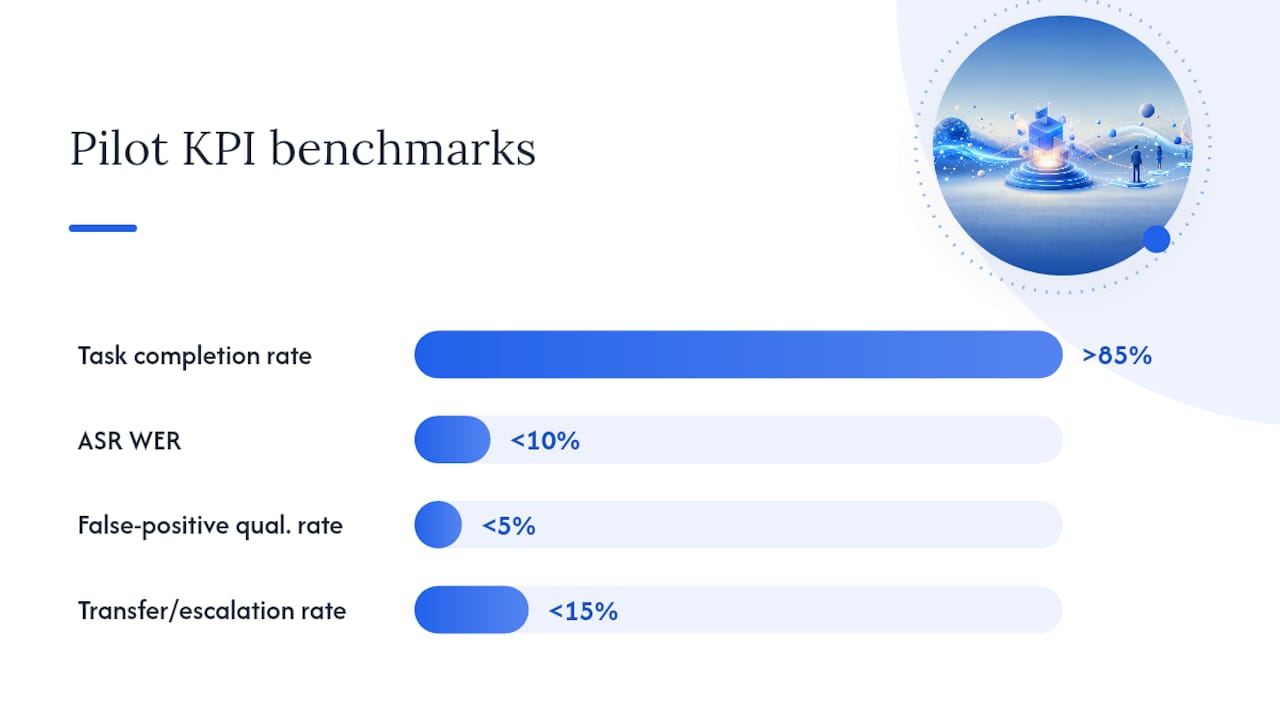
Measure task completion and business outcomes first, then work down to infrastructure signals. A four-layer evaluation framework keeps metrics organized and prevents teams from optimizing infrastructure at the expense of revenue outcomes.
| Metric | What it measures | Suggested benchmark |
|---|---|---|
| Task completion rate | Appointment set or lead qualified end-to-end | >85% for mature flows |
| ASR word error rate (WER) | Transcription accuracy | <10% |
| P95 turn latency | Worst-case response delay | <800ms |
| False-positive qualification rate | Leads booked that fail sales criteria | <5% |
| Transfer/escalation rate | Calls handed to humans | <15% for stable flows |
| Appointment show rate | Booked leads that attend | Baseline + track trend |
Measure latency by P95 and P99 percentiles rather than averages. Averages hide the worst-case delays that drive call abandonment. For early pilots with fewer than 200 calls per scenario, treat results as directional signals rather than statistically definitive benchmarks, and expand sample size before drawing go/no-go conclusions.
What integrations and compliance controls must you verify first?
Verify CRM and calendar webhooks, recording storage, and consent capture before running a single test. Failures in these three areas are the most common reasons pilots stall or create legal exposure.
Integration checklist:
- CRM write patterns: confirm field mapping, deduplication logic, and error handling on failed writes
- Calendar slot lookups: test availability queries, double-booking prevention, and confirmation message accuracy
- Authentication and role mapping: verify agents cannot access records outside their permission scope
- Webhook retries: confirm failed writes queue and retry rather than silently drop
Compliance checklist:
- TCPA opt-in: every outbound flow must verify consent status before dialing
- Recording notice: confirm the agent delivers a legally compliant notice on every recorded call
- PII redaction: SSNs, DOBs, and financial data must be masked in logs and recordings
- SOC 2 evidence: request audit reports before production
- HIPAA: if your agent handles protected health information, confirm Business Associate Agreement availability and PHI handling controls. Mediabloom’s AI chatbot for medical and healthcare websites is built with these controls in mind.
Pro Tip: Log a compact handoff packet for every escalation: prospect intent, last agent utterance, and explicit consent status. A human rep who receives this context closes the loop in seconds instead of re-qualifying from scratch.
What does a realistic pilot timeline look like?
A minimal viable pilot generally runs multiple weeks; longer timelines may be needed when CRM integrations require custom schema mapping or HIPAA controls need review.
| Week | Key tasks | Deliverable |
|---|---|---|
| 1 | Anonymize transcripts, map CRM schema, define success KPIs | Data package + KPI doc |
| 2 | Generate scenario scripts, build persona matrix, configure integrations | Test suite v1 |
| 3–4 | Run audio-native simulations, measure KPIs, log failures | Baseline metrics report |
| 5 | Iterate prompts, add regression tests, re-run suite | Iteration report |
| 6 | Go/no-go decision against pre-agreed thresholds | Pilot readout |
Cost drivers to budget:
- Simulator licensing or usage-based voice credits
- Engineering hours for CRM and calendar integration (typically 20–40 hours for standard connectors)
- Managed services fees if using a done-for-you pilot model
- Ongoing optimization retainer post-launch
How Mediabloom’s pilot model delivers measurable results
Mediabloom ran a structured simulation pilot for a multi-location healthcare benefits provider. The team collected over a hundred inbound appointment-request calls, labeled outcomes, and generated a scenario test suite covering multiple buyer personas and edge-case categories. Baseline task completion in simulation improved significantly after prompt iteration sprints and CRM schema corrections before any live call was placed.
At go-live, the client saw a material reduction in transfer rate and a measurable increase in appointments booked per 100 inbound calls. The Carolina Benefits Group case study documents a comparable pilot structure and outcome trajectory.
Three lessons other teams can apply immediately:
- Label your baseline call outcomes before generating scenarios — unlabeled data produces unbalanced test suites.
- Fix CRM write errors in simulation, not production. A missed field mapping that drops a lead is invisible in live calls but obvious in a simulator log.
- Set your go/no-go threshold before the first run, not after you see the numbers.
Quick evaluation checklist and vendor brief template
Pass/fail checklist for vendor demos:
- Audio-native testing with real ASR waveform input
- Scenario auto-generation from production transcripts
- CI/CD regression gating with configurable thresholds
- CRM write simulation with field-level validation
- TCPA consent capture verification per call flow
- P95 latency monitoring per turn
- SOC 2 audit log availability
Vendor brief template (paste into RFP or email):
- Pilot scope: [number] scenarios, [voice/chat/both], [primary use case]
- Integrations required: [CRM name], [calendar system], [webhook endpoints]
- Sample size: [number] representative production calls for scenario generation
- Success criteria: [primary KPI] at [threshold] before production rollout
- CI/CD expectations: automated regression gate on every prompt or integration change
- Security and compliance: SOC 2 Type II report, TCPA consent logging, [HIPAA BAA if applicable]
The case for simulating before you scale
The conventional wisdom says to launch fast and fix in production. For AI voice agents handling lead generation and appointment setting, that approach is expensive. A failed call does not just lose one lead — it can trigger a TCPA complaint, train your sales team to distrust the AI, and set back adoption by months.
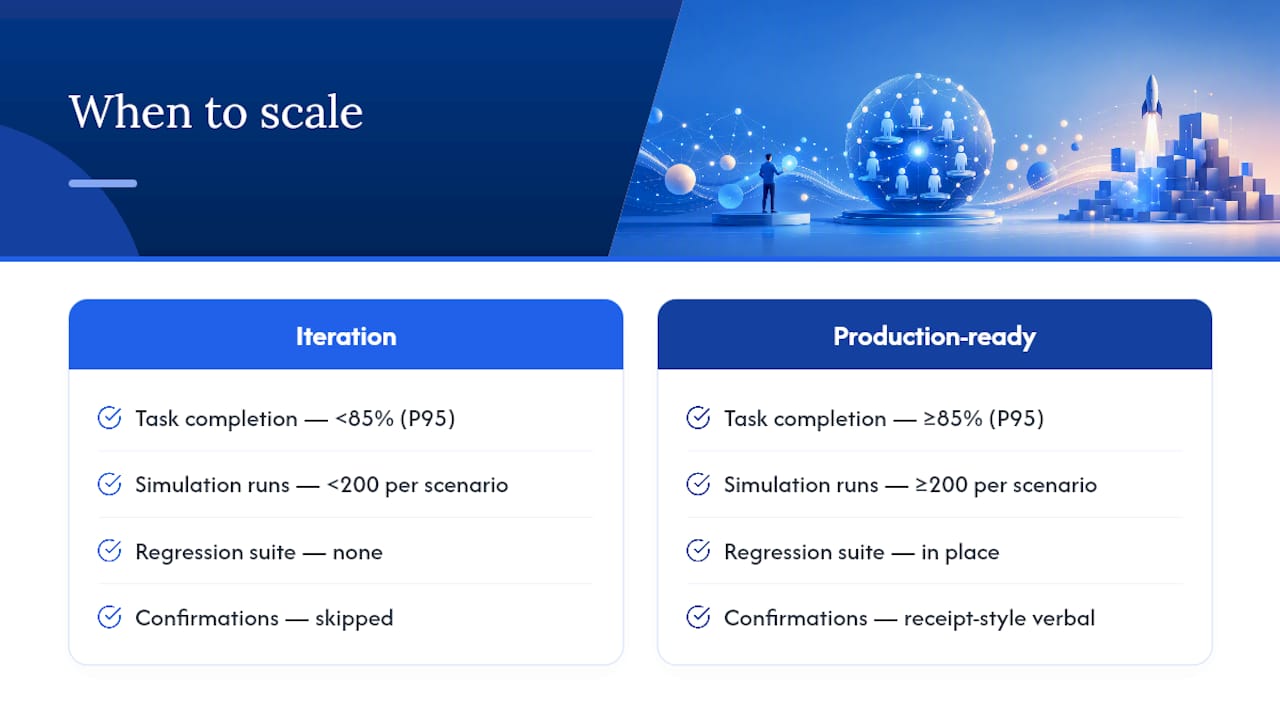
A simulated pilot moves from experiment to production-ready when task completion is stable above 85% across P95 latency and after at least 200 simulation runs have been completed per scenario. Below that threshold, you are still in iteration. Above it, you have a defensible baseline and a regression suite that protects it.
The detail most teams skip: short verbal confirmations at every key data point during multi-turn appointment setting. An agent that says “Got it, Wednesday the 12th at 2 PM” before writing to the CRM gives the prospect a correction window. Agents that skip this step generate clarification loops that inflate handle time and abandonment. Build receipt-style confirmations into your scenario scripts from day one, and test them explicitly in simulation.
Mediabloom pilots AI agents with built-in simulation and compliance
Mediabloom’s pilot model is built around the same methodology this guide describes: data-driven scenario creation from your production calls, CI/CD regression gating, CRM and calendar integrations across 600+ platforms, and robust compliance with TCPA and SOC 2 standards compliance posture from day one. You do not need to assemble a testing stack from scratch.
Several clients have used Mediabloom’s done-for-you approach to generate over 10,000 monthly leads. Watch a live appointment-setting demo to see the agent flow in action, or review pilot outcomes across industries before requesting your own pilot assessment.
Sources
These resources back the methodology in this guide and provide deeper technical detail for engineers and evaluation teams:
- Voice Agent Testing Guide: Methods, Regression, Load & Compliance (2026) | Hamming AI Resources
- Voice Agent Testing: 5 Tips To Build Reliable AI Voice Agent | Testmetry
- How to build reliable voice agents that scale in production | Microsoft Copilot Blog
Before buying any simulator: run the vendor’s sample test suite against 20–30 of your own anonymized transcripts. How the tool handles your actual call patterns tells you more than any demo script.
FAQ
What is an agent simulator for AI voice agents?
An agent simulator is a controlled test environment that replays scripted and production-derived conversations against an AI voice or chat agent, measures task completion and KPIs, and catches failures before live deployment.
How many test scenarios do you need for a valid pilot?
Start with 50–200 representative calls to generate your scenario suite. For statistically meaningful go/no-go decisions, aim for at least 200 completed simulation runs per scenario before production rollout.
What is the minimum task completion rate before going live?
Target above 85% task completion across all scenarios, measured at P95 latency, before approving production deployment. Below that threshold, continue iterating prompts and re-running regression tests.
How does TCPA compliance factor into simulation testing?
Every simulated outbound flow should verify that consent status is confirmed before dialing and that a compliant recording notice is delivered. Catching consent-capture failures in simulation prevents per-call statutory exposure in production.
Can Mediabloom run the pilot for you?
Yes. Mediabloom provides a done-for-you pilot model that includes scenario generation from your production calls, CRM and calendar integration, CI/CD regression gating, and TCPA and SOC 2 compliance controls. Watch the demo to see the appointment-setting flow before committing.