Yes, U.S. businesses that send commercial SMS from 10-digit local numbers must register for A2P 10DLC. The first move is preparing an exact legal-name and EIN match, plus a live business website with visible SMS opt-in language and a privacy policy. Your messaging provider handles the actual submission, and approval typically lands within a few weeks.
TL;DR:
- Businesses must ensure their legal name and EIN exactly match IRS records, and maintain a live website with clear SMS opt-in and privacy policies.
- Registration is required for any U.S. business sending marketing, support, or authentication texts from a 10-digit number, with unregistered traffic typically blocked.
- Approval usually takes five days for straightforward cases and up to four weeks for more complex or manual reviews, with costs including registration fees and monthly carrier charges.
- Proper sample message alignment, functional opt-in pages, and accurate volume estimates are critical to avoid rejection and maintain throughput caps.
- Long-term deliverability depends on ongoing compliance, data hygiene, and behavior that aligns with registered use cases, not just initial registration.
Table of Contents
- What Is A2P 10DLC Registration, and Who Runs It?
- Who Actually Needs to Register?
- How to Complete A2P 10DLC Registration Step by Step
- Why Registrations Get Rejected (and How to Fix Them)
- Timeline, Fees, and Throughput Caps to Plan Around
- What to Do After Your Campaign Gets Approved
- The Overlooked Part of A2P 10DLC Compliance
- Sources
- FAQ
What Is A2P 10DLC Registration, and Who Runs It?
A2P 10DLC stands for application-to-person messaging on 10-digit long code numbers. It’s the framework U.S. wireless carriers built so businesses can send high-volume texts from standard local numbers instead of only short codes or toll-free lines. The Campaign Registry sits at the center of this system as the reputation authority. It holds the brand and campaign data that carriers use to decide whether your traffic gets delivered or filtered.
The review chain runs in one direction: you submit through a Campaign Service Provider, usually your messaging platform, which sends your registration to TCR, which then shares vetted data with mobile network operators like AT&T, T-Mobile, and Verizon. Each carrier makes its own filtering decisions based on that shared reputation data.
10DLC differs from toll-free and short code registration in scope and speed. Toll-free numbers go through a separate carrier verification process with typically faster review, while short codes require a lengthier, costlier application aimed at very high-volume senders. 10DLC sits in the middle: local-number familiarity with enterprise-grade oversight
Who Actually Needs to Register?
If your business sends marketing texts, two-factor authentication codes, appointment reminders, or customer support messages from a U.S. 10-digit number, you need A2P 10DLC registration. Carriers now block unregistered A2P traffic on these numbers, so unregistered messages typically fail to reach recipients at all.
A few groups need special handling:
- Sole proprietors without an EIN can often register using a Sole Proprietor brand type, though throughput stays capped low.
- Public companies face a stricter identity check called Authentication+, which carries its own verification fee and documentation requirements.
- Political campaigns and nonprofits face additional scrutiny; groups running public-facing outreach should also check state and federal disclosure rules before launch.
- Businesses messaging exclusively non-U.S. recipients fall outside 10DLC’s scope, though few companies operate that narrowly in practice.
How to Complete A2P 10DLC Registration Step by Step
Getting through review on the first try comes down to preparation, not luck. Here’s the order that avoids the most delays.
Before you submit anything:
- Confirm your legal business name matches IRS records exactly, down to punctuation and abbreviations.
- Verify your EIN is active; many providers reject EINs younger than roughly 15 days.
- Publish a live business website with a visible privacy policy that mentions SMS data use.
- Designate an authorized representative with a business email that matches your website’s domain.
Registering the brand:
- Enter your legal business name and EIN exactly as filed with the IRS.
- Select the correct legal form (LLC, corporation, nonprofit, sole proprietorship).
- Provide a business email address on your company domain, not a generic Gmail account.
- List your website URL and confirm it resolves without errors.
Registering the campaign:
- Choose the use case that matches what you’re actually sending: marketing, 2FA, customer care, or mixed.
- Submit two to three sample messages that mirror your real message content, not generic placeholders.
- Provide the exact URL where customers opt in, along with your opt-in and opt-out language.
- Estimate your monthly message volume as accurately as you can.
Submitting and testing:
Submit through your CSP, typically your messaging provider like Twilio or a platform built on top of it. If you’re an agency or platform registering campaigns for clients, include the Reseller ID on every submission. Once approved, assign your numbers and send a small test batch before ramping to full volume.
Pro Tip: Match your sample messages word-for-word to what you’ll actually send. Reviewers flag generic templates immediately, and a mismatch between registered content and live traffic is one of the fastest ways to get your campaign suspended after approval.
Why Registrations Get Rejected (and How to Fix Them)
Most rejections trace back to documentation mismatches, not policy violations. Reviewers cross-check your EIN and legal name against IRS filing data, and any discrepancy in spelling, punctuation, or business structure triggers an automatic flag. Your business email domain also needs to match your registered website; a mismatch reads as a red flag for fraud review.
On the campaign side, carriers and CSPs actively check that your opt-in URL, privacy policy, and terms of service are live and reachable at the moment of review. A broken link or a page that loads but omits SMS language is enough to trigger a denial.
Common rejection causes and fixes:
- Vague use case description. Rewrite with specific, concrete language: “appointment confirmation texts for dental patients,” not “business communications.”
- Broken or missing opt-in URL. Test the link yourself, from an incognito browser, before you submit.
- No visible opt-out instructions. Add “Reply STOP to unsubscribe” directly to your sample messages and your website copy.
- Missing Reseller ID. Agencies submitting on a client’s behalf must include it every time.
If you’re rejected, don’t resubmit blindly. Read the specific denial reason, fix that exact field, and reference the correction clearly in your resubmission notes. Most fixable rejections clear on the second attempt within days.
Timeline, Fees, and Throughput Caps to Plan Around
Simple campaigns with clean documentation can clear brand and campaign review in a few business days. Marketing use cases, political campaigns, and cases requiring manual MNO review commonly take one to four weeks.
Fees break into two buckets: one-time brand and campaign registration fees charged by your CSP, and recurring monthly carrier fees per campaign, which vary by carrier and use case. Public companies pursuing Authentication+ pay an additional verification fee.
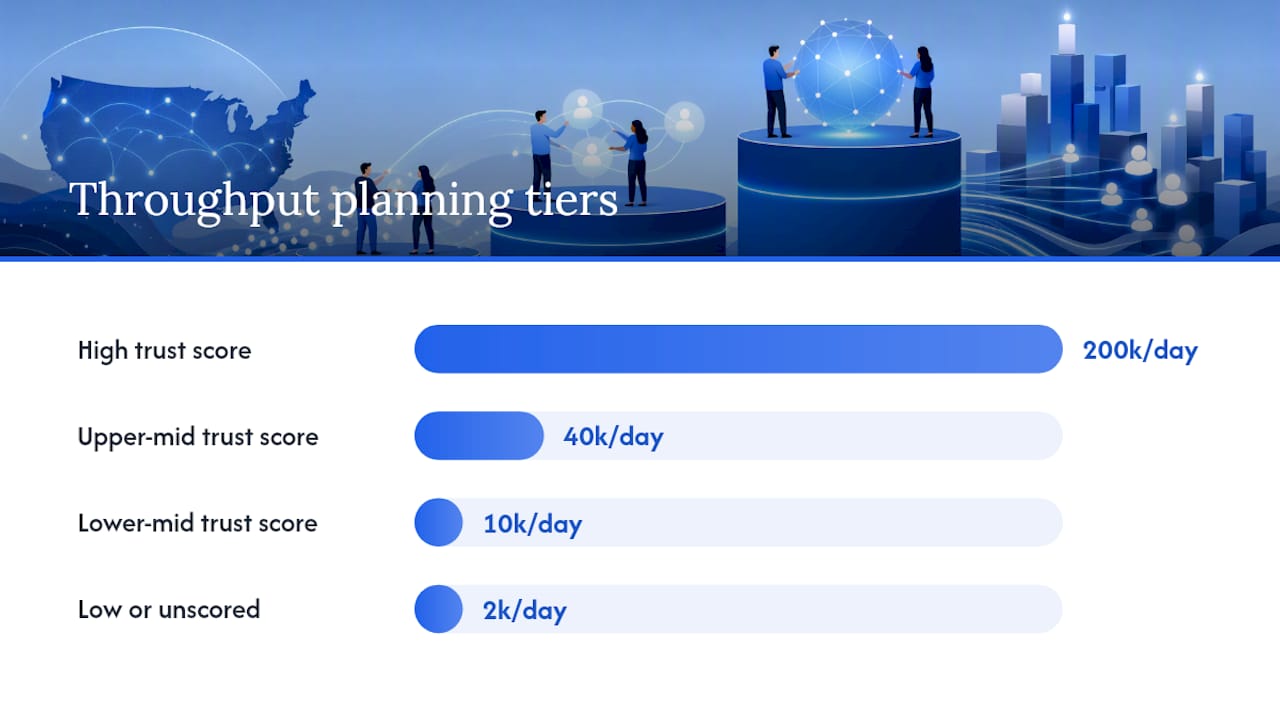
Your vetting score determines how much volume you can push. Industry-reported throughput tiers look roughly like this:
- High trust score: up to 200,000 messages per day
- Upper-mid trust score: around 40,000 messages per day
- Lower-mid trust score: around 10,000 messages per day
- Low or unscored: around 2,000 messages per day
These figures are industry-reported planning benchmarks, not guaranteed allocations; your actual cap depends on your CSP and campaign history. One more thing worth remembering: TCR and carrier registration governs delivery, not legal liability. Registering your brand doesn’t satisfy your obligations under the Telephone Consumer Protection Act, which separately governs consent, timing, and content of the messages you send.
What to Do After Your Campaign Gets Approved
Approval isn’t the finish line. Assign your registered numbers and send a small test batch before scaling to full volume, and confirm your live message content matches exactly what you registered.
Watch your opt-out and spam-complaint rates closely; carriers monitor these signals continuously and can throttle or suspend campaigns that drift from what was approved. Keep your privacy policy and opt-in pages live indefinitely, since carriers can re-verify at any time. If your volume needs outgrow your current trust tier, request a vetting upgrade and document any business changes, new use cases, or added campaigns before you push more traffic.
The Overlooked Part of A2P 10DLC Compliance
Most advice on A2P 10DLC treats registration as a one-time hurdle: fill out the form, get approved, move on. That framing misses what actually determines long-term deliverability. Carriers don’t just check your paperwork once. They watch behavior continuously, and a campaign that drifts from its registered use case or racks up complaint rates gets throttled regardless of how clean the original submission was.
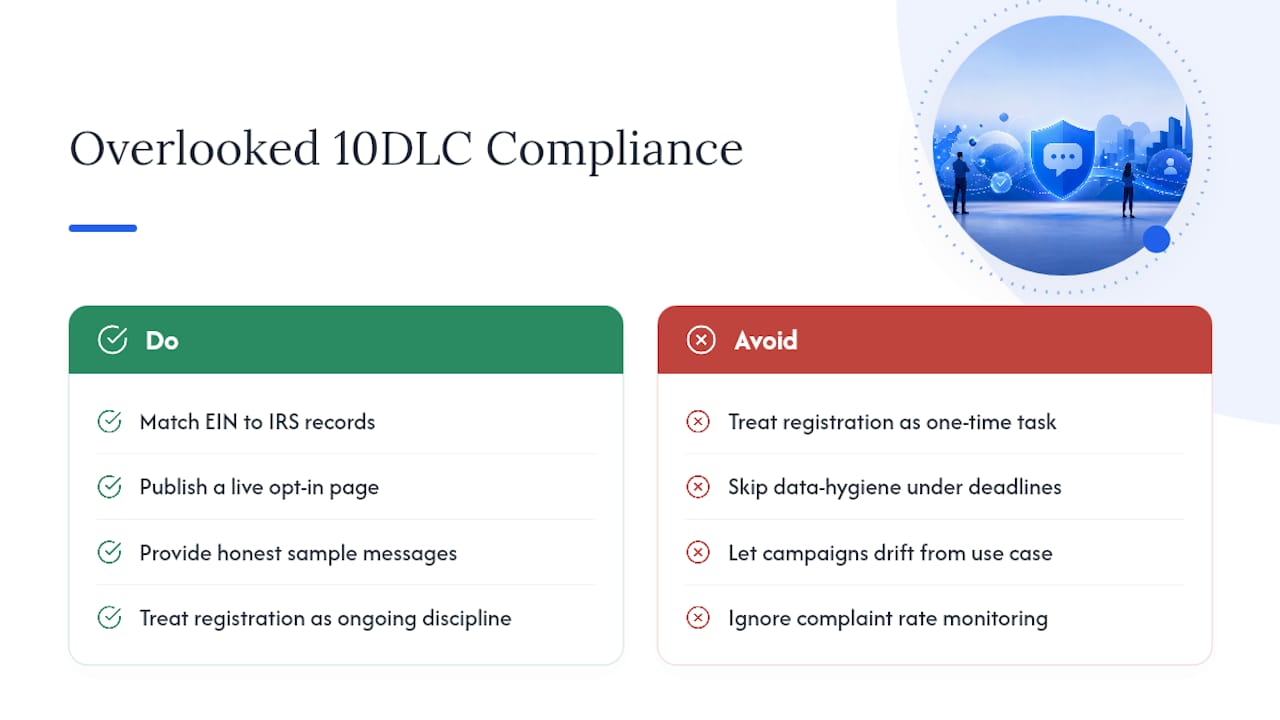
The conventional advice also underweights how much rejection risk sits in basic data hygiene. Businesses lose weeks not because carriers are being difficult, but because a legal name has a stray “Inc.” that doesn’t match IRS records, or a website’s privacy policy never mentions SMS at all. These aren’t compliance mysteries. They’re checklist items that get skipped under deadline pressure.
If you take one thing from this, prioritize the boring stuff first: EIN match, live opt-in page, honest sample messages. Marketers who treat registration as an ongoing operational discipline, not a form to submit once, are the ones who keep their throughput caps intact. For businesses that would rather hand this entire workflow, from campaign registration to ongoing message compliance, to a platform built for it, Mediabloom’s SMS-enabled lead generation systems manage that operational layer so your team can stay focused on the conversations, not the paperwork.
— Mediabloom
Sources
- Campaign Registry resources
- A2P 10DLC Registration Requirements and Compliance - LegalClarity
- A2P 10DLC registration step-by-step for 2026
FAQ
Is Registration Required for A2P 10DLC?
Yes. U.S. carriers require every business sending application-to-person SMS from a 10-digit local number to register a brand and campaign, and unregistered traffic is largely blocked from delivery.
How Long Does A2P 10DLC Campaign Approval Take?
Simple campaigns with accurate documentation often clear in about five business days, while marketing or special-use campaigns requiring manual carrier review can take one to four weeks.
How Much Does A2P 10DLC Registration Cost?
Costs include one-time brand and campaign registration fees from your messaging provider plus recurring monthly carrier fees per campaign, with public companies paying an added Authentication+ verification fee; exact amounts vary by provider and use case.
How Do I Complete A2P 10DLC Registration?
Register your brand with your legal name and EIN through your Campaign Service Provider, then register a campaign with your use case, sample messages, and opt-in/opt-out details, and assign numbers once approved.
What’s the Difference Between 10DLC and Toll-Free Registration?
10DLC uses local numbers with carrier-managed trust scoring and throughput caps, while toll-free registration follows a separate, typically faster verification process better suited to lower-complexity senders.