Voice identification, in a sales and marketing context, means matching an inbound or outbound caller to a CRM record, capturing their intent in real time, and routing them through a structured AI qualification flow that ends in a booked appointment or a warm rep handoff. The recommended setup: a CRM-integrated AI voice agent paired with a structured BANT or MEDDIC qualification script, instant omnichannel follow-up via SMS and email, and a clear human escalation path. Mediabloom’s platform delivers exactly this stack, with integrations across hundreds of CRM and telephony platforms, TCPA/SOC 2/HIPAA-ready compliance, and implementations that have produced over 10,000 monthly leads across clients including Miracle Ear and 1-800 Accountant.
- Core function: Match caller ID and phone metadata to CRM records; capture intent via NLP dialog
- Qualification layer: AI voice agent runs BANT/MEDDIC script, scores the lead, and populates structured CRM fields
- Handoff: Instant rep transfer or automated appointment booking with omnichannel confirmation
- Compliance posture: TCPA opt-in logging, SOC 2 certification, HIPAA-ready data handling
Key Takeaways
Voice identification in a sales context means CRM-matched caller qualification via AI voice agents, and the platforms that execute it fastest with the tightest compliance controls generate the most durable pipeline lift.
| Point | Details |
|---|---|
| Define the qualification script first | Map BANT or MEDDIC questions to CRM fields before touching any integration. |
| Run a 2–6 week controlled pilot | Test on 200–500 calls to validate transcript accuracy and structured-field capture before scaling. |
| Instrument speed-to-lead from day one | Target under 60 seconds response time and tie call outcomes to closed-won revenue. |
| Require SOC 2 and TCPA controls | Log opt-in timestamps at the record level; confirm HIPAA-readiness for regulated verticals. |
| Mediabloom as recommended platform | 600+ CRM integrations, managed onboarding, and 10,000+ monthly leads across client implementations. |
Table of Contents
- What does “voice identification” mean for sales and marketing teams?
- How does voice identification work inside a lead-generation stack?
- What business benefits and KPIs should you track?
- How do you implement voice identification in 2–12 weeks?
- What pitfalls should you avoid when deploying these systems?
- What outcomes have real implementations produced?
- How do you evaluate and choose the right vendor?
- Why voice identification is a near-term ROI play for SMBs
- Mediabloom delivers the full voice identification stack, managed
- Sources
- FAQ
What does “voice identification” mean for sales and marketing teams?
In security contexts, voice identification refers to biometric speaker authentication. This article covers a different discipline entirely: using AI voice agents to recognize callers, link them to existing pipeline records, capture qualification data, and move them toward a booked meeting. The industry term for this broader practice is AI voice agent qualification, and voice identification is the matching step inside it.
The data inputs that power the match:
- Caller ID and phone metadata (carrier signals, geographic data, call timestamps)
- CRM records (existing contact, lead stage, recent touchpoints, account owner)
- Call transcripts (real-time NLP extraction of intent, pain points, budget signals)
- Prior interaction history (email opens, form fills, prior call outcomes)
This article does not cover biometric speaker authentication, voiceprint forensics, or security identity verification. Every section below is scoped to lead generation and appointment setting.
How does voice identification work inside a lead-generation stack?
The operational flow runs in seconds, not minutes. Here is the sequence a revenue leader should map to their own stack:
- Trigger event — web form submission, inbound call, ad click, or SMS reply fires a workflow
- Instant answer — AI voice agent picks up within one ring; latency optimizations keep response feel near-instant
- CRM lookup — caller ID and metadata query the CRM; probabilistic match score calculated from caller ID, recent touchpoints, and carrier signals
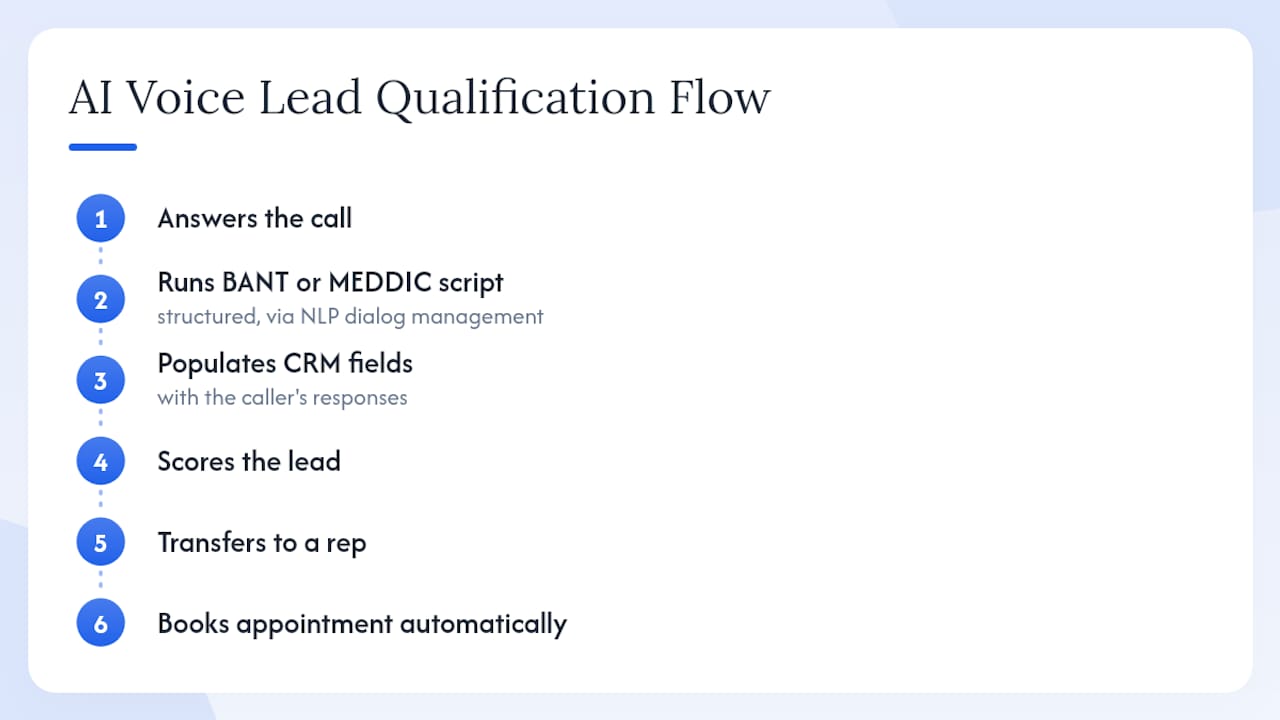
- Qualification dialog — NLP/LLM-driven agent runs the configured script (BANT, MEDDIC, or custom), capturing budget, authority, need, and timeline into structured fields
- Lead scoring — score threshold determines next action: live rep transfer, appointment booking, or nurture sequence
- Omnichannel follow-up — SMS confirmation, calendar invite, and email summary fire automatically post-call
The technical stack underneath this flow includes a telephony layer (SIP/CPaaS), a speech-to-text engine, an NLP/LLM dialog manager, a CRM API sync layer, and an orchestration engine for follow-up channels. Advances in realtime STT — such as ElevenLabs Scribe v2 — have materially reduced transcript latency, which directly improves downstream NLU accuracy and structured-field capture rates.
Voice synthesis quality also matters. Testing of AI voice synthesis tools shows that naturalness directly affects conversational completion rates — callers who perceive the agent as robotic disengage earlier, reducing qualification data captured.
Pro Tip: Set a conservative match-confidence threshold during your pilot. If the probabilistic score falls below your threshold, surface a human review task in the CRM rather than auto-linking the caller to an existing record. This protects data integrity and prevents overwriting active pipeline records.
What business benefits and KPIs should you track?
Speed-to-lead is the primary commercial lever. An AI voice agent answers in seconds; a human SDR team averages minutes to hours depending on shift coverage. That gap alone drives measurable lift in contact rates and qualified pipeline.
Primary benefits:
- Faster speed-to-lead (seconds vs. minutes)
- Higher qualified lead rate through consistent script execution
- Increased appointment volume without adding headcount
- More accurate routing based on real-time lead score
- Rep productivity gains from pre-populated CRM context before handoff
KPIs to instrument from day one:
- Average response time (target: under 60 seconds)
- Qualified leads per 1,000 inbound contacts
- Appointments booked per week
- Conversion rate from qualified lead to sales opportunity
- Rep close-rate after AI-assisted handoff
| KPI | Baseline Expectation | What Drives It |
|---|---|---|
| Speed-to-lead | Under 60 seconds | Voice agent answer rate, telephony latency |
| Qualified lead rate | Varies by vertical | Script quality, NLU accuracy, match confidence |
| Appointments booked/week | Scales with lead volume | Booking logic, calendar sync, follow-up cadence |
| Lead-to-opportunity rate | Improves with tuning | Scoring thresholds, rep handoff timing |
Implementations running Mediabloom’s platform have aggregated to over 10,000 monthly leads across clients including Miracle Ear and 1-800 Accountant — a scale that reflects consistent qualification script execution and CRM-integrated routing across high-volume inbound and outbound campaigns.
How do you implement voice identification in 2–12 weeks?
Phase 0: Prep (1–2 weeks)
- Define your qualification script (BANT, MEDDIC, or custom) and map each question to a CRM field
- Audit CRM data quality — duplicate records and missing phone fields break match logic
- Configure TCPA opt-in logging and set data retention policies; review HIPAA-ready data handling if your vertical requires it
- Assign owners: marketing ops (script and campaign), sales ops (CRM mapping and scoring), IT/vendor PM (telephony and API integration)
Phase 1: Integration and pilot (2–6 weeks)
- Connect telephony layer to voice agent platform; enable CRM API sync
- Run a controlled sample of 200–500 calls; verify transcript accuracy and structured-field capture
- Confirm voicemail detection, fallback flows, and human escalation triggers are working
Phase 2: Optimize and scale (4–12 weeks)
- Tune NLU branching logic and scoring thresholds based on pilot data
- Refine rep handoff rules and omnichannel follow-up timing
- Expand call volume; measure KPIs weekly and iterate on script variants
Pro Tip: Instrument end-to-end call outcome tracking from day one — link call disposition to closed-won revenue in your CRM. This single data connection tells you exactly which script variants and routing rules are generating pipeline, so tuning decisions are driven by revenue, not call volume.
What pitfalls should you avoid when deploying these systems?
Most failed deployments share the same root causes: weak qualification scripts, poor transcript accuracy, and inadequate TCPA consent handling.
- Low match-confidence thresholds cause the agent to auto-link callers to wrong CRM records, corrupting pipeline data. Set conservative thresholds and route low-confidence matches to human review.
- Poor transcript accuracy degrades NLU performance and produces incomplete structured fields. Prioritize STT engines with proven realtime accuracy — transcript quality is the foundation of every downstream qualification step.
- Weak qualification scripts produce leads that look qualified but convert poorly. Test at least two script variants in pilot before committing to one.
- Slow rep handoff SLAs erase the speed-to-lead advantage. Define a maximum handoff window (typically under 5 minutes) and enforce it with escalation alerts.
- Inadequate TCPA/consent handling creates legal exposure. Log opt-in timestamps, consent language version, and channel at the record level — not just at the campaign level.
What outcomes have real implementations produced?
Mediabloom deployments span multiple verticals and campaign types. Three implementations illustrate the range of outcomes:
- Miracle Ear: High-volume inbound qualification for hearing care appointments; AI voice agents handled initial caller matching and booking, contributing to the platform’s aggregate 10,000+ monthly lead outcomes
- 1-800 Accountant: Outbound and inbound tax and accounting lead qualification; structured BANT capture routed high-intent prospects directly to licensed accountants
- Commserve Connect: The Commserve Connect implementation demonstrates measurable commercial outcomes from omnichannel AI deployment across a service-business vertical
| Client | Campaign Type | Key Outcome Signal |
|---|---|---|
| Miracle Ear | Inbound qualification | High-volume appointment booking |
| 1-800 Accountant | Inbound + outbound | Structured BANT capture, rep routing |
| Commserve Connect | Omnichannel | Commercial outcomes across service vertical |
Across these implementations, the consistent driver of scale is the combination of instant answer rates, structured CRM field capture, and omnichannel follow-up — not any single channel in isolation.
How do you evaluate and choose the right vendor?
Questions to ask every vendor:
- How many CRM platforms do you integrate with natively, and which APIs do you support directly?
- What is your real-time handoff latency SLA from qualification completion to rep notification?
- What speech-to-text engine do you use, and what is your transcript accuracy benchmark?
- How flexible is the qualification scripting — can we run BANT, MEDDIC, and custom branching?
- What reporting and analytics are available out of the box?
- Do you hold SOC 2 certification? Are you TCPA-compliant and HIPAA-ready?
- What does onboarding include — do you offer managed setup and ongoing optimization?
Red flags to watch for:
- No native CRM integration (CSV exports are not a substitute)
- No structured field capture — transcripts alone don’t populate your pipeline
- Opaque per-call pricing with hidden overage fees
- No pilot or sandbox environment before full deployment
- Compliance handled entirely by the customer with no platform-level controls
Mediabloom connects to hundreds of CRM and telephony platforms, holds SOC 2 certification, and is HIPAA-ready for regulated verticals. Onboarding includes managed setup, integration configuration, and ongoing optimization — so your team is not building and tuning the stack alone.
Why voice identification is a near-term ROI play for SMBs
The speech stack has matured faster than most SMB revenue teams realize. LLM-driven dialog management, advances in HD voice and transcription from providers like Google Cloud, and realtime STT improvements have collectively pushed AI voice agent quality to a point where callers routinely complete full qualification dialogs without requesting a human. That was not reliably true two years ago.
Buyer attention windows are shorter. Paid channel lead volumes are higher. The commercial cost of a 30-minute speed-to-lead gap is measurable in lost contact rates and stalled pipeline. Managed onboarding from a platform like Mediabloom compresses time-to-value significantly — you are not starting from a blank configuration.

Mediabloom delivers the full voice identification stack, managed
Mediabloom’s AI lead generation and appointment setting platform combines AI voice agents, omnichannel automation, and CRM integrations across 600+ platforms into a single managed deployment. The difference for SMB and mid-market teams: you get done-for-you onboarding, integration configuration, and continuous optimization — not a self-serve tool that requires a dedicated ops team to run.
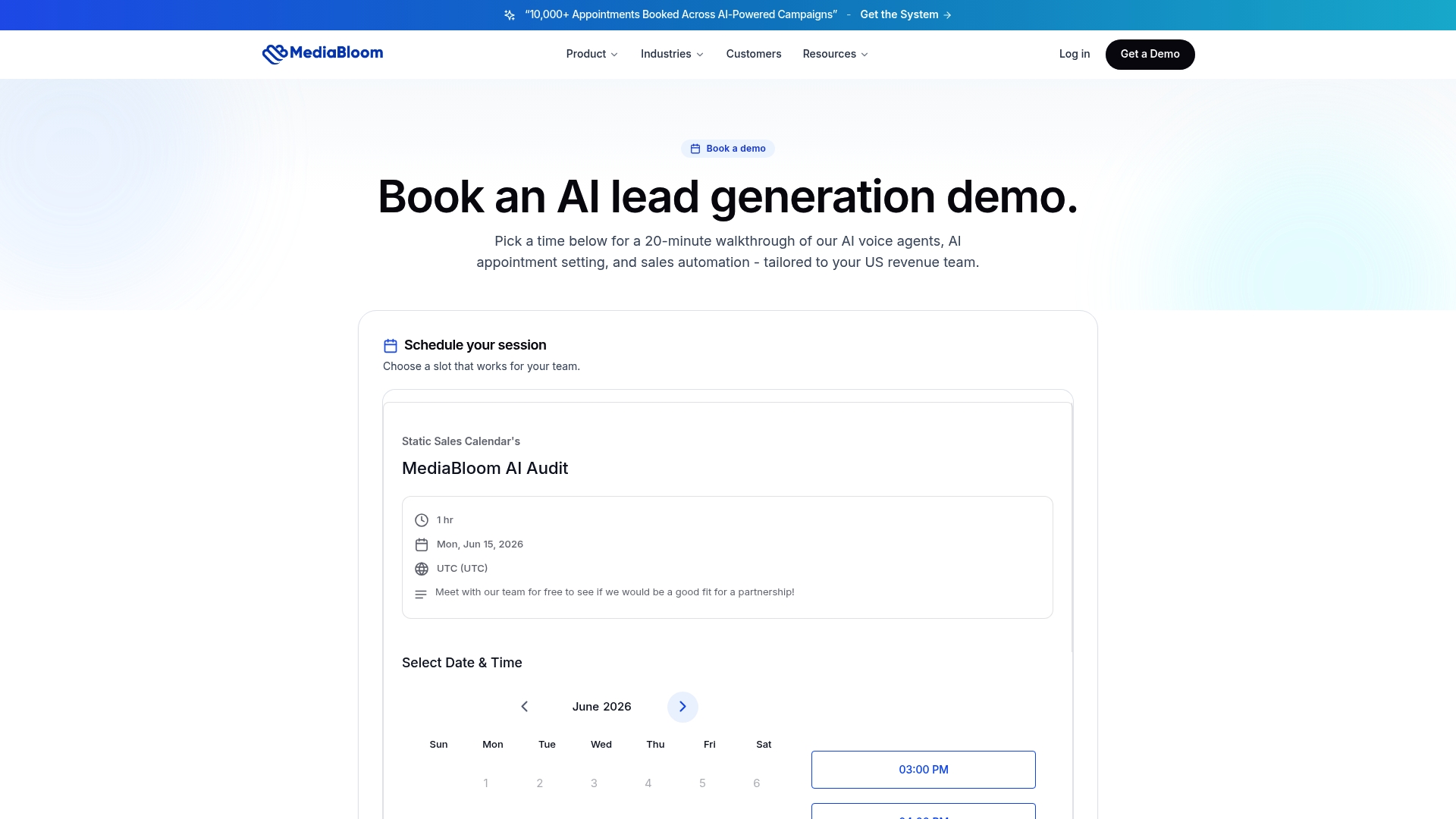
Pilot programs are available. Mediabloom’s team configures your qualification script, connects your CRM, and runs the first campaign with you. Review client outcomes across verticals or request a demo to see the qualification flow live.
Sources
- Scribe v2 Realtime: ElevenLabs makes its play for live speech-to-text · Signal
FAQ
What is voice identification in a sales and marketing context?
Voice identification, for sales teams, means matching an inbound or outbound caller to a CRM record using caller ID and metadata, then running an AI qualification dialog to capture intent and book appointments. It is distinct from biometric speaker authentication used in security systems.
How does an AI voice agent qualify leads in real time?
The agent answers the call, runs a structured BANT or MEDDIC script via NLP dialog management, populates CRM fields with the caller’s responses, scores the lead, and either transfers to a rep or books an appointment automatically.
What compliance requirements apply to AI voice agents in the US?
TCPA requires documented opt-in consent before automated outbound calls or texts; opt-in timestamps and consent language must be logged at the record level. For healthcare verticals, HIPAA-ready data handling is also required.
How long does it take to deploy a voice identification system?
A controlled pilot typically runs in 2–6 weeks; full optimization and scale takes 4–12 weeks depending on CRM complexity, script tuning, and call volume. Managed onboarding from a platform like Mediabloom compresses this timeline.
How many CRM platforms does Mediabloom integrate with?
Mediabloom integrates with hundreds of CRM and telephony platforms natively, covering the major SMB and mid-market stacks without requiring custom API development.