


AI lead qualification criteria are defined as composite scoring models that combine fit, behavior, intent, and decay signals to rank leads by their likelihood to convert. When you set up AI lead qualification criteria correctly, predictive AI scoring reaches 40–60% accuracy, compared to just 15–25% for traditional rule-based systems. That gap is not a minor improvement. It means your sales team spends time on leads that actually close, not on contacts that were never going to buy. This guide covers the signal types, preparation steps, setup process, and troubleshooting practices that make AI lead qualification work in 2026.
What signals and criteria types build an effective AI lead qualification model?
The four signal quadrants that compose a reliable AI scoring model are fit, behavioral engagement, buying intent, and negative or decay signals. Each quadrant captures a different dimension of lead quality. Using all four together gives the model enough context to rank leads accurately.
Fit signals
Fit signals measure how closely a lead matches your ideal customer profile (ICP). They include firmographic data such as company size, industry, revenue range, and job title. A mid-market SaaS company targeting operations directors, for example, would weight “director or above” titles and companies with 100–1,000 employees heavily in this quadrant.

Behavioral engagement signals
Behavioral signals track what a lead does on your website and with your content. Page visits, time on pricing pages, email open rates, webinar attendance, and demo requests all fall here. A lead who visits your pricing page three times in one week signals far more urgency than one who opened a single newsletter.
Buying intent signals
Intent-based signals come from third-party data providers that track research activity across the web. When a lead’s company is actively searching for solutions in your category on review sites or industry forums, that activity registers as a high-intent signal. Combining fit and intent is especially powerful. A 60-fit/high-intent lead often converts better than a 90-fit/low-intent lead, which means intent data can override a weak firmographic match.
Negative and decay signals
Negative scoring filters out leads who will never convert. Competitor email domains, student addresses, free webmail accounts, and contacts who have explicitly unsubscribed all belong here. Only about 25% of organizations implement negative scoring, yet it improves model accuracy by 12–15%. Decay signals reduce scores for leads who go silent after initial engagement, preventing stale contacts from clogging your pipeline.
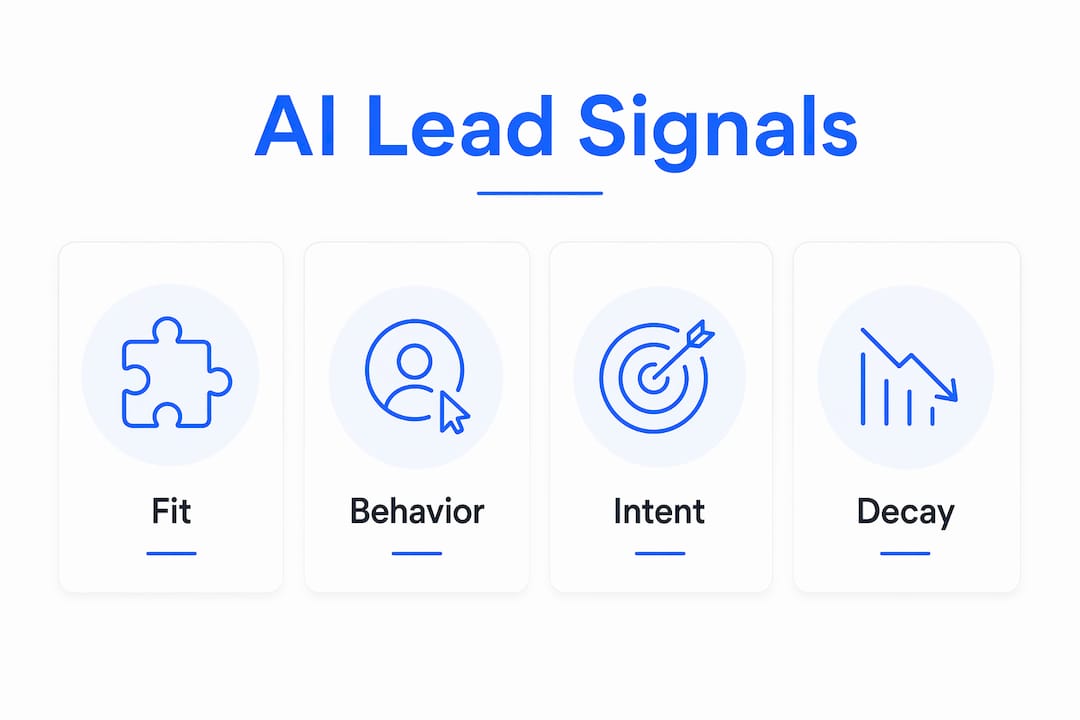
Effective AI scoring models use 8–12 factors across these four quadrants rather than relying on a single field like job title or company size. The table below summarizes each quadrant with examples and typical weighting ranges.
| Signal quadrant | Example inputs | Typical weight range |
|---|---|---|
| Fit | Job title, company size, industry, revenue | 25–35% |
| Behavioral engagement | Page visits, email clicks, demo requests | 25–30% |
| Buying intent | Third-party intent data, review site activity | 20–30% |
| Negative/decay | Competitor domains, inactivity, unsubscribes | Subtracted from total |
Pro Tip: Start with fit and behavioral signals if you lack intent data. Add third-party intent feeds once your model is stable and you have a baseline to measure improvement against.
How to prepare your data and tools before implementing AI lead criteria
Data quality determines model quality. Before you configure any scoring logic, you need clean, connected data from the right sources. Gaps or inconsistencies in your historical data will produce a biased model that scores leads incorrectly from day one.
The minimum data sources you need are:
- CRM history: Closed-won and closed-lost deal records with contact and company attributes attached
- Website analytics: Session data, page-level engagement, and form submissions tied to individual contacts
- Marketing automation platform: Email engagement history, campaign responses, and lead source data
- Intent data provider: Third-party signals showing research activity outside your owned channels
The most critical data readiness threshold is deal volume. AI models require at least 200 closed-won deals in historical data before they produce reliable predictions. If your organization has fewer than 200 closed deals, the model lacks enough signal to learn meaningful patterns. Early-stage teams should use rule-based scoring until that volume is reached.
Data cleaning is non-negotiable before training. Duplicate records, missing company fields, and inconsistent job title formatting all introduce noise that degrades model performance. Run deduplication, standardize field formats, and fill critical gaps using data enrichment tools before you begin.
The preparation checklist every team should complete:
- Audit CRM for duplicate and incomplete records
- Confirm closed-won and closed-lost outcomes are tagged consistently
- Map website analytics events to individual contact records
- Align on shared definitions for MQL and SQL with both sales and marketing
- Document which fields are required versus optional in your scoring model
- Confirm your marketing automation platform exports engagement data at the contact level
Pro Tip: The MQL-to-SQL definition gap is the most common reason AI models fail within two quarters. Write down exactly what “sales-ready” means before you touch any scoring configuration. Both teams must sign off on it.
Sales and marketing alignment on scoring thresholds is not optional. Misalignment between teams leads to model failure within two quarters because sales reps stop trusting scores that do not match their experience, and marketing stops updating inputs that sales ignores.
Step-by-step process to set up and calibrate AI lead scoring
Setting up an AI lead scoring model follows a defined sequence. Skipping steps, especially validation, produces a model that looks functional but misdirects your sales team.
-
Define the outcome variable precisely. Decide what “qualified” means in your model. “Became a paying customer within 90 days” is a usable outcome. “Showed interest” is not. Precision here determines everything downstream.
-
Select your signal inputs. Choose 8–12 factors across the four quadrants. Assign each a preliminary weight based on your team’s hypothesis about what drives conversion. Fit signals typically anchor the model; behavioral and intent signals refine it.
-
Configure composite scoring with thresholds. Set score ranges that map to sales actions. For example: 80–100 triggers immediate outreach, 50–79 enters a nurture sequence, and below 50 stays in marketing automation. Base these thresholds on your historical conversion data, not on guesswork.
-
Train the model on historical CRM data. Feed your closed-won and closed-lost records into the model. The algorithm identifies which signal combinations predicted conversion most reliably. This step requires the 200-deal minimum discussed in the preparation section.
-
Validate using AUC scoring. An AUC score of 0.75 or above indicates good predictive power. An AUC of 0.85 or above is excellent. If your model scores below 0.75, revisit your signal selection and data quality before deploying.
-
Add explainability layers. Configure the model to surface the top three reasons a lead received its score. Sales reps distrust scores they cannot interrogate. Showing a rep that a lead scored 87 because of “director-level title + pricing page visit + intent spike” gives them the context to act confidently.
-
Build human override lanes. Allow sales reps to manually adjust scores for leads in new market segments or unusual situations. AI models can inherit historical bias, and segments without training data will score inaccurately until enough closed-loop data accumulates.
-
Deploy and initiate closed-loop feedback. Connect your CRM outcome data back to the model so it learns from new wins and losses. Schedule the first recalibration review for 90 days after deployment.
The table below compares three scoring approach categories by complexity and use case.
| Scoring approach | How it works | Best for |
|---|---|---|
| Rule-based | Fixed point values assigned manually to fields | Teams under 200 closed deals |
| Machine learning model | Algorithm learns patterns from historical data | Teams with sufficient deal volume and clean data |
| Hybrid | Rules set the floor; ML adjusts weights dynamically | Teams scaling from rule-based to full AI scoring |
Pro Tip: Run your AI model in shadow mode for 30 days before replacing your existing scoring. Compare its rankings against your current system. If the AI model surfaces leads that convert at a higher rate, you have proof to drive team adoption.
Common challenges and how to troubleshoot AI lead qualification setups
Most AI lead scoring problems are predictable. Knowing what to watch for lets you fix issues before they erode sales trust or waste pipeline capacity.
The most frequent failure points are:
- Biased training data: If your historical wins skew toward one segment, the model will over-score similar leads and under-score new segments. Audit your closed-won data for demographic or firmographic concentration before training.
- No feedback loop: A model that does not receive outcome data after deployment stops learning. Without closed-loop feedback, accuracy decays as market conditions shift.
- Threshold miscalibration: Score cutoffs set too high push qualified leads into nurture sequences. Set too low, they flood sales with unready contacts. Revisit thresholds every quarter using actual conversion data.
- Intent signal gaps: Teams that skip third-party intent data miss a critical dimension of buyer readiness. A lead can look cold on your owned channels while actively researching competitors elsewhere.
- Score surfacing failure: Scores buried in CRM fields that reps never open are useless. Surface scores directly in the rep’s daily workflow view.
AI lead scoring is not a “set and forget” system. Models decay as your market shifts, your product evolves, and your ICP changes. Quarterly review and recalibration is the minimum maintenance schedule to keep predictive power intact. Teams that skip recalibration typically see accuracy erode within two quarters.
Signs your model needs immediate attention include a drop in the conversion rate of high-scored leads, sales reps consistently overriding AI scores, and a widening gap between MQL volume and SQL acceptance rates. Any one of these signals a calibration or alignment problem.
Fixing a drifting model starts with pulling the last 90 days of closed-won and closed-lost data and rerunning the training cycle. Then check whether your signal weights still reflect current buyer behavior. A conversational AI platform that captures real-time engagement data can accelerate this recalibration by feeding fresh behavioral signals into the model continuously.
Key Takeaways
Effective AI lead qualification requires composite scoring across fit, behavior, intent, and decay signals, validated with an AUC score above 0.75 and recalibrated every quarter.
| Point | Details |
|---|---|
| Use four signal quadrants | Combine fit, behavioral, intent, and negative signals across 8–12 factors for accurate scoring. |
| Meet the data threshold | Collect at least 200 closed-won deals before training an AI model to avoid unreliable predictions. |
| Validate with AUC scoring | Target an AUC of 0.75 or above before deploying; 0.85 or above indicates excellent model performance. |
| Add explainability layers | Show sales reps the top reasons behind each score to build trust and drive adoption. |
| Recalibrate every quarter | Schedule quarterly model reviews to offset accuracy decay from market and product changes. |
Why explainability is the most underrated part of AI lead scoring
The teams that get the most out of AI lead qualification are not always the ones with the most sophisticated models. They are the ones whose sales reps actually use the scores.
At Mediabloom, we have seen this pattern repeatedly. A technically sound model sits unused because reps do not trust a number they cannot explain to a prospect or a manager. The fix is not a better algorithm. It is better communication between the model and the person acting on it. Explainability layers are not a nice-to-have feature. They are the mechanism that converts a scoring system into a sales behavior change.
The second thing we have learned is that AI lead qualification is a cross-team discipline, not a marketing project. When sales owns the outcome definition and marketing owns the signal inputs, the model reflects both realities. When only one team controls the setup, the other team finds reasons to ignore the output. Shared ownership is the structural requirement that most implementations skip.
Continuous monitoring matters more than the initial setup. A model trained on last year’s closed-won data reflects last year’s buyer. Your ICP shifts, your product evolves, and your competitive set changes. The teams that treat quarterly recalibration as a standard operating procedure outperform those that treat it as an emergency response. Build the review cycle into your calendar before you deploy, not after the model starts underperforming.
— Mediabloom
Mediabloom’s AI qualification tools for revenue teams
Mediabloom builds AI systems that qualify leads, book appointments, and engage contacts across every channel your buyers use.
The Mediabloom platform combines AI lead generation with voice agents, chatbots, and sales automation in a single system. Clients like Miracle Ear and 1-800 Accountant generate over 10,000 monthly leads through the platform. Mediabloom’s AI scoring layer surfaces explainability signals directly in the sales workflow, so reps know exactly why a lead ranked high and what to say next. For teams ready to move from manual qualification to a fully automated assessment system, Mediabloom’s case studies show the exact results other revenue teams have achieved. Contact Mediabloom to build a qualification model configured for your pipeline.
FAQ
What is AI lead qualification?
AI lead qualification is the process of using machine learning models to score and rank leads based on composite signals including fit, behavior, and intent. It replaces manual review with automated, data-driven prioritization.
How many factors should an AI lead scoring model use?
Effective AI scoring models use 8–12 factors across fit, behavioral, intent, and decay signal quadrants. Using fewer factors reduces accuracy; using too many introduces noise.
What AUC score indicates a reliable AI lead qualification model?
An AUC score of 0.75 or above indicates good predictive power, and 0.85 or above is considered excellent for AI lead scoring models.
Why does negative scoring matter in AI lead qualification?
Negative scoring removes unqualified leads such as competitor domains and student emails from consideration. It improves model accuracy by 12–15% but is implemented by only about 25% of organizations.
How often should an AI lead scoring model be recalibrated?
AI lead scoring models require quarterly review and recalibration to maintain accuracy as market conditions, product offerings, and buyer behavior change over time.


