

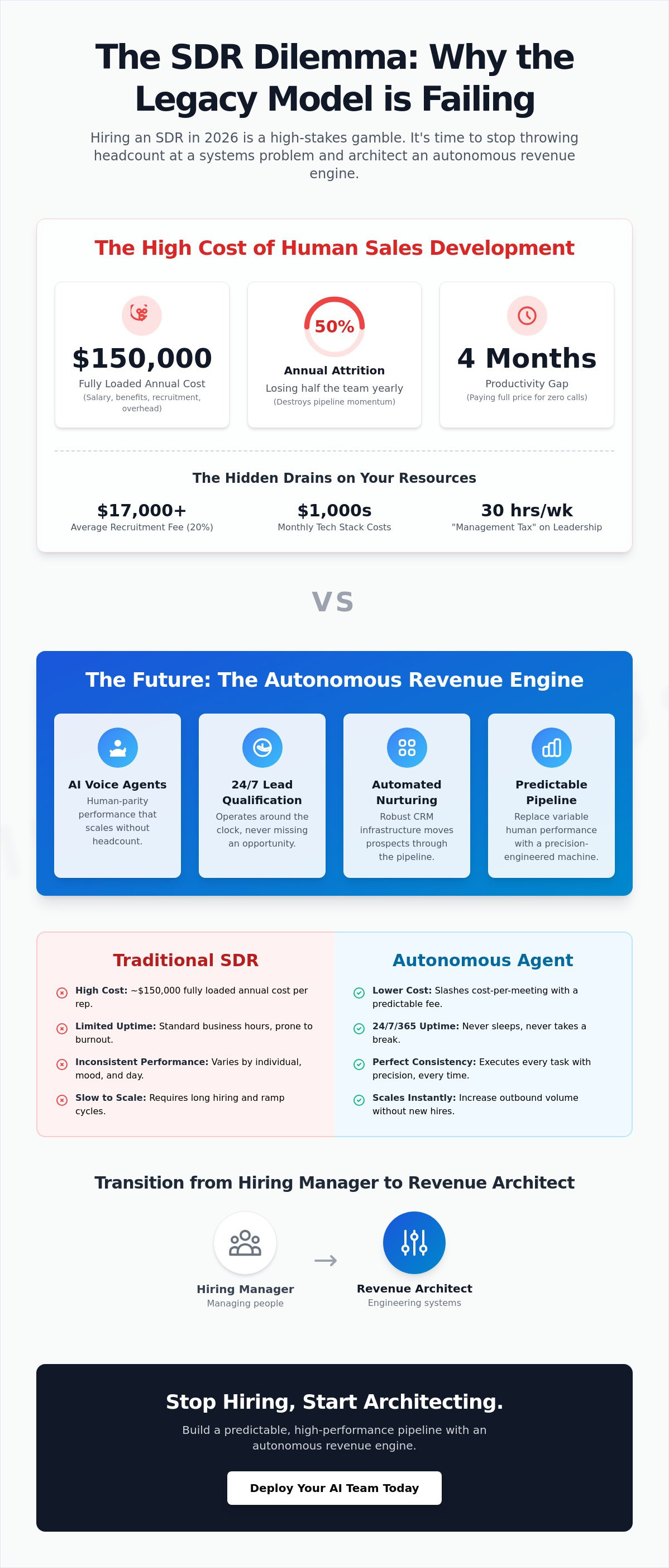
Hiring an SDR in 2026 isn't a growth strategy; it's a high-stakes gamble where the house usually wins. With fully loaded costs reaching $150,000 and annual attrition rates hovering at 50 percent, the traditional sales development model has become a structural bottleneck. You've felt the frustration of the four-month ramp time and the inconsistency of manual follow-ups that let prime opportunities slip through the cracks. It's time to stop throwing headcount at a systems problem. Discover the most effective alternatives to hiring SDRs by architecting an autonomous revenue engine built for technical mastery.
This article reveals how to bypass the high cost and churn of legacy sales teams by deploying a scalable, AI-driven outbound infrastructure. We will examine the transition to agentic AI, the deployment of 24/7 lead qualification systems, and the specific frameworks needed to build a predictable, high-performance pipeline. You'll learn how to replace variable human performance with a precision-engineered machine that slashes your cost per meeting while operating around the clock. The future of revenue isn't found in a bigger bullpen; it's found in a better architecture.
Key Takeaways
- Quantify the true "fully loaded" cost of traditional SDRs to expose the structural inefficiencies of the legacy hiring model.
- Compare the most effective alternatives to hiring SDRs in 2026, from outsourced BPO models to geographical remote fixes.
- Deploy AI Voice Agents to reach human-parity performance and scale your outbound volume without increasing headcount.
- Build a robust CRM infrastructure that serves as the foundation for 24/7 automated lead nurturing and prospect movement.
- Transition your role from a hiring manager to a strategic revenue architect by integrating custom AI automations into your growth engine.
The SDR Hiring Crisis: Why the Legacy Model is Failing in 2026
The legacy sales development model has hit a structural wall. In 2026, relying solely on human headcount to drive outbound growth is no longer a viable strategy; it is a financial liability. The Sales Development Representative (SDR) role, once the engine of the Silicon Valley growth machine, is now plagued by soaring overhead and diminishing returns. Most organizations are trapped in a cycle of hiring, training, and replacing reps before they ever reach peak productivity. This turnover doesn't just cost money. It destroys your pipeline momentum and leaves your market reputation in the hands of inexperienced staff.
Deceptive base salaries often mask the true cost of human sales development. Verified industry data shows the fully loaded annual cost of an in-house SDR ranges from $110,000 to $150,000 when you factor in benefits, recruitment fees, and office overhead. With annual attrition rates hovering between 40 and 50 percent, you're likely losing half your team every year. You spend three to four months ramping a new hire, paying full price for zero discovery calls, only to see them exit shortly after they become proficient. This constant churn makes finding alternatives to hiring SDRs a strategic priority for any lean, results-oriented executive.
To better understand why the traditional hiring landscape is shifting and how entry-level roles are evolving, watch this analysis on the current state of sales hiring:
The Economic Math of Human Sales Development
Recruitment is a massive hidden drain on resources. Most agencies charge a 20 percent placement fee, meaning you're down $17,000 before a rep even sends their first email. Then comes the tech stack. Seat costs for CRMs, sequencing tools, and data providers add thousands more to the monthly burn. Perhaps most damaging is the "Management Tax." High-level VPs and Managers often spend 30 hours a week babysitting entry-level activity, diverting their attention from high-level market architecture. The SDR Efficiency Gap is the delta between the high cost of human maintenance and the superior, consistent output of an automated revenue engine.
The Problem with "Activity for Activity’s Sake"
Hitting 100 dials a day is a vanity metric that belongs in the past. In the data-driven landscape of 2026, volume without precision is just noise. Human reps naturally suffer from burnout, leading to "leaky" funnels where follow-ups are missed and intent signals are ignored. When a rep is tired, their tone shifts, their persistence drops, and your brand suffers. Modern outreach requires 24/7 responsiveness and meticulous adherence to complex TCPA regulations, tasks that are increasingly difficult for variable human performance to manage. Shifting to an autonomous system at MediaBloom ensures that every prospect receives a perfect, intent-based engagement every single time.
Evaluating the Alternatives: Outsourced BPOs vs. Remote Reps
When the internal hiring model breaks, most executives pivot toward external human labor. They seek alternatives to hiring SDRs by looking at Business Process Outsourcing (BPO) or building distributed remote teams. On paper, these shifts look like efficiency gains. In reality, they often replace one set of management headaches with another. You might lower your upfront recruitment fees, but you're still tethered to the limitations of human bandwidth and the high cost of manual oversight.
The agency model offers a seductive promise: instant scale without the long-term commitment. Verified industry data shows that outsourced sales programs in 2026 typically cost between $2,500 and $15,000 per month. While this is lower than a fully loaded in-house salary, it comes at the expense of your brand's voice. High-ticket B2B sales require deep technical mastery and a nuanced understanding of prospect pain points. An outsourced rep handling multiple clients simultaneously simply can't provide that level of sophistication. You end up with a high-volume, low-intent operation that treats your precious lead data as fuel for a generic fire.
Why BPOs Often Fail to Convert High-Ticket Leads
Outsourced call centers suffer from a fundamental lack of product intimacy. Reps usually operate from rigid scripts, creating a "Script-Bot" effect where they sound more mechanical than modern AI. This rigidity prevents them from navigating complex objections or identifying subtle intent signals. Beyond the call, CRM hygiene becomes a secondary concern. External teams often fail to log data with the precision required for sophisticated revenue operations, leaving your internal team to clean up the mess. If you want to see how a technical architecture outperforms manual labor, speak with a revenue architect to evaluate your current stack.
The Management Overhead of Distributed Teams
Remote SDR teams are frequently positioned as the ultimate geographical fix. While they broaden the talent pool, they don't solve the structural problem of human inconsistency. Managing a distributed team introduces time-zone friction and the hidden costs of an ever-expanding management stack. You're still paying for communication licenses, project management tools, and the mental energy required to maintain a high-energy culture across continents. Whether a rep is in your office or halfway across the globe, they still require sleep, suffer from burnout, and eventually churn. You haven't installed a solution; you've just moved the problem to a different time zone.
The fractional SDR model is equally problematic. Expecting full-time results from a part-time contractor is a recipe for missed targets. These alternatives to hiring SDRs still hit the "Human Bottleneck." Any system that relies on a person to manually dial, email, and follow up is inherently unscalable. In an era where speed to lead is measured in seconds, waiting for a human to finish their lunch break to respond to a prospect is an expensive mistake. The engine must be autonomous to be effective.
The AI Voice Agent: The Ultimate SDR Alternative
Stop searching for human alternatives to hiring SDRs that simply shift the management burden from one time zone to another. The real breakthrough in 2026 isn't a better hiring process; it's the transition to an autonomous voice infrastructure. This isn't the robotic IVR of the past. Modern AI voice agents achieve human-parity performance, engaging in fluid, natural conversations that are indistinguishable from a top-tier sales professional. They don't suffer from "Monday morning lag" or "Friday afternoon burnout." They just execute your strategy with surgical precision, every single hour of every single day.
Scalability is where the autonomous engine truly leaves human teams behind. Imagine the logistical nightmare of making 10,000 outbound calls in a single morning. A traditional organization would need an entire office building, a massive management stack, and months of recruitment. An AI agent handles that volume simultaneously from a single server. This 24/7 sales engine qualifies leads while your competitors are asleep, ensuring that your brand is always the first to respond when a prospect shows intent. Speed to lead isn't just a metric; it's a competitive moat.
Data integrity is the silent killer of human sales teams. Reps forget to log notes, misinterpret objections, or simply fail to update the CRM after a long day of dialing. AI voice agents provide total recall. Every detail of every interaction is instantly transcribed, analyzed, and synced with your CRM. Your follow-up sequences are never late because the machine doesn't forget a promise. It creates a closed-loop system where no lead is ever truly lost to human error or poor memory.
Beyond the Script: Conversational AI for High-Stakes Sales
High-stakes B2B sales require more than just reading a script. They require the ability to pivot. Custom AI voice agents handle complex objections in real-time by accessing your entire knowledge base in milliseconds. They understand the psychology of the "Instant Response," knowing that a lead contacted within 60 seconds is significantly more likely to convert than one called an hour later. Custom AI voice agents utilize sophisticated logic-branching to identify and navigate complex B2B gatekeepers by mimicking the professional cadence and authority of a senior executive. This technical mastery ensures your message reaches the decision-maker, not the voicemail box.
ROI Comparison: Human SDR vs. AI Voice Agent
The financial delta between human labor and AI is staggering. While an in-house SDR costs upwards of $110,000, AI voice systems operate at a fraction of that overhead. You eliminate the "cost per dial" volatility and replace it with a predictable, scalable expense. There is no ramp time. You move from deployment to "live" status in days, not months. For a deeper look at the technical data and performance metrics, read The Definitive Guide to AI Voice Agents. You aren't just saving money; you're buying back the time your leadership team spends on human management.
Architecting the Pipeline: CRM Automation & Lead Nurturing
Deploying high-performance AI agents without a robust CRM architecture is like putting a jet engine on a tricycle. The system will collapse under its own power. To truly leverage alternatives to hiring SDRs, you must build a digital infrastructure that supports autonomous decision-making. Your CRM is no longer just a database. It's the central nervous system of your revenue engine. It manages the flow of data, dictates the timing of outreach, and ensures that every interaction is grounded in historical context. Without this foundation, your automation is just faster noise.
The real power of an autonomous engine lies in the synergy between the engine and the fuel. AI agents require high-quality, real-time data to function at peak efficiency. When your CRM is correctly architected, it feeds the AI the exact context needed to handle complex objections or personalize a follow-up. This creates a closed-loop system where data integrity is guaranteed. Automated logging ensures that every call, chat, and email is recorded without human intervention. Your CRM becomes the undisputed single source of truth, allowing you to scale operations with absolute certainty.
Custom CRM Workflows: The Foundation of Growth
Manual prospecting is a legacy bottleneck. Modern revenue architects replace these human tasks with sophisticated "Trigger-Action" sequences. When a prospect interacts with your content or hits a specific intent threshold, the system automatically initiates a multi-channel attack. This strategy combines precision email marketing services with immediate voice outreach. By architecting the autonomous revenue engine through CRM automation, you eliminate the "wait time" that kills deals. The machine doesn't hesitate; it executes the moment intent is detected.
Lead Qualification Bots: Filtering the Noise
Your Account Executives are your most expensive assets. They shouldn't waste time on "junk" leads or tire-kickers. Intelligent chatbots act as the first line of defense, pre-qualifying web traffic with technical precision before a human ever enters the loop. MediaBloom builds bespoke logic into these bots to mirror your top-performing rep's qualification process. This ensures that only high-intent, high-fit prospects make it to the calendar. The result is a cleaner pipeline and a significantly higher win rate for your closing team. These alternatives to hiring SDRs don't just replace headcount; they optimize the talent you already have.
Seamless handoffs are the hallmark of a mature system. When an AI agent identifies a qualified prospect, it doesn't just send a notification. It books the meeting directly into your AE's calendar. This removes the friction of back-and-forth scheduling and keeps the momentum of the conversation alive. Architect your autonomous engine today to stop the leak in your sales funnel and start booking meetings on autopilot.
Transitioning to an Autonomous Revenue Engine with MediaBloom
The shift from a traditional sales bullpen to an autonomous revenue engine is more than a technical upgrade. It's a fundamental change in leadership philosophy. You are no longer a hiring manager caught in a cycle of recruitment and churn. You are a revenue architect. By exploring alternatives to hiring SDRs, you've identified the structural flaws of the legacy model. Now, you must deploy the infrastructure that turns those insights into predictable growth. MediaBloom doesn't just provide tools. We build the foundational systems that allow your business to scale to 10x revenue without a single addition to your payroll.
Every industry has its own nuances, and your tech stack must reflect that. We specialize in custom AI automations that integrate seamlessly with your existing operations. Whether it's high-frequency voice outreach or sophisticated email marketing services, the engine is tailored to your specific market demands. To keep the engine running at peak capacity, we utilize managed ad deployment. This ensures a constant flow of high-intent leads that are instantly captured and qualified by your AI agents. You stop chasing prospects and start managing a high-conversion machine.
Deployment Strategy: How We Build Your Engine
Our methodology is precise and results-oriented. We follow a four-stage process: Audit, Architect, Automate, and Optimize. We begin by auditing your current sales funnel to identify the leaks where human inconsistency is costing you deals. From there, we architect the logic that will govern your autonomous engine. This isn't a generic software subscription; it's a strategic asset. Our custom AI voice agent development creates a unique intellectual property for your brand that learns and improves with every interaction. Enterprises are already seeing the impact, replacing entire SDR pods with single, high-performance AI agents that never miss a beat or a follow-up.
Ready to Stop Hiring and Start Scaling?
The 2026 market moves too fast for manual labor. Competitors who adopt lean, automated infrastructures will outpace those tethered to the high overhead of human teams. There is a diminishing window to gain a first-mover advantage with agentic AI. You've seen the data, and you understand the ROI. The next step is to see the machine in action. Watch the Demo to witness how an autonomous engine handles the complexities of modern sales development with technical mastery. Stop searching for alternatives to hiring SDRs and start installing the future of your revenue. Your next top-performing SDR isn't a person. It's a system.
Master the Future of Revenue Architecture
The era of the bloated, high-churn sales bullpen is over. Legacy sales models are failing under the weight of soaring overhead and 50 percent attrition rates. Success in 2026 belongs to the strategic architects who replace human bottlenecks with autonomous systems. By leveraging AI voice agents and sophisticated lead nurturing, you gain a scalable machine that works 24/7 without the management tax or ramp-time delays. These technical alternatives to hiring SDRs provide human-parity communication while ensuring absolute data integrity through seamless CRM integration with zero manual entry.
You are no longer managing variable headcount; you are optimizing a precision-engineered engine designed for infinite growth. We have a proven track record in scaling high-energy sales organizations by replacing human inconsistency with technical mastery. Stop the hiring cycle. Watch our demo to see how AI Voice Agents can transform your pipeline. Your business is ready for a system that never sleeps and never misses a follow-up. Embrace the architecture of excellence and outpace the competition today.
Frequently Asked Questions
What is the best alternative to hiring in-house SDRs for a growing company?
The most effective alternative to hiring in-house SDRs is an autonomous revenue engine that combines AI voice agents with CRM automation. This model eliminates the $110,000 to $150,000 fully loaded annual cost per rep and bypasses the 50 percent attrition rates common in 2026. Unlike human teams, this digital infrastructure scales instantly without increasing your management overhead or recruitment fees.
Can AI voice agents really sound like a human for cold calls?
Yes, modern AI voice agents deliver human-parity communication that is indistinguishable from top-tier sales professionals. These agents utilize advanced conversational logic to handle objections and navigate complex B2B gatekeepers in real-time. They lack the "robotic" latency found in legacy systems, ensuring your prospects experience a fluid, authoritative interaction that builds immediate trust and credibility.
How much can I save by using AI automation instead of a human SDR team?
Switching to AI automation can reduce your operational costs by 70 to 90 percent compared to a traditional human team. AI systems typically operate at 10 to 30 percent of the cost of full-time employees while producing higher output. You save on base salaries, benefits, and the "management tax" of VPs babysitting entry-level activity, allowing you to reinvest that capital into high-intent lead generation.
Will an automated sales system work for complex B2B sales cycles?
Automated systems thrive in complex B2B cycles by ensuring 100 percent follow-up consistency and meticulous data integrity. While human reps often give up after four attempts, an autonomous engine executes infinite follow-ups across multiple channels. The system uses custom logic to pre-qualify leads based on your specific technical criteria, ensuring your Account Executives only spend time on high-value, high-intent opportunities.
What happens to the leads that don’t book a meeting immediately?
Unbooked leads are automatically funneled into persistent lead nurturing sequences managed by the engine. The system utilizes multi-channel outreach, including targeted email marketing services and follow-up AI calls, to maintain engagement over time. No lead is ever lost to human error or poor memory. The machine tracks every interaction and re-engages prospects the moment they show renewed intent signals.
How long does it take to set up a custom AI voice agent and CRM workflow?
A custom AI engine can be deployed in just a few days, which is a major advantage when looking for alternatives to hiring SDRs. While a human rep requires 3 to 4 months of ramp time before becoming productive, an autonomous system is live and booking meetings almost immediately. This speed allows your organization to pivot strategies and capture market opportunities with unprecedented agility.
Do I still need Account Executives if I automate my SDR function?
Yes, Account Executives remain essential for managing high-level negotiations and final closings. Automation is designed to replace the repetitive "grunt work" of prospecting and qualification, not the strategic role of the closer. By automating the SDR function, you allow your AEs to focus 100 percent of their energy on closing deals rather than cold calling or manual data entry.
Is it difficult to integrate AI voice agents with my existing CRM like Salesforce or HubSpot?
Integration is seamless with enterprise CRMs like Salesforce and HubSpot, especially with the 2026 "Headless 360" API capabilities. These systems are designed to act as the central nervous system for your autonomous agents. All call transcriptions, intent scores, and follow-up tasks are logged automatically. This ensures your CRM remains the single source of truth without requiring a single minute of manual data entry from your team.


