
AI lead generation is defined as the process of sourcing, researching, qualifying, and personalizing outreach to net-new prospects at scale, without manual effort. This is distinct from lead enrichment, which adds data to existing lists, and from list buying, which skips qualification entirely. The core advantages of AI lead generation include task automation, improved lead scoring, personalized outreach, predictive analytics, campaign optimization, 24/7 engagement, and competitive intelligence. Mediabloom deploys all of these capabilities in a single platform, helping clients like Miracle Ear and 1-800 Accountant generate over 10,000 monthly leads.
1. AI lead generation benefits: automating repetitive prospecting tasks
AI replaces the most time-consuming tasks in prospecting, including data scraping, contact research, initial outreach, and lead qualification. Sales teams that previously spent hours building lists can redirect that time to closing deals. The efficiency gain is not marginal. It is structural.
Here is what AI automates in a standard lead generation workflow:
- Data sourcing: AI scrapes firmographic and technographic signals from public sources to build prospect lists without manual research.
- Initial outreach: Automated sequences send personalized emails, SMS messages, and follow-ups based on prospect behavior.
- Lead qualification: AI scores and filters inbound leads before a human ever reviews them, removing low-intent contacts from the pipeline.
- Data entry: AI pushes qualified lead data directly into CRM systems, eliminating copy-paste errors and delays.
- Meeting scheduling: AI books appointments automatically when a lead meets qualification criteria.
The result is that your sales reps spend their time on conversations, not spreadsheets. AI lead generation produces researched, scored leads without manual work, which is a fundamentally different operating model than traditional outbound.
Pro Tip: Connect your AI lead generation system directly to your CRM from day one. Data that flows automatically into a central record creates a feedback loop that improves scoring accuracy over time. Disconnected systems waste the efficiency gains AI creates.

2. How AI improves lead scoring and qualification accuracy
AI lead scoring models analyze firmographic, technographic, and behavioral signals simultaneously to rank prospects by their likelihood to convert. A human reviewer can weigh three or four variables. An AI model weighs dozens in real time. That difference in processing depth produces meaningfully better prioritization.
The scoring process works by training models on your historical closed-won and closed-lost data. Over two to three quarters, the model learns which combinations of signals predict a sale. It then applies those patterns to new leads automatically. Models improve over time as data quality and CRM integration improve, which means the system compounds in value the longer you run it.
The table below shows how lead qualification performance shifts after AI deployment:
| Metric | Before AI deployment | After AI deployment |
|---|---|---|
| Lead qualification rate | 30–40% | 55–70% |
| Time spent on low-intent leads | High | Significantly reduced |
| Sales rep focus on qualified leads | Moderate | High |
| Model accuracy | Static | Improves each quarter |
The qualification rate improvement from 30–40% to 55–70% means your sales team works a fundamentally different pipeline. Fewer dead ends. More conversations with buyers who are actually ready to move.
Pro Tip: Feed your AI scoring model with closed-lost data, not just closed-won. Understanding why deals failed is as predictive as understanding why they succeeded. Most teams skip this step and leave accuracy gains on the table.
3. How AI enhances personalization at scale
AI personalization adapts messaging by role, industry, company size, and recent behavioral signals without adding headcount. A marketing manager at a 200-person SaaS company receives a different subject line, opening sentence, and call to action than a VP of Sales at a 2,000-person manufacturer. Both sequences run simultaneously, automatically.
The specific elements AI personalizes in outreach campaigns include:
- Subject lines: Optimized by role and industry based on historical open-rate data.
- Message body: Adapted to the prospect’s specific pain points, company context, and recent activity.
- Send timing: Scheduled based on when similar contacts historically engage.
- Channel selection: Routes prospects to email, SMS, or chat based on prior response behavior.
- Follow-up cadence: Adjusted dynamically based on engagement signals like opens, clicks, and replies.
AI personalization increases engagement and campaign efficiency without proportional increases in cost or staff. That scalability is the core advantage over manual personalization, which breaks down above a few hundred contacts. With AI, the same quality of tailored outreach scales to tens of thousands of prospects.
Pairing personalization with intent-based targeting sharpens results further. When you know a prospect is actively researching a solution, personalized outreach lands at exactly the right moment.
4. What role do AI voice agents play in 24/7 lead engagement?
AI voice agents answer inbound calls, qualify leads, and route high-intent prospects to sales reps without any human involvement in the initial interaction. They operate at any hour, on any day, with consistent quality. That consistency is what makes them a genuine revenue asset rather than a novelty.
The performance numbers behind well-deployed voice AI are concrete. Leads contacted within 60 seconds are 391% more likely to convert than leads contacted after 5 minutes. That statistic alone justifies the investment in AI-powered instant response. Speed to lead is not a nice-to-have. It is the single biggest conversion lever in inbound sales.
Properly deployed voice AI delivers the following outcomes:
- Answer rates of 96–99%, compared to typical human team answer rates well below that threshold.
- Lead qualification rates of 55–70%, meaning the majority of answered calls result in a scored, routed prospect.
- Sales team productivity gains of 2–3x, because reps only receive calls that have already passed qualification.
- Appointment booking without human scheduling, reducing friction in the conversion process.
Customer service automation and voice AI share the same underlying principle: remove the wait time between prospect interest and business response. The faster and more consistently you respond, the more leads you convert.
Pro Tip: Design your AI voice agent conversations for latency under 700ms. Response latency above that threshold causes conversations to feel unnatural, which reduces lead warmth and can drop conversion rates by 20–30%. Test latency before you go live, not after.
5. How AI optimizes ad campaigns and competitive intelligence
AI-driven campaign optimization reallocates budget in real time based on channel performance data, removing the lag that kills traditional campaign management. A human campaign manager reviews performance weekly. An AI system adjusts bids, targeting, and creative distribution hourly. That difference in reaction speed compounds into measurably better ROI over a campaign’s lifetime.
AI enables smarter budget allocation and targeting than manual methods by processing multi-channel performance signals simultaneously. It identifies which audience segments, ad formats, and messaging combinations produce the lowest cost per qualified lead, then shifts resources toward those combinations automatically.
The table below compares AI-driven and traditional campaign management across key dimensions:
| Feature | Traditional campaign management | AI-driven campaign management |
|---|---|---|
| Budget reallocation | Weekly or manual | Real-time, automated |
| A/B testing speed | Days to weeks | Continuous, parallel |
| Audience segmentation | Broad, static | Dynamic, behavior-based |
| Competitive signal use | Periodic manual review | Ongoing automated analysis |
| Performance learning | Analyst-dependent | Model-driven, self-improving |
AI also analyzes competitor positioning signals, including ad copy patterns, keyword targeting, and landing page messaging, to inform your own campaign strategy. This is not espionage. It is the same competitive research your team already does, executed faster and at greater depth. Pairing this with AI SEO capabilities creates a full-funnel approach where paid and organic channels reinforce each other.
6. How AI supports lead nurturing across the sales funnel
AI for lead nurturing keeps prospects engaged between their first contact and their final buying decision. Most leads do not convert on first contact. The nurturing phase, which spans days to months depending on deal size, is where most sales teams lose momentum. AI prevents that drop-off by maintaining consistent, personalized contact without requiring manual follow-up.
The mechanics are straightforward. AI monitors engagement signals such as email opens, page visits, and content downloads. When a prospect’s behavior indicates increased interest, the system escalates outreach automatically. When engagement drops, it adjusts the cadence or switches channels. The sales rep receives a notification only when the lead crosses a qualification threshold.
This approach integrates directly with AI lead capture setup, where the same system that captures a lead also manages its progression through the funnel. The result is a continuous pipeline with no manual handoffs between stages. Sales reps enter the process at the moment of highest conversion probability, not at the beginning of a cold relationship.
7. How AI reduces cost per lead over time
AI lead generation reduces cost per lead through two mechanisms: it eliminates labor costs associated with manual prospecting, and it improves lead quality so that fewer leads are required to produce a sale. Both effects compound as the system matures.
Most AI lead generation teams see measurable results in conversion and efficiency after 2–3 quarters, provided data quality is maintained and systems are integrated across sales funnel stages. The first quarter typically involves calibration. The second and third quarters produce the performance gains that justify the investment. Teams that abandon AI programs before the three-quarter mark rarely see the full return.
The cost reduction is not only financial. AI reduces the time cost of prospecting, the opportunity cost of chasing low-quality leads, and the organizational cost of misaligned sales and marketing efforts. Sales AI integration best practices consistently point to cross-functional alignment as the factor that separates high-performing AI deployments from average ones.
8. How AI improves data quality and CRM accuracy
AI maintains cleaner CRM data than manual entry by capturing, formatting, and syncing lead information automatically at every touchpoint. Dirty data is one of the most expensive problems in sales operations. Duplicate records, missing fields, and outdated contact information cause misdirected outreach, inaccurate forecasting, and wasted sales effort.
AI solves this at the source. Every interaction, whether a voice call, chatbot conversation, or email reply, is logged with structured data fields populated automatically. The CRM record updates in real time. Sales reps see a complete, current picture of every prospect without spending time on data hygiene.
Clean data also makes AI scoring models more accurate. A model trained on incomplete or inconsistent data produces unreliable rankings. A model trained on complete, integrated data improves its predictions each quarter. Data quality and AI performance are directly linked, which means investing in clean CRM infrastructure is not an IT project. It is a revenue project.
Key takeaways
AI lead generation benefits compound over time when automation, scoring, personalization, and voice engagement are deployed together with clean CRM data and consistent measurement across the full sales funnel.
| Point | Details |
|---|---|
| Speed to lead is critical | Leads contacted within 60 seconds convert at 391% higher rates than those reached after 5 minutes. |
| AI scoring improves over time | Models trained on closed-won and closed-lost data reach peak accuracy after 2–3 quarters of consistent use. |
| Voice AI drives qualification at scale | Properly deployed voice agents achieve answer rates of 96–99% and qualify 55–70% of inbound leads. |
| Personalization scales without headcount | AI adapts messaging by role, industry, and behavior for thousands of prospects simultaneously. |
| Data quality determines AI performance | Clean, integrated CRM data is the foundation that makes every AI lead generation benefit measurable. |
What Mediabloom has learned about AI lead generation
The most common mistake we see is teams treating AI lead generation and lead enrichment as the same thing. They are not. Lead generation creates net-new pipeline. Lead enrichment adds data to contacts you already have. Buying the wrong tool for the wrong job produces campaigns that do not scale and results that disappoint. Getting this distinction right before you deploy is the single most important strategic decision in the process.
The second lesson is harder to accept: AI does not replace sales judgment. It amplifies it. The teams that see the strongest results treat AI as a filter and a scheduler, not a closer. They use it to remove low-value leads from the pipeline, respond instantly to inbound interest, and surface high-intent prospects at the right moment. Then they put their best sales people on those conversations. The AI handles volume. The humans handle nuance.
We have also seen that fail-fast filtering rules matter more than most teams expect. Setting clear disqualification criteria, such as company size thresholds, budget signals, or geographic limits, and encoding them into the AI qualification layer keeps reps focused on winnable deals. Without those filters, AI just delivers more leads, not better ones.
The teams that measure compound performance gains quarterly, not monthly, are the ones that stay committed long enough to see the real return. Patience and data discipline are the two human inputs that no AI system can substitute.
— Mediabloom
Mediabloom’s AI lead generation platform for sales teams
Mediabloom builds AI systems that handle the full lead generation and appointment setting cycle, from first contact to booked meeting, across voice, chat, SMS, and email. The platform integrates voice agents, chatbots, and outbound automation in one system, so your team manages every channel from a single interface.
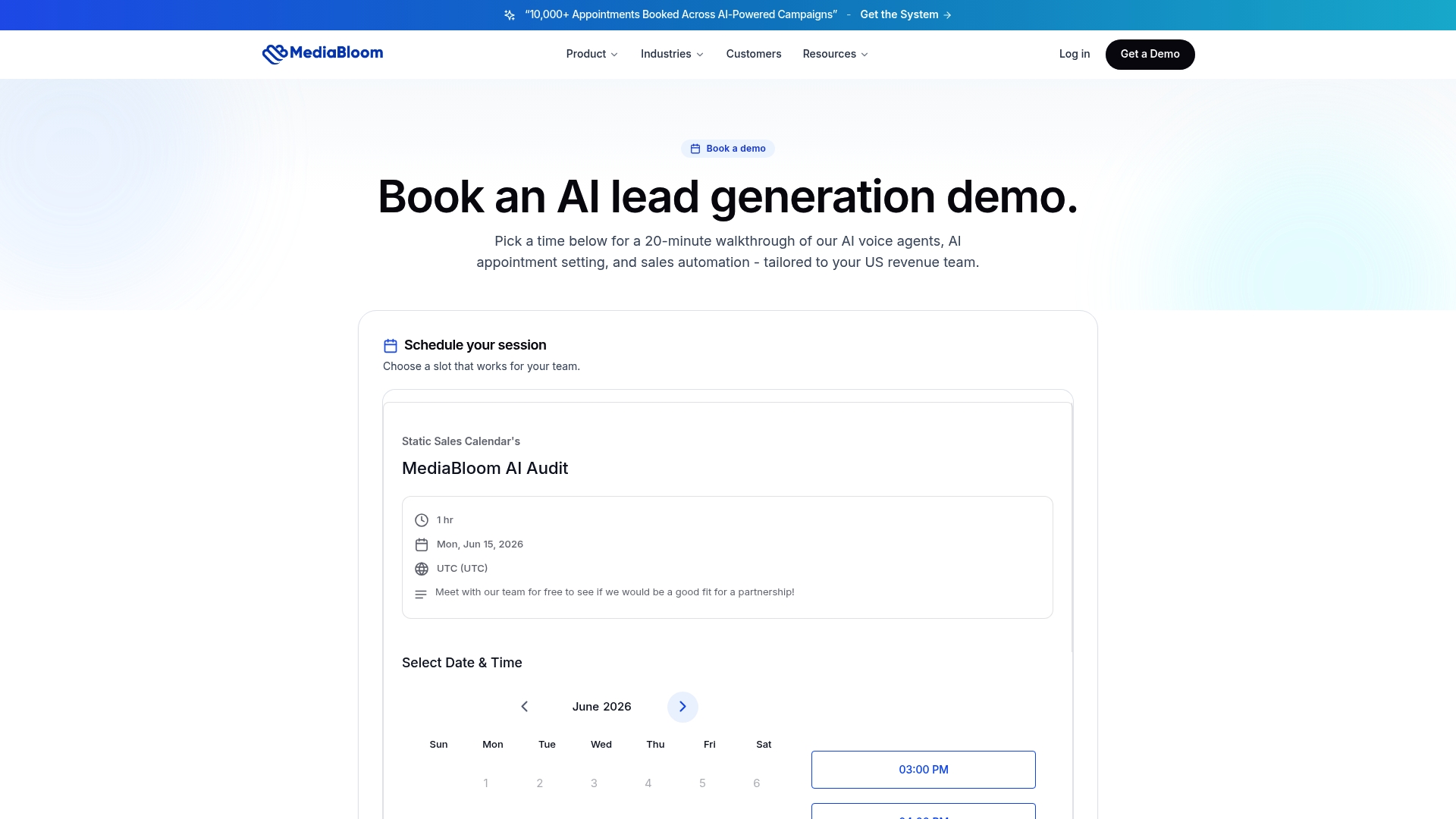
Clients like Miracle Ear and 1-800 Accountant use Mediabloom to generate over 10,000 monthly leads with faster qualification and higher conversion rates than their previous manual processes. The Fifth Avenue Leads case study shows exactly how that performance translates to pipeline growth in a competitive market. If you want to see how these results apply to your sales funnel, request a demo and Mediabloom’s team will build a deployment plan specific to your business.
FAQ
What are the main AI lead generation benefits?
AI lead generation benefits include automated prospecting, improved lead scoring, personalized outreach at scale, 24/7 voice and chat engagement, and continuous campaign optimization. These advantages reduce cost per lead and increase conversion rates across the sales funnel.
How does AI lead generation differ from lead enrichment?
AI lead generation sources and qualifies net-new prospects. Lead enrichment adds data to contacts you already have. Conflating the two leads to selecting the wrong tools and running campaigns that do not produce new pipeline.
What conversion rate improvement can voice AI deliver?
Properly deployed voice AI achieves lead qualification rates of 55–70% and answer rates of 96–99%. Leads contacted within 60 seconds convert at 391% higher rates than leads reached after 5 minutes.
How long does it take to see results from AI lead generation?
Most teams see measurable conversion and efficiency gains after 2–3 quarters of consistent use, provided CRM data is clean and systems are integrated across all funnel stages.
What is the role of CRM integration in AI lead generation?
CRM integration is the foundation of effective AI lead generation. It feeds scoring models with accurate data, enables real-time lead routing, and ensures every prospect interaction is logged automatically for follow-up and analysis.


