
Chatbots in the sales pipeline are AI-powered conversation tools that automate lead capture, qualification, and engagement at every stage of the buyer journey. The industry term for this practice is conversational sales automation, though “chatbots in sales” is how most revenue teams search for it. HubSpot deflects over 80% of website chat volume with AI chatbots, freeing human reps to focus on complex, high-value deals. That single metric captures the core promise: chatbots do not replace your sales team. They remove the low-value work that slows your team down. For sales and marketing professionals, understanding the role of chatbots in sales pipeline management means understanding how to qualify faster, route smarter, and close more with the same headcount.
How chatbots accelerate lead qualification in the sales pipeline
Speed is the single biggest driver of lead conversion. A prospect who fills out a form and waits 24 hours for a response is already talking to someone else. Chatbots eliminate that gap by engaging visitors the moment they land on a page, asking qualification questions in real time, and routing high-fit leads directly to a sales rep or calendar.
The mechanism works in three steps. First, the chatbot captures intent signals: pages visited, content downloaded, and questions asked. Second, it scores those signals against your ideal customer profile using AI-powered logic. Third, it routes the lead to the right rep or books a meeting automatically. Chatbots improve funnel velocity by cutting days out of sales cycles and increasing pipeline from the same traffic volume. That means your existing web traffic produces more qualified pipeline without adding headcount or ad spend.

CRM integration is what separates a useful chatbot from a great one. When a chatbot pulls live data from your CRM, it can personalize conversations based on account history, firmographic data, and prior interactions. The best sales chatbots draw from and update CRM data in real time for clean, actionable lead information. Without that integration, you capture contact details but gain no context, and your reps still have to do the qualification work manually.
Here is what effective chatbot qualification covers at the top of the funnel:
- Immediate response: Engages every inbound visitor within seconds, preventing drop-off
- Fit scoring: Matches visitor responses against defined criteria like company size, industry, and budget
- Dynamic routing: Sends high-fit leads to senior reps and low-fit leads to nurture sequences
- CRM sync: Writes lead data directly into your CRM with no manual entry required
- Meeting booking: Schedules demos and discovery calls without human involvement
Pro Tip: Before you configure a single chatbot flow, write out your qualification criteria in plain language. Define what a sales-accepted lead looks like: industry, company size, role, budget range, and timeline. Your chatbot logic is only as good as the criteria you feed it.
What features do chatbots provide across the sales funnel?
Chatbots do not operate at just one stage. They work across the full funnel, from first touch to post-sale retention. Each stage requires different capabilities, and the strongest implementations deploy the right feature set at the right moment.
Lead capture and segmentation
At the top of the funnel, chatbots greet visitors with personalized messages based on traffic source or page context. A visitor arriving from a LinkedIn ad about enterprise pricing sees a different opening message than someone browsing a product features page. That personalization increases engagement rates and produces cleaner segmentation data from the start.
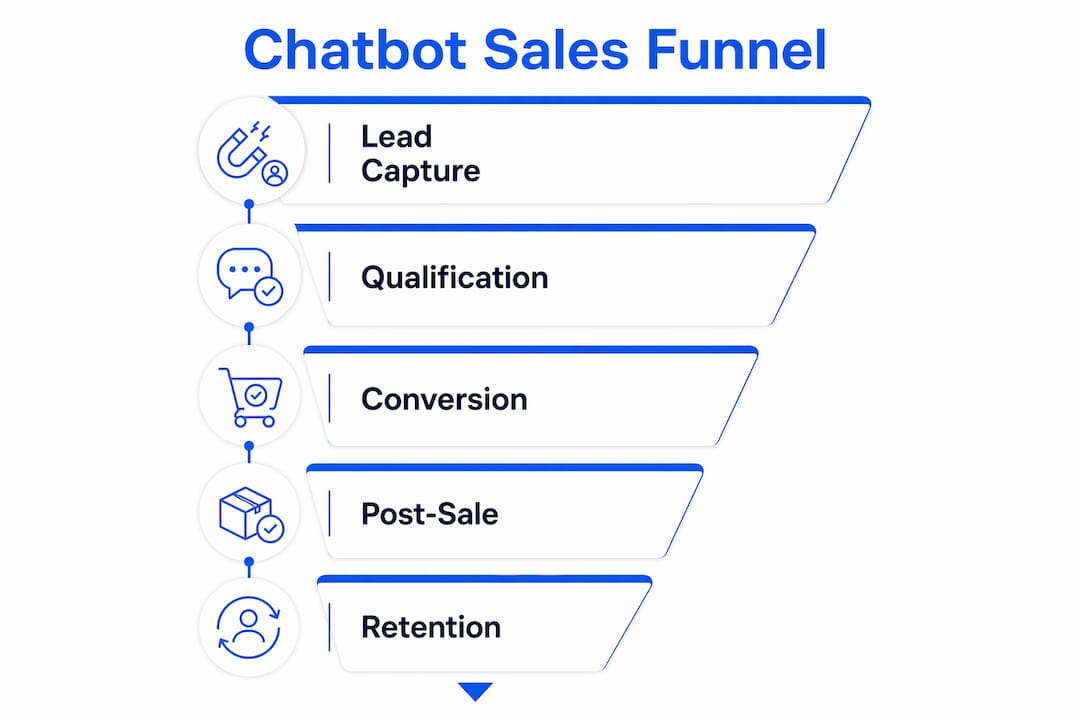
Chatbots also gate content more effectively than static forms. Instead of a form that sits on a landing page, a chatbot asks two or three qualifying questions before delivering a white paper or case study link. You collect richer data and the visitor gets a more interactive experience.
Qualification and objection handling
Mid-funnel, chatbots run structured questionnaires that mirror the questions a skilled SDR would ask. They handle common objections automatically, such as pricing concerns or competitor comparisons, using pre-approved responses. Chatbots must be integrated into sales workflows to move conversations forward, not merely answer questions. The distinction matters: a chatbot that only answers FAQs is a support tool. A chatbot that qualifies, scores, and routes is a sales tool.
Conversion and scheduling
Chatbots automate appointment scheduling, lead capture, and personalized nurturing across multiple channels simultaneously. A prospect who qualifies during a chat session can book a demo in the same conversation, with the meeting appearing on the rep’s calendar in real time. That removes the back-and-forth email exchange that kills momentum.
Post-sale nurturing and upsell
After the sale closes, chatbots support onboarding, loyalty programs, and upsell campaigns. The UA Made loyalty program used automated, personalized chatbot offers to drive a 34% increase in repeat purchases. That result shows chatbots are not just a top-of-funnel tool. They generate revenue throughout the customer lifecycle.
| Funnel stage | Chatbot function | Business outcome |
|---|---|---|
| Capture | Personalized greetings, content gating | Higher engagement, cleaner data |
| Qualify | Questionnaires, AI scoring, CRM sync | Faster lead prioritization |
| Convert | Meeting booking, order processing | Shorter sales cycles |
| Nurture | Onboarding flows, upsell offers | Higher retention and lifetime value |
What are the biggest pitfalls when deploying chatbots for sales?
Most chatbot deployments underperform not because the technology fails, but because the strategy behind the technology is incomplete. Sales leaders who skip the planning phase end up with chatbots that generate volume without generating value.
The most common mistake is configuring a chatbot before defining qualification architecture. Qualification architecture is the foundation of chatbot effectiveness. It covers fit criteria, question mapping, routing logic, and feedback loops. Skipping this step produces a flood of unqualified leads that waste SDR time and distort your pipeline forecast.
A second pitfall is treating qualification rules as permanent. Markets shift, buyer profiles change, and what qualified a lead in january may not apply in september. Static lead qualification rules degrade over time. Feedback loops that integrate sales acceptance and conversion data into chatbot logic allow continual improvement and prevent stagnation. Without those loops, your chatbot gets less accurate over time, not more.
Here is a structured approach to avoiding the most common deployment errors:
- Define qualification criteria first. Document your ideal customer profile before writing a single chatbot question. Include industry, company size, job title, budget, and buying timeline.
- Map questions to criteria. Each chatbot question should map directly to one qualification criterion. Remove any question that does not influence routing or scoring.
- Build feedback loops. Connect sales acceptance data back to your chatbot configuration monthly. If reps are rejecting leads from a specific segment, adjust the scoring logic.
- Set escalation triggers. Define the exact conditions under which a chatbot hands off to a human. Complex objections, enterprise deal sizes, and legal questions all require a person.
- Audit CRM data quality. Chatbot-generated leads are only useful if the data writes cleanly into your CRM. Test the integration before going live and audit records weekly.
Over-automation is a real risk in complex B2B sales. A prospect evaluating a six-figure software contract does not want to be managed entirely by a bot. The chatbot’s job is to qualify and route, not to close. Preserving human judgment at the right moments is what separates a high-performing sales AI integration from one that frustrates buyers.
Pro Tip: Run a monthly review where sales reps score the quality of chatbot-generated leads. Use that feedback to update your qualification questions and routing rules. Treat it like a sprint retrospective, not an annual audit.
How do you implement chatbots effectively in 2026?
Practical implementation starts with choosing the right entry point. Most sales teams get the fastest results by deploying chatbots on their highest-traffic pages first: the homepage, the pricing page, and the demo request page. Those pages attract visitors with the highest purchase intent, so even a basic qualification flow produces measurable pipeline impact quickly.
AI chatbots enable sales teams to handle broad inquiry volume while focusing on high-intent deals. That shift in focus is where the real productivity gain comes from. Reps stop spending time on discovery calls with poor-fit prospects and start spending it on deals that are likely to close.
CRM integration determines how much of that productivity gain you actually capture. When chatbot conversations write directly into your CRM with structured fields, reps walk into every call with full context. They know what the prospect asked, what content they consumed, and what score the chatbot assigned. That preparation shortens discovery calls and accelerates deal progression.
Choosing the right feature set depends on your industry and funnel complexity:
- High-volume B2C funnels: Prioritize speed, personalization, and automated nurture sequences
- Complex B2B funnels: Prioritize qualification depth, CRM integration, and human escalation triggers
- E-commerce and retail: Prioritize post-sale chatbots for loyalty, upsell, and repeat purchase campaigns
- Professional services: Prioritize appointment booking and intake qualification to reduce admin load
A step-by-step starting point for most sales teams looks like this: deploy on the pricing page first, run a two-week test, review lead quality with your SDR team, adjust qualification logic, then expand to additional pages. That iterative approach produces better results than a full-site rollout on day one. Mediabloom clients like Miracle Ear and 1-800 Accountant have used this phased model to generate over 10,000 monthly leads through AI-driven lead generation and chatbot automation.
Key takeaways
Chatbots accelerate sales pipeline performance when they are built on clear qualification logic, integrated with CRM systems, and refined continuously through sales feedback.
| Point | Details |
|---|---|
| Define qualification first | Document your ideal customer profile before configuring any chatbot flow. |
| CRM integration is non-negotiable | Chatbots without CRM sync capture data but do not reduce rep workload. |
| Feedback loops prevent stagnation | Update qualification rules monthly using sales acceptance data to maintain accuracy. |
| Deploy by funnel stage | Match chatbot features to the specific job at each stage: capture, qualify, convert, nurture. |
| Preserve human escalation | Complex deals require human judgment. Set clear triggers for chatbot-to-rep handoffs. |
What sales leaders get wrong about chatbot strategy
Chatbots accelerate and amplify good go-to-market strategies. They do not fix broken ones. That distinction is the most important thing we have learned working with revenue teams across industries.
The teams that see the strongest results treat chatbot configuration as a sales strategy exercise, not a technology project. They start by asking: what does a qualified lead look like, and what questions reveal that fit fastest? The technology is secondary to that thinking. When the qualification logic is sharp, even a basic chatbot produces pipeline. When the logic is vague, even the most sophisticated AI generates noise.
The second thing most sales leaders underestimate is the maintenance requirement. A chatbot deployed and forgotten is a chatbot that gets worse over time. Markets shift, buyer language changes, and the questions that worked in Q1 may not work in Q3. The teams that sustain results run monthly reviews, treat chatbot performance like a campaign metric, and update their logic the same way they update ad creative.
The third mistake is using chatbots to replace empathy rather than to create space for it. When a chatbot handles qualification and scheduling, your reps get more time for the conversations that actually require human skill: building trust, navigating complex objections, and closing deals. That is the real value. The chatbot does not sell. It creates the conditions for your best people to sell better.
— Mediabloom
Mediabloom’s approach to chatbot-driven pipeline growth
Sales teams that want to move from theory to results need more than a chatbot widget. They need a system that connects qualification logic, CRM data, and multi-channel engagement into one coordinated workflow.
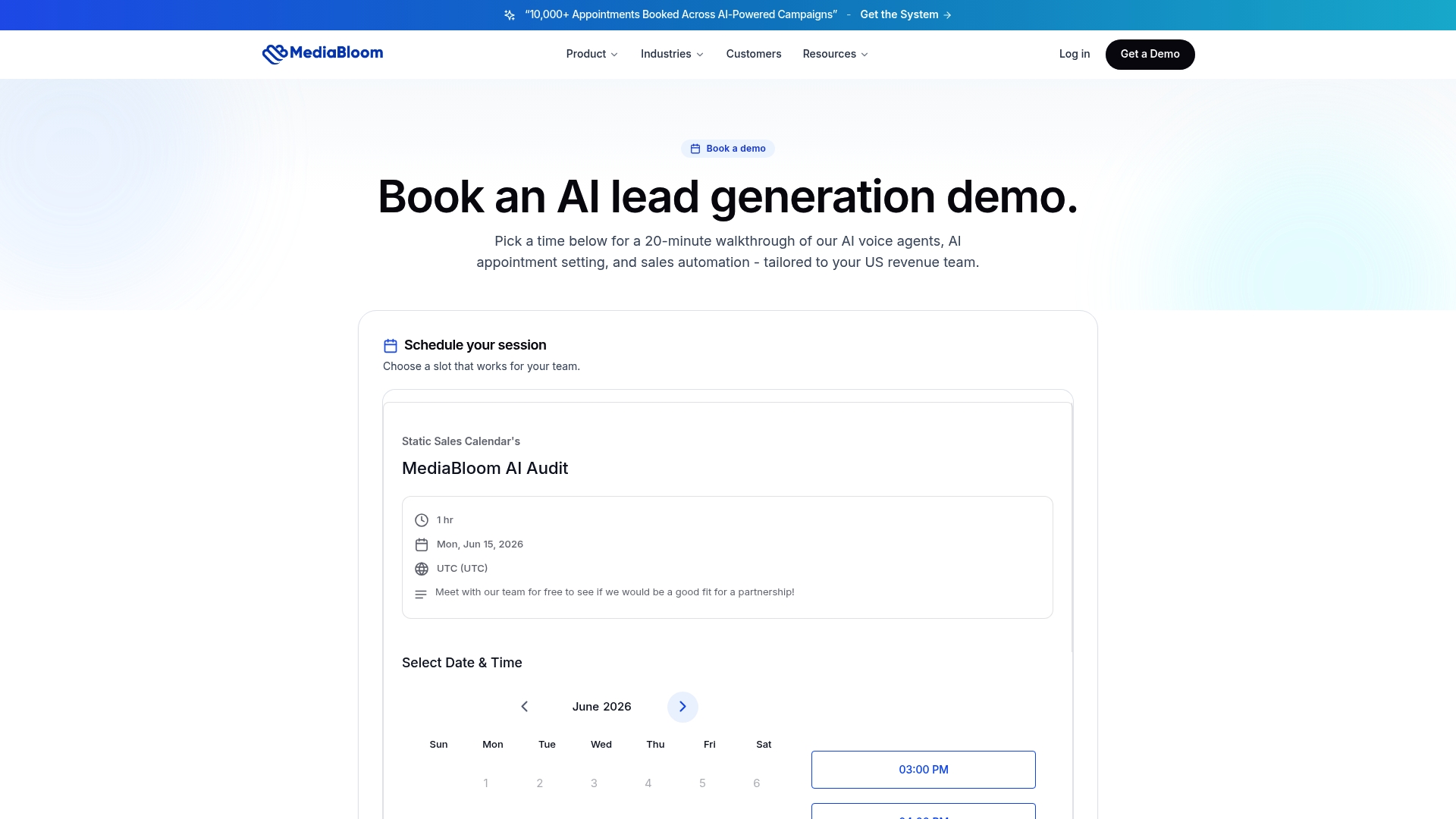
Mediabloom builds that system. The platform integrates AI chatbots, voice agents, and sales automation across SMS, email, and chat to qualify leads and book appointments at scale. Clients like Miracle Ear and 1-800 Accountant generate over 10,000 monthly leads using Mediabloom’s approach. You can review the real-world results from those deployments or watch a live demo to see the qualification and routing logic in action. If you are ready to build a chatbot-driven pipeline that produces consistent, qualified revenue, Mediabloom is the place to start.
FAQ
What is the role of chatbots in the sales pipeline?
Chatbots automate lead capture, qualification, and routing so sales reps spend time only on high-fit prospects. They reduce sales cycle length by engaging buyers instantly and booking meetings without human involvement.
How do chatbots improve lead qualification?
Chatbots run structured questionnaires, score responses against your ideal customer profile, and route qualified leads to the right rep in real time. Without CRM integration, that scoring lacks context and produces lower-quality handoffs.
What is an automated marketing workflow?
An automated marketing workflow is a sequence of triggered actions, such as emails, chatbot messages, and lead scoring updates, that move a prospect through the funnel based on their behavior. Chatbots are one execution layer within that broader workflow.
How do you avoid poor-quality leads from chatbots?
Define your qualification architecture before configuring any chatbot flow, and build feedback loops that update your scoring logic monthly based on sales acceptance data. Static rules degrade over time and produce increasingly poor lead quality.
Can chatbots support post-sale revenue growth?
Chatbots drive post-sale revenue through automated onboarding, loyalty programs, and personalized upsell offers. The UA Made loyalty program used chatbot-driven personalization to increase repeat purchases by 34%.


