
Conversational lead generation is the process of using AI-driven conversations to identify, qualify, and capture leads interactively and in real time. Unlike static forms that demand information upfront, this approach engages prospects through guided dialogue before asking for contact details. The industry term for the broader strategy is conversational marketing, and lead generation chatbots are its primary execution tool. Platforms like Salesforce, Twilio, and 6sense have all documented how this shift from passive data collection to active conversation produces measurably better results for marketing and sales teams.
What is conversational lead generation and how does it differ from traditional methods?
Conversational lead generation is defined as a real-time, dialogue-based method of capturing and qualifying prospects through AI chatbots, voice agents, or live chat. The key distinction from traditional lead capture is intent. Traditional forms ask for information before delivering value. Conversational lead generation delivers value first, then earns the contact detail.
Only about 3% of site visitors fill out a standard web form. That number tells you everything about why static forms fail at scale. Twilio reports that 71% of visitors abandon experiences they find irrelevant. Conversational lead generation addresses both problems by making the interaction feel personal and useful from the first message.

The terminology in this space overlaps. Conversational marketing describes the overall strategy of using real-time dialogue to move buyers through the funnel. Conversational lead capture focuses on the specific moment of collecting contact information. Lead generation chatbots are the technology layer that executes both. Understanding these distinctions helps marketing teams build programs that are coherent from strategy down to execution.
How does conversational lead generation work in practice?
The mechanics follow a clear sequence. An AI chatbot or voice agent initiates contact when a visitor lands on a high-intent page. The bot asks discovery questions to understand the visitor’s problem, timeline, and budget. It then routes the lead to the right sales rep or books an appointment directly. The entire exchange happens without a human on the other end.
Here is how a typical conversational lead generation flow operates:
- Trigger and greet. The chatbot activates based on page behavior, time on site, or referral source. It opens with a relevant question, not a generic “How can I help you?”
- Ask discovery questions. The bot works through a structured sequence of questions to surface intent, urgency, and fit. Salesforce describes this as dynamic discovery that adapts based on each answer.
- Deliver value. Before asking for contact information, the bot offers a recommendation, resource, or answer. This is the “help first, ask later” principle that reduces friction.
- Capture identity. Once the visitor signals interest or fit, the bot requests a name, email, or phone number. At this stage, the visitor has already received something useful and is far more likely to comply.
- Sync to CRM. Lead data, along with conversation context and intent signals, flows directly into the CRM. Sales reps receive a qualified record, not a raw transcript.
Pro Tip: Set your chatbot to trigger on exit intent or after 45 seconds on a pricing page. Visitors at those moments have already shown buying intent, and a well-timed question converts far better than a popup form.
The “help first, ask later” model is not just a UX preference. It reflects a fundamental shift in how marketing teams think about earning visitor information rather than extracting it. When a prospect feels helped, they share contact details willingly. That willingness produces higher-quality data and lower drop-off rates.
What are the key benefits of conversational lead generation compared to traditional lead capture?
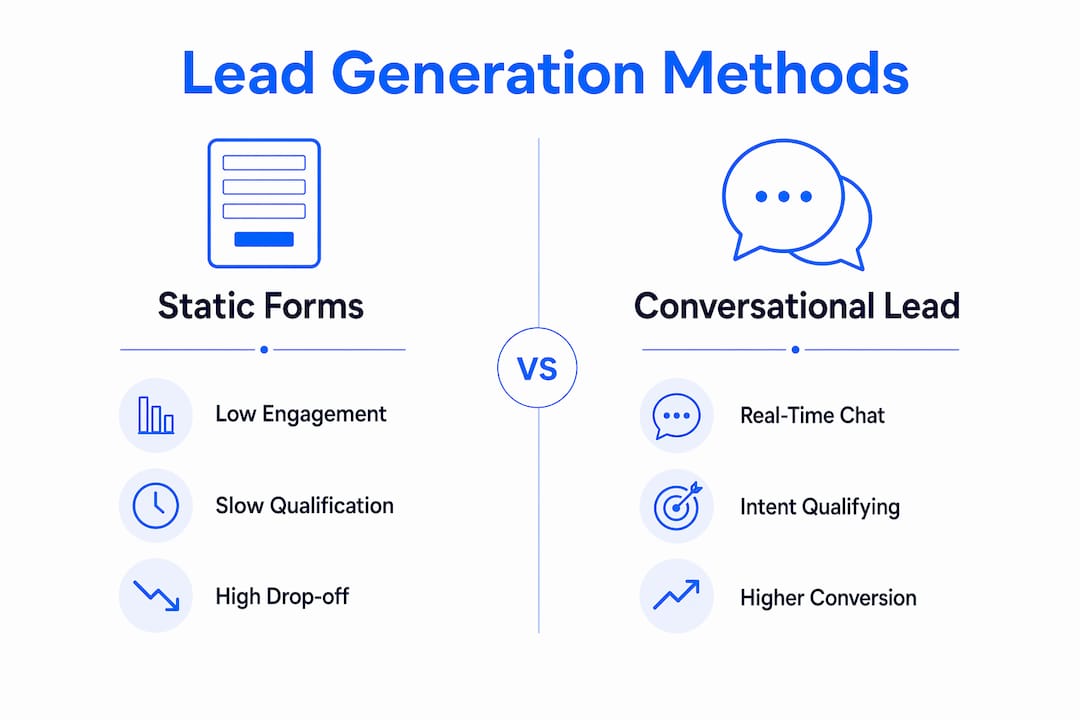
The performance gap between static forms and guided conversations is significant. HubSpot reports that live chat integration as part of conversational marketing produces 20% more qualified leads. That lift comes from two sources: more visitors engage, and those who do engage provide richer, more accurate data.
Engagement and conversion
| Factor | Static forms | Conversational lead generation |
|---|---|---|
| Visitor completion rate | ~3% of site visitors | Significantly higher due to guided interaction |
| Data quality | Self-reported, often incomplete | Structured, intent-tagged, CRM-ready |
| Lead qualification | Manual, post-submission | Automated, in-conversation |
| Response speed | Hours to days | Immediate routing or booking |
| Abandonment trigger | Asking for info before delivering value | Minimized by “help first” sequencing |
The table above shows why marketing teams that switch to conversational lead generation rarely go back. The qualification happens inside the conversation, not after it.
Lead quality and routing accuracy
Real-time signals from chat conversations outperform static demographic data for routing leads. Gartner research shows that intent-based routing from chat context improves lead-to-opportunity conversion rates by 20–35%. A form tells you a visitor’s job title. A conversation tells you their problem, their timeline, and whether they have budget authority.
Key benefits marketing and sales teams consistently report include:
- Faster sales handoff. Leads arrive in the CRM with intent data already attached, so reps skip the discovery call and go straight to the pitch.
- 24/7 lead capture. AI chatbots engage visitors at 2 a.m. on a Sunday with the same quality as a Tuesday afternoon.
- Reduced cost per lead. Automated qualification replaces hours of manual outreach and screening.
- Higher lead-to-close rates. Leads qualified through conversation show stronger buying intent than form fills.
Zendesk experts describe conversational marketing as an interaction where the visitor controls the pace. That control is what builds trust. Prospects who feel in control of the conversation are more likely to share accurate information and move forward in the sales process.
What are best practices and common pitfalls when implementing conversational lead generation?
The most common mistake is treating a chatbot like a digital form. Teams build a bot that asks for a name, email, and phone number in the first three messages. That approach produces the same abandonment rates as the form it replaced. The fix is structural.
Separate help from identity collection. Best practices recommend building two distinct phases into every bot flow. Phase one delivers recommendations, answers, or resources. Phase two requests contact information only after the visitor has signaled fit or interest. This separation is the single biggest driver of qualification success.
Build for CRM-ready output, not chat transcripts. The goal is not to send a conversation log to your sales team. Structured, CRM-ready field data on intent, urgency, and problem context is what makes the handoff fast and actionable. Configure your bot to tag and store specific fields, not just record what was said.
Additional best practices for marketing and sales teams:
- Write discovery questions in plain language. Avoid jargon. “What’s your biggest challenge with X right now?” outperforms “Please describe your current pain points.”
- Limit questions per session. Three to five questions is the ceiling before drop-off increases. Prioritize the signals that matter most for routing.
- Test routing logic before launch. A misrouted lead is worse than no lead. Map every answer path to a specific outcome before going live.
- Avoid early friction. Never ask for a phone number before you have delivered value. Phone number requests trigger the highest abandonment rates of any field.
Pro Tip: Use intent-based lead generation signals from your chatbot to pre-score leads before they reach your CRM. A lead tagged “urgent timeline, confirmed budget” should route differently than one tagged “researching options.”
Common pitfalls go beyond bad question design. Teams also underestimate the importance of routing logic. Extracting and tagging conversational signals in real time during chat improves routing accuracy and speed. A lead that waits 24 hours for follow-up after a live chat session loses most of its conversion potential. Speed of response is a competitive advantage, and your bot’s routing logic determines whether you capitalize on it.
What tools and technologies support conversational lead generation?
The technology stack for conversational lead generation has matured significantly. Marketing and sales teams now have access to platforms that handle everything from initial engagement to CRM sync and appointment booking.
Core platforms and their roles
- Salesforce chatbots. Salesforce offers native chatbot functionality that integrates directly with its CRM. Leads captured through Salesforce chatbots flow into Sales Cloud with intent data already structured and tagged.
- Drift. Drift specializes in conversational marketing for B2B teams. Its platform includes account-based routing, real-time intent detection, and meeting scheduling built into the chat flow.
- Intercom. Intercom combines live chat, AI automation, and product tours. It is widely used for both lead capture and post-sale customer engagement.
- HubSpot Conversations. HubSpot’s native chat tool connects directly to its CRM and marketing automation suite, making it a practical choice for teams already in the HubSpot ecosystem.
Integration requirements for effective execution
Chatbots and conversational AI must integrate with CRM and marketing platforms to automate lead qualification and nurture workflows. Integration enables structured data collection, lead scoring, and sales follow-up without manual intervention. A chatbot that does not sync to your CRM is a data silo, not a lead generation tool.
Conversational lead generation also extends beyond website chat. HubSpot reports that conversational marketing now spans live chat, messaging apps, SMS, and social media. This multichannel reach means prospects can engage on their preferred platform, which increases the total volume of conversations and leads captured.
| Platform | Best for | Key integration |
|---|---|---|
| Salesforce chatbots | Enterprise CRM-native teams | Sales Cloud, Marketing Cloud |
| Drift | B2B account-based marketing | Salesforce, Marketo, HubSpot |
| Intercom | SaaS and product-led growth | Stripe, Salesforce, Slack |
| HubSpot Conversations | SMB and mid-market teams | HubSpot CRM, email automation |
AI features like intent detection, real-time tagging, and behavioral scoring are now standard in enterprise-grade platforms. These features are what separate a basic chatbot from a true automated lead generation system. When a bot can detect that a visitor is comparing pricing pages and tag them as “high intent,” your sales team receives a lead that is already pre-qualified before a human ever makes contact.
Key Takeaways
Conversational lead generation outperforms static forms because it qualifies leads inside the conversation, delivers value before requesting contact details, and routes structured intent data directly to CRM systems for faster sales follow-up.
| Point | Details |
|---|---|
| Help before identity | Deliver value first, then request contact info to reduce abandonment and improve data quality. |
| CRM-ready data output | Configure bots to tag intent, urgency, and fit as structured fields, not raw transcripts. |
| Intent-based routing | Real-time chat signals improve lead-to-opportunity conversion rates by 20–35% over static data. |
| Multichannel reach | Deploy conversational lead generation across chat, SMS, and social to capture leads on every channel. |
| Separate qualification phases | Build distinct “help” and “identity” phases into every bot flow to maximize completion rates. |
Mediabloom’s take on what conversational lead generation actually demands
Most marketing teams approach conversational lead generation as a technology problem. They pick a chatbot platform, write a few questions, and expect results. The technology is the easy part. The hard part is the mindset shift.
What we have seen consistently, working with clients across industries, is that the teams who get the most from conversational lead generation are the ones who treat every bot interaction as a sales conversation, not a data collection exercise. That means thinking about what the visitor needs to hear before they will trust you with their contact information. It means writing discovery questions that reveal genuine intent, not just demographic data. And it means building routing logic that gets the right lead to the right rep within minutes, not hours.
The CRM integration piece is where most implementations fall short. Teams celebrate when their chatbot captures a lead. They stop short of asking whether that lead arrived in the CRM with enough context for a rep to act on it immediately. A lead record that says “Name: John, Email: john@company.com” is not a qualified lead. A record that says “Problem: scaling outbound, Timeline: Q2, Budget: confirmed, Competitor mentioned: yes” is. That level of structured output requires deliberate bot design, not just a platform subscription.
The future of this space is not more chatbots. It is smarter qualification logic and tighter CRM integration. Teams that build those two things correctly will generate more pipeline from the same traffic. Teams that treat their bot as a form replacement will keep getting form-level results.
— Mediabloom
How Mediabloom applies conversational lead generation at scale
Mediabloom builds AI-powered lead generation systems that go beyond basic chatbot deployment. The platform integrates voice agents, chatbots, and sales automation into a single system that qualifies leads, books appointments, and syncs structured data to your CRM without manual intervention.
Clients like Miracle Ear and 1-800 Accountant have used Mediabloom’s system to generate over 10,000 monthly leads. The Fifth Avenue Leads case study shows how Mediabloom’s conversational approach delivers qualified appointments at scale, not just raw contact data. If your team is ready to replace static forms with a system that qualifies and routes leads automatically, Mediabloom’s AI lead generation platform is built for exactly that outcome. Request a demo to see the results firsthand.
FAQ
What is conversational lead generation in simple terms?
Conversational lead generation is the practice of using AI chatbots or live chat to engage website visitors, qualify their intent through guided questions, and capture their contact details in real time. It replaces static forms with interactive dialogue that delivers value before requesting information.
How does conversational lead generation improve lead quality?
Conversational lead generation captures intent signals, urgency, and problem context during the chat, producing structured CRM-ready data that static forms cannot match. Gartner research shows intent-based routing from chat context improves lead-to-opportunity conversion rates by 20–35%.
What is the difference between conversational marketing and conversational lead generation?
Conversational marketing is the broader strategy of using real-time dialogue across the full buyer journey. Conversational lead generation is the specific application of that strategy to identify and capture new prospects at the top of the funnel.
Which tools are best for conversational lead generation?
Salesforce chatbots, Drift, Intercom, and HubSpot Conversations are the most widely used platforms. The right choice depends on your existing CRM, team size, and whether you need B2B account-based routing or broader SMB functionality.
Why do most chatbot lead generation efforts underperform?
Most chatbot implementations fail because they ask for contact information before delivering value, mirror the structure of a static form, and send raw chat transcripts to sales instead of structured, intent-tagged lead records. Fixing the sequencing and CRM output resolves the majority of underperformance.


