What is a sales conversation intelligence tool?

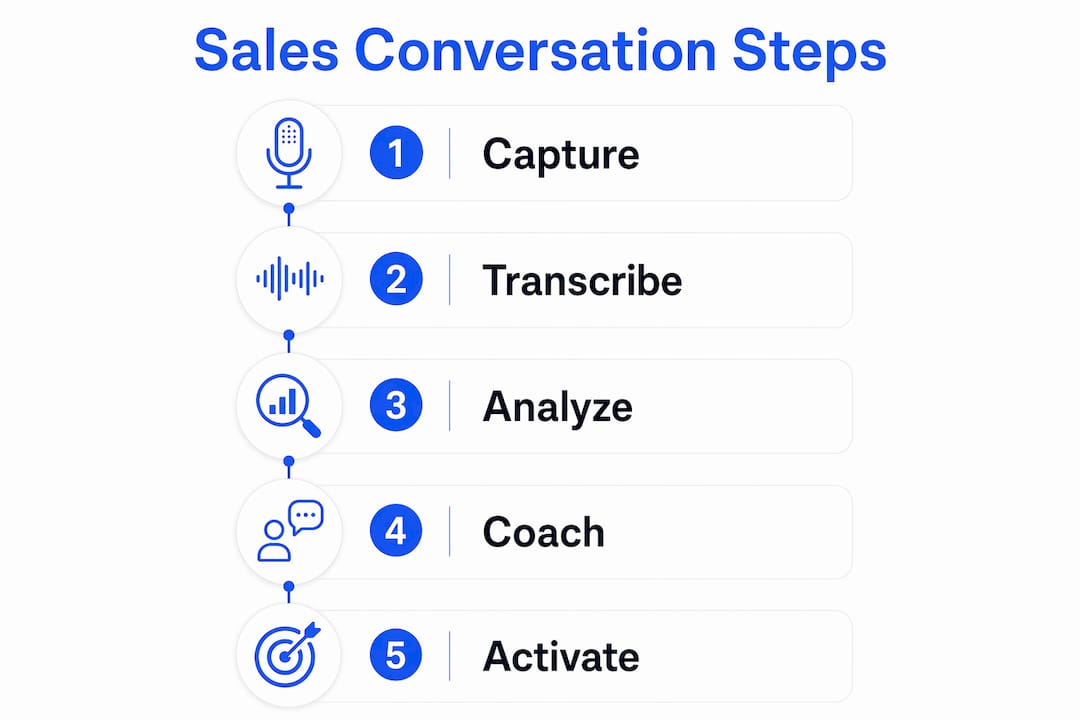
A sales conversation intelligence tool is AI-powered software that automatically records, transcribes, and analyzes every sales call, extracting winning patterns, objections, competitive signals, and rep skill gaps from raw audio. It is not call recording. It is an intelligence engine that tells you what happened on a call and why it won or lost.
Core capabilities include:
- Real-time transcription with speaker labeling across voice and video
- Sentiment analysis that detects tone shifts and buyer engagement levels
- Call scoring against defined criteria, automatically applied to every conversation
- AI-generated summaries that condense a 60-minute call into a 60-second read
- Action-item extraction that surfaces next steps without manual note-taking
- Keyword and topic tracking for pricing mentions, competitor references, and objections
One distinction worth locking in early: conversation intelligence analyzes human-to-human interactions, while conversational AI (chatbots, voice agents) conducts automated conversations. Many sales teams run both, but they solve different problems.
How the three-layer architecture actually works
Every effective conversation intelligence platform operates across three interconnected layers. A platform missing any one of them reduces its return on investment significantly.
- Capture layer: Records audio and video from calls across Zoom, phone, and web conferencing platforms, then converts speech to searchable text using natural language processing.
- Intelligence layer: NLP and machine learning models scan transcripts to detect sentiment, extract topics, flag objections, identify competitor mentions, and score rep behavior against benchmarks.
- Activation layer: Pushes summaries, coaching cues, and next steps directly into CRM records and workflow automation, closing the loop between insight and action.
The activation layer is where most teams leave money on the table. Insights that stay inside the conversation intelligence platform never change rep behavior. Insights that auto-sync to Salesforce, trigger follow-up tasks, and surface in coaching queues do.
How conversation intelligence shifts coaching from gut feel to evidence
Traditional sales coaching relies on a manager’s memory of a handful of calls reviewed each month. Intuition-based coaching cannot scale, and it cannot identify patterns across hundreds of conversations simultaneously.
Conversation intelligence changes the model entirely. Managers receive AI-generated coaching cues tied to specific call moments, so feedback is precise rather than general. New hires ramp faster because winning talk tracks are identified automatically and built into onboarding playbooks.
The performance data is concrete. Companies using AI conversation intelligence see significant improvements in win rates and call coverage, according to McKinsey and Gartner data. Reviewing 3% of calls by hand versus analyzing 95% automatically is not a marginal difference in visibility.
Real-time AI coaching during live calls pushes this further. Rather than waiting for a post-call debrief, reps receive in-call prompts that produce immediate behavior change. Coaching lag, the gap between a bad call and corrective feedback, shrinks from days to seconds.
Integrating conversation intelligence with omnichannel sales automation
Conversation intelligence delivers its highest value when integrated with CRM and sales automation workflows, not sitting as a standalone analytics tool. The integration connects call insights to the full revenue pipeline.
Practical integration points include:
- Auto-syncing call summaries and next steps to CRM opportunities after every conversation
- Triggering follow-up email or SMS sequences based on topics detected during a call
- Routing high-intent leads identified by buying signals to appointment-setting workflows
- Feeding conversation analytics into omnichannel dashboards covering calls, chat, and email
- Alerting managers when a deal shows risk signals like tone shifts or competitor mentions
For teams running omnichannel communication across SMS, email, chat, and voice, conversation analytics create a unified signal layer. Every channel informs the others, and no buyer interaction disappears into a rep’s memory.
Pro Tip: Map your highest-value objection types before deployment. Pre-configuring keyword tracking for those specific phrases means your intelligence layer starts surfacing relevant coaching data from day one.
How Mediabloom applies conversation intelligence at scale
Mediabloom combines AI conversation intelligence with omnichannel automation and voice agents into a single lead generation platform. The result is a system where every conversation, whether handled by an AI voice agent or a human rep, feeds back into qualification scoring and appointment-setting workflows.
Clients including Miracle Ear and 1-800 Accountant have deployed Mediabloom’s platform to generate over 10,000 leads monthly, with rapid response times and automated follow-up sequences that prevent lead decay. The platform’s architecture mirrors the three-layer model: capture across channels, intelligence applied to every interaction, and activation through CRM-connected workflows.
Key outcomes from Mediabloom deployments:
- Consistent lead qualification at volume, without adding headcount
- Omnichannel coverage across SMS, email, chat, and voice in a single control plane
- Appointment booking automation triggered by conversation signals in real time
Common challenges and limitations to plan for
Conversation intelligence tools are powerful, but they come with real constraints that teams should address before deployment.
Transcription accuracy drops with heavy accents, technical jargon, or poor audio quality. Most enterprise platforms handle standard American English well, but multilingual or highly specialized sales environments require additional configuration. Data volume is another challenge: a platform analyzing hundreds of calls daily generates more coaching flags than most managers can act on without a triage process in place.
Adoption resistance from sales reps is common. Reps who feel monitored rather than supported disengage from the tool’s feedback loops. Framing conversation intelligence as a coaching asset rather than a surveillance system is a prerequisite for sustained adoption.
Data privacy and security considerations
Recording sales calls carries legal obligations that vary by state. In the United States, one-party consent states allow recording with only one participant’s knowledge, while two-party (all-party) consent states like California require all parties to be informed. Deploying a conversation intelligence tool without a compliant disclosure process creates legal exposure.
At the platform level, look for SOC 2 Type II certification, end-to-end encryption for stored recordings, and role-based access controls that limit who can retrieve call data. AI-powered sales tools that handle customer conversations should also comply with GDPR requirements for any calls involving European contacts, even when the selling team is US-based.
What leading conversation intelligence tools offer
The market divides into two broad categories. Enterprise platforms embed conversation intelligence directly into existing CRM ecosystems, offering deep pipeline visibility and revenue forecasting alongside call analysis. Standalone tools prioritize coaching workflows and call libraries, often integrating with CRMs via API rather than native connection.
CallCabinet’s conversation analytics platform automatically surfaces effective sales techniques and compliance signals from recorded calls, making it a strong fit for technology organizations with regulatory requirements. For teams already using Pipedrive, AI-assisted sales coaching built into the CRM reduces the integration overhead of adding a separate conversation intelligence layer.
The right choice depends on whether your priority is coaching depth, CRM-native workflow automation, or compliance coverage.
Implementation best practices for successful adoption
Start with a defined use case rather than a broad rollout. Teams that deploy conversation intelligence to solve one specific problem, such as reducing objection-handling inconsistency or cutting new hire ramp time, see faster adoption and clearer ROI than teams that deploy it as a general analytics layer.
Configure your keyword library before going live. Pricing terms, competitor names, and your top five objection types should be tracked from the first call. Review your onboarding approach with reps before launch, positioning the tool as a coaching resource. Set a weekly cadence for managers to act on the coaching flags the platform surfaces, because unused insights produce no behavior change.
Mediabloom turns conversation intelligence into pipeline
Most conversation intelligence tools give you data. Mediabloom gives you leads. The platform pairs AI conversation analysis with automated voice agents, chatbots, and omnichannel follow-up sequences, so insights from every call immediately feed the next outreach action.
For businesses that need volume and speed, Mediabloom’s architecture handles qualification, appointment booking, and follow-up across SMS, email, and voice without adding headcount. Clients like Miracle Ear and 1-800 Accountant reached 10,000-plus monthly leads by deploying this system. See what that pipeline looks like for your business by reviewing Mediabloom’s lead generation results or exploring the full AI-powered platform.
Key Takeaways
Sales conversation intelligence tools deliver measurable pipeline impact only when all three layers, capture, intelligence, and activation, are fully connected to CRM and omnichannel workflows.
| Point | Details |
|---|---|
| Three-layer architecture | Capture, intelligence, and activation must all be present; a missing layer cuts ROI. |
| Win rate impact | AI conversation intelligence lifts win rates 15–20% and raises call coverage from 3% to 95%. |
| Coaching transformation | Evidence-based coaching replaces gut-feel reviews, reducing new hire ramp time at scale. |
| Privacy compliance | US two-party consent states like California require all-party disclosure before recording calls. |
| Mediabloom | Combines conversation intelligence with omnichannel automation to generate 10,000-plus leads monthly for clients like Miracle Ear and 1-800 Accountant. |
FAQ
What does a sales conversation intelligence tool actually do?
It records, transcribes, and analyzes sales calls using AI, extracting insights like objections, sentiment, and buying signals that feed directly into coaching and CRM workflows.
How is conversation intelligence different from conversational AI?
Conversation intelligence analyzes recorded human-to-human calls to extract insights. Conversational AI, such as chatbots or voice agents, conducts automated conversations with customers in real time.
What win rate improvement can teams expect?
According to McKinsey and Gartner data, companies using AI conversation intelligence see win rates climb 15–20%, with call coverage rising from 3% to 95%.
Is call recording legal for sales teams in the United States?
Legality depends on state law. One-party consent states allow recording with one participant’s knowledge, while all-party consent states like California require disclosure to every participant on the call.
How does Mediabloom use conversation intelligence for lead generation?
Mediabloom integrates AI conversation analysis with omnichannel automation across voice, SMS, email, and chat, enabling clients like Miracle Ear and 1-800 Accountant to generate a high volume of leads monthly.