What does a voice agent lead capture setup actually include?

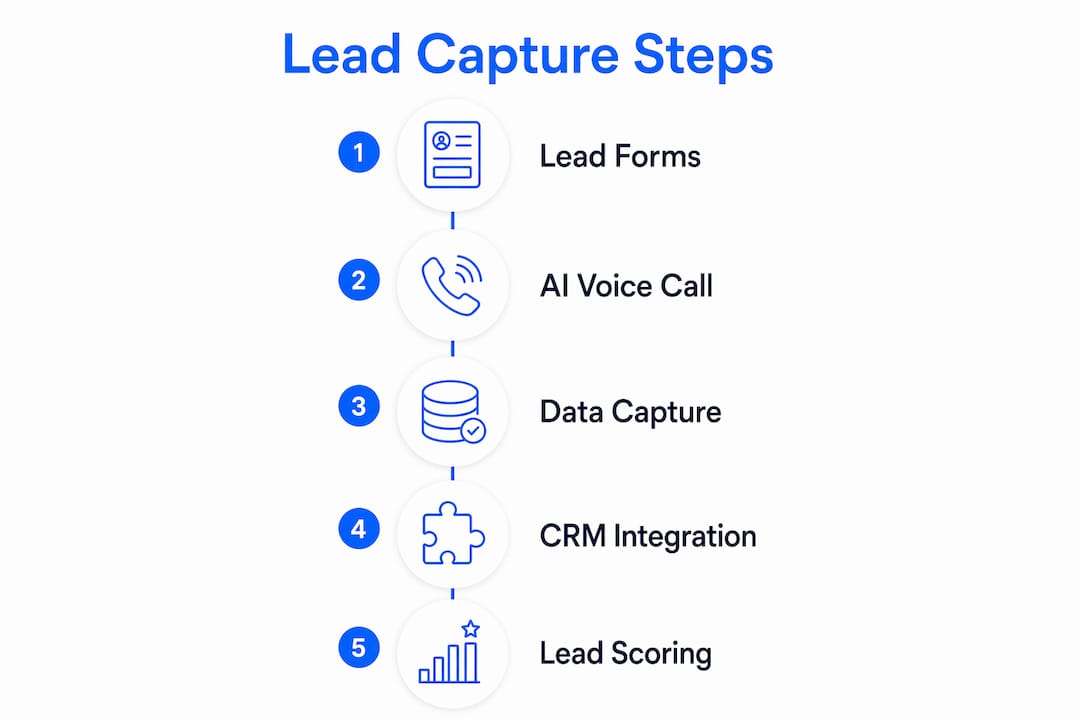
A voice agent lead capture setup is the deployment of AI-driven voice agents that automate inbound or outbound lead qualification calls while integrating with CRM tools to accelerate sales pipelines. Done right, it replaces the slow, inconsistent human SDR first-touch with a system that qualifies leads in real time, writes structured data to your CRM, and hands off high-intent prospects to a human rep without losing momentum.
The core components every production setup requires:
- AI voice platform: VoiceGenie or ElevenLabs Conversational AI handle speech-to-text (STT), large language model (LLM) reasoning, and text-to-speech (TTS) in a single pipeline.
- Telephony layer: Twilio manages outbound dialing, call recording, media stream bridging, and voicemail detection.
- CRM connection: HubSpot (or equivalent) receives structured lead data via webhook after each qualified call.
- Qualification logic: A strict JSON tool schema forces the LLM to collect every required field before proceeding, turning the system prompt from decorative to load-bearing.
- Compliance gates: TCPA and Do-Not-Call (DNC) registry checks must run before any dial is placed. The FCC requires explicit consent disclosures for AI-generated voice calls, identical to conventional automated messaging.
- Human handoff protocol: A warm transfer or Slack notification path for high-intent callers the agent cannot fully serve.
- Latency management: Response times above 800ms reduce user conversion and create the perception of a dropped call.
The benefit is speed and data quality. An AI voice agent can call a new lead within five minutes of form submission, qualify along BANT criteria (Budget, Authority, Need, Timeline), and push a typed payload to HubSpot before a human SDR has even opened their inbox. That speed advantage compounds when you scale to thousands of dials per day.
How do you set up a voice agent lead capture system step by step?
Building a production-ready automated voice lead capture system takes roughly eight to ten weeks from first configuration to full ramp. Here is the sequence that works.
-
Configure your AI voice platform account. Create your VoiceGenie or ElevenLabs agent. Select a voice model, set the language to English (US), and define the agent’s persona. For lead capture calls running three minutes or less, a faster, lighter model outperforms a premium one because latency is the binding constraint, not intelligence ceiling.
-
Build the compliance gate first. Before writing a single line of dialer code, implement TCPA and DNC checks. The gate must verify the lead against your internal suppression list, the federal DNC registry, and TCPA time windows (no calls before 8:00 AM or after 9:00 PM local time). States including California, Florida, and Pennsylvania require two-party consent disclosures at the top of every recorded call. TCPA fines can be substantial per violating call, so this gate is not optional.
-
Define the qualification tool schema. Do not ask the LLM to “qualify the lead” in free text. Give it a
qualify_leadtool with a strict JSON schema that marksfull_name,email,company,pain_point,budget_band, andtimelineas required fields. The LLM will not call the tool until all six fields are captured, which makes the qualification instruction enforceable rather than advisory. -
Write the system prompt. Keep it thin. One paragraph: identify the product, instruct the agent to ask one question at a time, capture the six required fields, call
qualify_leadwhen complete, confirm the email back to the caller, and offer to book a meeting. The tool schema does the heavy lifting; the prompt sets the tone and sequence. -
Set up Twilio for outbound dialing. Connect your Twilio account to the voice platform via account SID and auth token. Enable
machine_detectionto hang up on voicemail rather than wasting a session on a recording. Enable call recording for compliance and QA. Wire the Twilio Media Stream to the voice platform’s WebSocket so audio flows bidirectionally in real time. -
Integrate HubSpot with an idempotent upsert webhook. Never call HubSpot’s
create_contactdirectly from the LLM layer. Build a singleupsert_contactwebhook on your side that first searches by email, then routes toupdate_contactif a record exists orcreate_contactif it does not. This prevents duplicate records from flooding your CRM when the same lead calls twice. -
Implement human handoff. Build a
transfer_to_humantool with two paths: a warm Twilio transfer that bridges the caller to a live rep in roughly five seconds, and a Slack notification path where the first rep to claim the lead dials back within 60 seconds. Trigger conditions should include any caller-stated budget above your top tier, compliance or legal questions, and any explicit request for a human. -
Run pre-launch simulation. Before dialing real leads, auto-generate 200–500 branching call scenarios covering your top ten objection types. Score each scenario on task completion. Every objection branch should hit 80% task completion across 50 synthetic calls before you go live.
-
Launch to a low-priority list first. Run your first 500–1,000 dials against a re-engagement or nurture list. Monitor task completion scores daily. Persistent gaps are script bugs, not model bugs.
-
Ramp and iterate weekly. Once the sandbox launch is clean, scale to higher-priority lists. Review objection clusters weekly and ship script fixes on a rolling basis.
What challenges should you expect in a voice agent lead capture setup?
Most voice agent deployments hit the same failure modes. Knowing them in advance cuts weeks off your troubleshooting cycle.
-
Latency above 800ms causes caller drop-off. When the agent goes silent for more than a second, callers assume the call dropped. The fix is end-to-end streaming: ASR should stream audio rather than waiting for a sentence boundary, the LLM should stream tokens as they are generated, and TTS should begin audio output on the first sentence fragment. Prefetching calendar and contact data before the call starts masks API latency with natural filler speech.
-
Webhook timeouts create silent gaps mid-call. HubSpot’s API can take 2–3 seconds at the 99th percentile. If your webhook tool waits synchronously, the agent goes silent and the caller assumes a disconnection. Respond to every tool call in under 500ms with a queued confirmation (
{"status": "queued", "lead_id": "uuid-here"}), then process the actual CRM write in a background job. -
CRM duplicate flooding. Relying on the LLM to remember deduplication logic is a production failure waiting to happen. The idempotent upsert webhook described in the setup steps above is the only reliable fix.
-
The opening rejection cliff. A large share of calls end within the first ten seconds. A/B testing your opening prompt is the highest-leverage optimization available before you touch anything else in the stack.
-
Objection handling gaps. Scripts that cover only the “happy path” fail in production. Every script needs at least ten objection branches, each with a response, a fallback, and a graceful exit. “Send me an email” is not a conversation-ender; it is an objection with a scripted response.
-
TCPA violations from improper consent. The FCC confirmed in 2024 that AI-generated voice calls require the same consent disclosures as conventional automated messages. Recording disclosure must appear in the agent’s first utterance in two-party consent states. Never leave a recorded voicemail; that is a TCPA violation in most contexts.
-
Deepfake and voice cloning fraud. Deepfake fraud in voice AI rose 1,300% during 2024. Anti-spoofing detection and identity verification are not optional features for production deployments. Build audit logging and apply the principle of least privilege to every integration layer.
-
Integration fragility. Do not call CRM APIs directly from the LLM layer. Build a structured tool layer between the LLM and your enterprise systems with defined schemas, timeout handling, retry logic, and fallback responses. Treat every tool call like a payment: idempotent, retried, logged, and alerted on failure.
Pro Tip: Set a latency service-level objective (SLO) of 900ms or below for the full round-trip from caller utterance to agent response. If you cannot measure it, you cannot defend it when call quality degrades at scale.
What operational practices separate working demos from production systems?

The teams that ship reliable voice agent appointment setting setups share one discipline: they treat operational rigor as the product, not an afterthought.
Prioritize latency tuning over model upgrades. Switching from one LLM to another rarely fixes poor conversation flow. System prompt design and function tool architecture are the actual drivers of call quality. Before you evaluate a new model, exhaust your latency and scripting improvements first.
Key operational practices that production teams apply:
- Structured handoff payloads. Every human handoff must include a conversation summary, identified intent, emotional state signal, extracted entities (name, company, budget band, timeline), and the specific escalation reason. The rep should be briefed before they say hello, not after.
- Scope boundaries with graceful exits. Build explicit triggers for when the agent should escalate: scope boundary reached, emotional distress detected, ASR confidence below threshold, action exceeds the agent’s permission model, or explicit human request. The “I can’t help with that” moment must be designed, not improvised.
- A/B test opening prompts. This is the fastest path to reducing early call drop-offs. Test two to three opening variants on a low-priority list before committing to one for your main campaign.
- Warm transfer over cold. A warm Twilio transfer where the rep picks up while the caller is still on the line converts at a significantly higher rate than an asynchronous callback promise. Build the warm path on day one.
- Background webhook jobs. All heavy CRM writes, SMS sends, and calendar bookings should run asynchronously. The agent should never wait on an external API while the caller is listening.
- Weekly script iteration. Cluster your objection failures from the live call feed every week. The top three recurring failures become the next sprint’s script fixes.
For sales teams integrating AI at scale, the operational layer is where ROI is won or lost. A well-tuned script on a mediocre model outperforms a premium model running a vague prompt every time.
What does the research say about voice agent lead capture performance?
The data on voice agent lead capture is specific enough to inform architecture decisions directly.
Voice recognition as a market hit $18.39 billion in 2025 and is growing at 22% annually. In targeted B2B campaigns, demo bookings have increased significantly when AI voice agents handle qualification. A B2B SaaS case study showed an AI qualification agent achieving qualification rates comparable to human SDRs, notable improvement in lead-to-meeting rate driven by faster outreach, and a substantial reduction in cost per qualified lead.
That tension between performance and governance is where most setups fail. The FCC’s consumer guidance on robocalls applies directly to AI voice agents, and California’s CCPA adds data handling obligations on top of federal TCPA requirements. Compliance is not a legal review you schedule after launch; it is an architecture decision you make in week one.
Mediabloom’s deployments for clients including Miracle Ear and 1-800 Accountant demonstrate what a production-grade voice agent pipeline delivers at scale: over 10,000 monthly leads generated through an integrated system combining voice agents, chatbots, and sales automation across SMS, email, and chat. The lead nurturing path after initial voice qualification is where that volume converts to revenue, and it requires the same structured data discipline applied to the qualification call itself.
Effective lead scoring downstream of voice capture depends entirely on the quality of the typed payload the agent pushes to the CRM. A free-text summary is unscoreable. A structured BANT payload with enum fields for budget and timeline is sortable, filterable, and directly actionable by your sales team.
See Mediabloom’s voice agent system in action
Mediabloom’s AI voice agent platform combines outbound dialing, real-time lead qualification, CRM integration, and human handoff into a single production-ready system. Clients like Miracle Ear and 1-800 Accountant use it to generate over 10,000 qualified leads per month across voice, SMS, and chat.
Watch the demo to see a live qualification call, or review client case studies to see the ROI numbers from real deployments.
Key Takeaways
A voice agent lead capture setup delivers reliable results only when compliance gates, structured qualification schemas, idempotent CRM writes, and warm human handoff are built into the architecture from day one, not added later.
| Point | Details |
|---|---|
| Compliance gates are non-negotiable | TCPA fines can be substantial per violating call; build the gate before any dialer code. |
| Schema-driven qualification | A strict JSON qualify_lead tool forces the LLM to collect all required fields before proceeding. |
| Latency SLO of 900ms | Voice agent response times above 800ms reduce conversion; stream ASR, LLM, and TTS end-to-end. |
| Idempotent CRM writes | An upsert webhook that checks by email before creating prevents duplicate records in HubSpot. |
| Warm handoff converts better | A live Twilio transfer where the rep picks up while the caller is still on the line outperforms async callbacks. |
FAQ
What platforms do you need for a voice agent lead capture setup?
The core stack is an AI voice platform (VoiceGenie or ElevenLabs), Twilio for telephony and media streaming, and a CRM like HubSpot for structured lead data storage. A compliance gate checking TCPA and DNC registries must run before any dial is placed.
How does TCPA compliance affect AI voice agent outbound calls?
The FCC requires explicit consent disclosures for AI-generated voice calls, identical to conventional automated messaging. TCPA fines can be substantial per violating call, and states like California, Florida, and Pennsylvania require two-party recording disclosure at the start of every call.
Why does latency matter so much in voice agent lead capture?
Response times above 800ms cause callers to perceive the call as dropped, leading to early hang-ups. Streaming ASR, LLM token output, and TTS synthesis end-to-end keeps the round-trip below the 900ms threshold where conversion rates hold.
How do you prevent duplicate leads in HubSpot from voice agent calls?
Build an idempotent upsert webhook on your side that searches HubSpot by email before creating a new contact. If a record exists, route to update_contact; if not, create a new one. Never rely on the LLM layer to handle deduplication logic.
When should a voice agent transfer a caller to a human rep?
Transfer triggers should include any caller-stated budget above your top qualification tier, compliance or legal questions outside the agent’s authorization, ASR confidence dropping below reliable intent classification, and any explicit request for a human. Pass a structured context payload including conversation summary, intent, and emotional state to the receiving rep before they speak.