

Paying $150 per month for a seat that simply manages a sequence is no longer a strategic advantage. It is a tax on your growth. In the high-stakes environment of 2026, the choice between a traditional sales engagement platform vs custom AI has shifted from simple tool selection to a fundamental question of architectural ownership. You've likely felt the friction of rigid workflows that don't match your unique sales cycle. You've also seen the ballooning SaaS invoices that effectively punish you for every new hire. Most frustrating of all is the influx of low-quality AI add-ons that sound robotic and fail to convert your hard-earned leads.
You deserve a system that functions as a high-performance asset rather than a recurring liability. This article will help you discover whether a subscription-based sales engagement platform or a bespoke AI architecture is the superior engine for scaling your national sales operations. We will examine the shift from simple activity management to autonomous strategic execution. You'll learn how to implement human-parity AI voice agents and custom logic to gain full control over your data. It's time to stop renting your outreach and start building a scalable revenue engine that drives results without increasing costs.
Key Takeaways
- Shift your focus from vanity metrics like activity tracking to an execution-based model that prioritizes revenue over simple "touches."
- Understand the technical divide between multi-tenant SaaS limitations and the full ownership provided by a single-tenant custom AI environment.
- Calculate the long-term impact of subscription debt versus building an owned infrastructure that serves as a high-value capital asset.
- Apply a strategic decision framework to choose between a sales engagement platform vs custom AI based on your data maturity and sales complexity.
- Learn how to engineer a high-performance ecosystem using custom CRM automations and AI voice agents to scale operations without increasing headcount.
Beyond Activity Tracking: Why Sales Engagement Platforms Are Reaching Their Limit
The "Engagement Era" is a relic of the past. It focused on activity. We are now in the Execution Era. If your team is stuck tracking "touches" instead of closed revenue, you are running a legacy operation. Traditional sales engagement platforms were built to assist humans, not replace the friction of manual work. This is the core conflict when evaluating a sales engagement platform vs custom AI; one manages the rep, while the other manages the result. Activity is noise. Revenue is signal.
Most SEPs act as fancy digital checklists. They integrate with Salesforce to log activity, but they don't actually close the gap between a lead and a meeting. We are seeing a shift toward an automated AI workforce. This is a system that handles the entire top-of-funnel without a human ever picking up a phone. It is about replacing the sequence with a strategy. Build an asset. Don't rent a cadence.
To better understand this concept, watch this helpful video:
The SaaS Ceiling: When 'Standard' Becomes a Hindrance
Rigid workflows kill brand identity. Generic AI assistants offer "personalization" that feels like a mad-lib. It's transparent and ineffective. Then there is the seat-based scaling trap. Your software bill should not grow in lockstep with your team. This model punishes success. Keeping engagement data in a separate silo from your core AI logic prevents you from building a proprietary advantage. You are effectively training someone else's model with your own hard-won data. Break the cycle of subscription debt. Own your infrastructure.
The Rise of the Sales Execution Engine
Execution means moving a lead to a meeting autonomously. Human-parity AI voice agents are replacing traditional dialers and email sequencers. They don't just follow a sequence; they respond to nuance. They navigate objections in real-time. This is not about sending more emails. It's about having more conversations. A Sales Execution Engine is the architectural evolution of the SEP, designed to automate the entire top-of-funnel through proprietary logic and integrated AI agents. It focuses on the output, not the activity. It is the core of a high-performance revenue engine.
SaaS SEP vs. Custom AI: A Technical and Strategic Architecture Breakdown
Architecture is the foundation of performance. When evaluating a sales engagement platform vs custom AI, you are choosing between a rented apartment and a custom-built fortress. Multi-tenant SaaS platforms provide immediate convenience. They are designed for standard, linear sales processes where every user follows the same pre-defined rails. However, this convenience comes with a technical ceiling. You are one of thousands sharing the same codebase. This means your unique strategy must fit into their boxes, or it won't work at all. This technical divide is why the debate over sales engagement platform vs custom AI is no longer about features; it's about ownership.
In a single-tenant custom AI environment, the architecture is yours. You own the prompts. You own the logic. Most importantly, you own the training data. This level of control is impossible in a multi-tenant model where the vendor dictates the product roadmap. If you need a specific agentic capability today, you shouldn't have to wait for a vendor's quarterly release cycle. This "Feature Lag" is a silent killer of competitive advantage in fast-moving markets.
The SaaS Model: Convenience at the Cost of Customization
SEPs like Outreach.io are excellent for teams with commodity products and simple outreach cadences. They offer a "plug and play" experience that gets reps up and running quickly. But as your operations mature, the limitations become clear. Security and compliance become major hurdles when navigating 3rd party data processing. Every lead you upload is processed through a vendor's infrastructure, creating a layer of risk you cannot fully mitigate. You are essentially outsourcing your most valuable asset, your customer data, to a system you don't control. Convenience shouldn't come at the expense of your data's integrity.
The Custom AI Model: Building Your Own Revenue IP
Building your own revenue IP is the ultimate strategic move for a growing enterprise. Custom LLM workflows allow for hyper-niche lead qualification that generic tools simply cannot match. You can turn your most successful sales scripts into proprietary AI logic, creating a "Sales Brain" that lives within your organization. By integrating AI Voice Agents directly into your custom stack, you bridge the gap between digital outreach and human conversation. This is a deep-coded CRM workflow, not a superficial plugin. It ensures your AI agents are active participants in your revenue engine rather than mere writing assistants.
Scalability is the final differentiator. A custom engine handles 1,000 or 1,000,000 leads with the same level of precision. Overhead doesn't increase linearly because the system is built for volume from day one. Consider these advantages of an owned architecture:
- Control: You manage the specific prompts and the underlying logic.
- Ownership: Your training data remains internal and proprietary.
- Security: Data processing happens within your own secured environment.
- Cost Efficiency: Scaling doesn't require purchasing additional user seats for every hire.
You aren't paying for more seats as you grow; you are simply fueling a machine that you already own. This shift from a recurring expense to a capital asset is what separates market leaders from those just trying to keep up. If you're ready to move beyond the limitations of standard platforms, you can speak with our technical team to map out a custom solution that fits your specific goals.
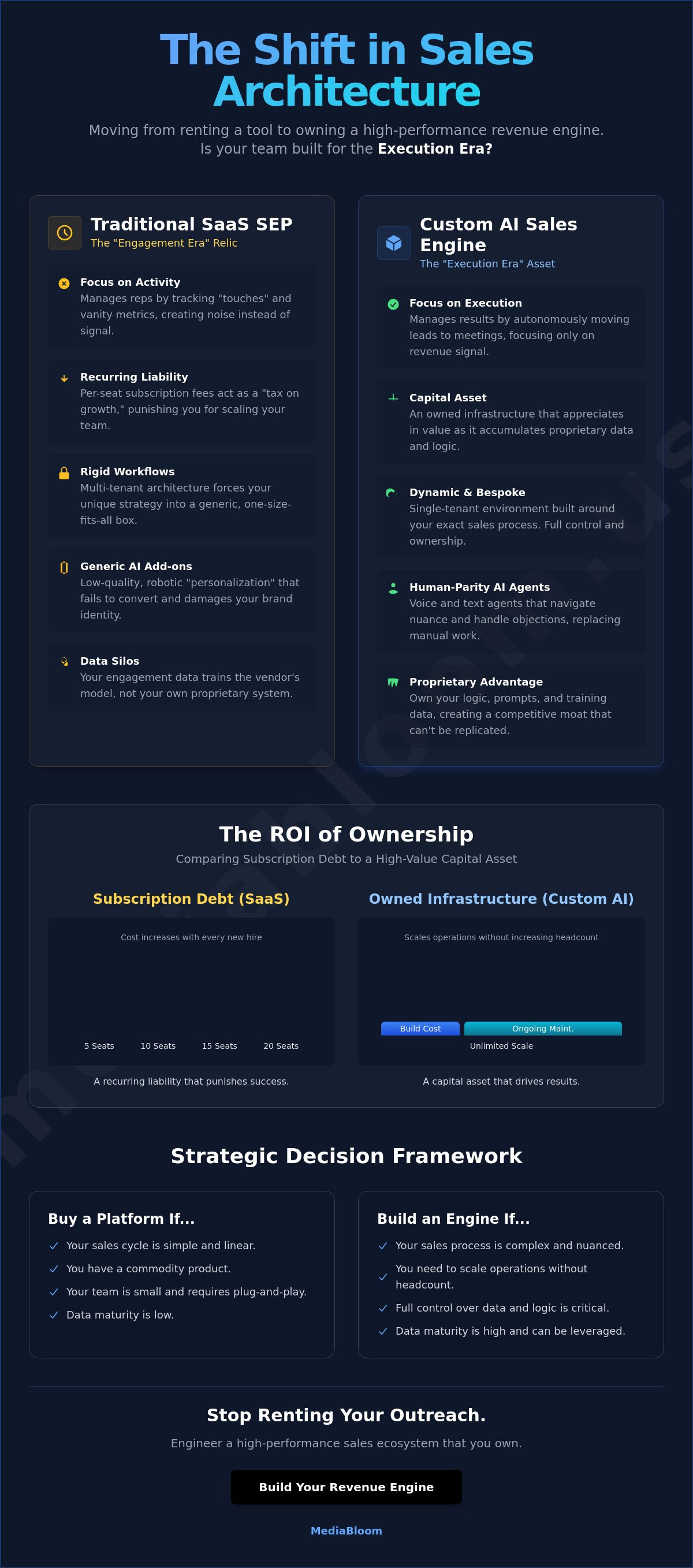
The ROI of Custom AI: Comparing Subscriptions to Owned Infrastructure
Subscription models are designed to extract maximum value from your growth. In the strategic debate between a sales engagement platform vs custom AI, the financial delta becomes staggering as you scale toward a national footprint. When you rent a platform, you are paying a "seat tax" that compounds with every new hire. This is subscription debt. Over a five-year horizon, a 100-seat deployment can easily exceed $750,000 in licensing fees alone. That capital disappears into a vendor's balance sheet, leaving you with zero equity in the technology driving your revenue.
Custom AI development flips this script. It transforms your sales technology from a recurring OPEX drain into a CAPEX investment that builds tangible company value. You aren't just buying a tool; you are architecting a proprietary asset. One custom AI agent can effectively replace the output of ten human BDRs by operating 24/7 without fatigue. This "Outreach Bloom" allows you to scale volume exponentially while actually increasing personalization. Because the AI logic is yours, it can draw from your entire historical data set to craft messages that resonate with human-parity precision.
Calculating the TCO: 3-Year Projection
A true total cost of ownership (TCO) analysis goes far beyond the initial sticker price. Standard platforms often hide costs in implementation fees, mandatory training, and aggressive API usage charges for data enrichment. When you calculate the cost-per-lead-qualified, the custom model wins on efficiency every time. You avoid the linear cost increase associated with seat-based scaling. Rented AI is always more expensive at scale because you are paying a significant markup on raw compute costs alongside a platform tax that offers zero long-term equity. By owning the infrastructure, you pay for the compute, not the permission to use it.
Performance Metrics: Beyond Open Rates
Vanity metrics like open rates are distractions. The only metric that matters is the "Meeting Set" rate. Custom AI architectures excel here because they react to lead sentiment in real-time. Instead of following a rigid, pre-set cadence, a custom engine adjusts its logic based on the specific nuances of a prospect's reply. The impact of automated lead nurturing on long-tail conversion is profound. It ensures that no lead is ever abandoned, regardless of how long the sales cycle lasts.
We've seen this play out in real-world scenarios. Organizations transitioning from a standard SEP to a custom MediaBloom engine often report a significant shift in lead quality. They move from high-volume, low-intent "spraying" to a surgical, automated approach. This isn't just about saving money on software; it's about building a high-performance ecosystem that converts more effectively. You gain full control over the AI logic, ensuring your brand's voice is never diluted by generic, third-party templates. Own the engine. Control the outcome.
Decision Framework: When to Buy a Platform vs. When to Build an Engine
Strategic growth demands more than just adding tools. It requires an architectural shift. Deciding between a sales engagement platform vs custom AI comes down to one question: Is your sales process a commodity or a competitive advantage? If your workflow is identical to every other player in your industry, a standard platform might suffice. However, if your success depends on unique data signals, complex qualification, or a specific brand voice, you are building a proprietary engine. You must decide if you want to manage a team of people using tools or own a machine that executes strategy.
Evaluating your data maturity is the next critical step. Custom AI requires a foundation of clean, accessible data to function at peak performance. If your CRM is a graveyard of unformatted leads, you aren't ready for an engine; you need an architect. You must also calculate your Scale Point. For many national sales operations, the seat-based model of a traditional SEP becomes financially inefficient once you surpass 20 representatives. At this volume, the recurring licensing fees often exceed the cost of developing and maintaining a custom, owned infrastructure that doesn't charge you for every new hire.
Identifying the Human Gap is where the ROI becomes undeniable. Research indicates that manual pre-call preparation can take up to 28 minutes per meeting. A custom AI task agent layer reduces this to under 4 minutes. If your reps are wasting hours on formatting emails or digging through LinkedIn, your current platform is failing. It's time to shift those tasks to an automated workforce so your humans can focus on closing deals.
Step 1: Audit Your Current Sales Stack
Start by identifying the waste. Look for redundant tools and "zombie" seats that your team hasn't logged into for 30 days. Map your current lead flow to see exactly where prospects drop off during the engagement phase. Most bottlenecks occur when a human is required to perform a repetitive task, such as lead qualification or follow-up. You can check out our solutions page for a structured audit framework to help visualize these gaps. Eliminate the noise to make room for the signal.
Step 2: Determine Your Ownership Goals
Ownership is the ultimate hedge against market volatility. When you build a custom revenue engine, you create a capital asset. This proprietary AI logic adds significant value to your company during an acquisition or IPO. It proves that your revenue is generated by a scalable system, not just a handful of high-performing individuals. Choosing "custom" doesn't mean you have to manage the code yourself. Managed services allow you to enjoy the benefits of bespoke AI automation without the burden of a massive in-house dev team. You own the brain; we provide the architecture.
If you are ready to stop renting your sales process and start building a high-performance asset, you can schedule a technical audit of your current stack to see where custom automation can drive the highest impact.
MediaBloom: Engineering Your High-Performance Sales Ecosystem
MediaBloom eliminates the compromise between restrictive SaaS and the prohibitive costs of in-house development. We don't sell tools; we engineer ecosystems. When you weigh the merits of a sales engagement platform vs custom AI, you are ultimately deciding who controls your revenue logic. Our "Architect" approach ensures your CRM workflows aren't just logging data but actively driving your AI workforce. We deploy human-parity AI voice agents that function as a 24/7 extension of your team, executing outbound calls with the nuance and objection-handling skills of your top performers.
Integrating email marketing for sales into this bespoke architecture transforms outreach from a guessing game into a data-driven conversion engine. We build the infrastructure that allows your strategy to scale without the friction of manual intervention. This transition is essential for organizations aiming for the 50% faster sales cycles and 15-30% revenue growth reported by leaders who adopt integrated AI architectures. We don't just provide a platform; we provide a proprietary asset that builds company equity with every lead qualified.
The MediaBloom Methodology
Our process begins with Discovery and Architecture. We don't just "install" software. We engineer a revenue engine tailored to your specific sales cycle and data maturity. This includes Custom LLM Training to ensure your AI sounds like your best closer, not a generic chatbot. We train models on your historical winning transcripts and successful scripts to maintain brand integrity across every interaction. Finally, we provide Continuous Optimization through our "Engine Room" approach. We monitor performance and refine logic in real-time, ensuring your national reach continues to expand without a linear increase in overhead or complexity.
Take the Next Step Toward Automation
Stop renting your sales process and start owning your revenue infrastructure. The era of seat-based taxes and rigid, one-size-fits-all workflows is over. You deserve a system that adapts to your strategy rather than forcing you to adapt to its limitations. You can watch a demo of a custom AI voice agent in action to see the level of human-parity automation we achieve for our clients. If you're ready to build a scalable, high-performance asset that drives measurable results, contact MediaBloom today for a custom architecture consultation. Engineer the engine that will power your growth through 2026 and beyond.
Architect Your 2026 Revenue Dominance
The landscape of enterprise sales has fundamentally shifted. Choosing between a legacy sales engagement platform vs custom AI is no longer a simple software decision; it's a choice between renting activity or owning execution. You've seen how subscription debt drains capital while custom architectures build long-term corporate equity. By prioritizing human-parity AI voice agents and deep CRM automation, you eliminate the manual bottlenecks that stall national growth.
MediaBloom specializes in engineering these high-performance ecosystems. We deploy custom AI voice agents that operate with human-parity precision, supported by expert CRM automation setup. This allows you to achieve national scale without the overhead of human BPO services. You gain full control over your data, your logic, and your results. It's time to stop managing sequences and start architecting a machine that actually closes.
Ready to architect your custom revenue engine? Contact MediaBloom today.
The future of your revenue engine is yours to build. We look forward to engineering your success.
Frequently Asked Questions
What is the main difference between a Sales Engagement Platform and Custom AI?
The primary difference between a sales engagement platform vs custom AI lies in the unit of work. A platform orchestrates sequences for humans to follow, whereas custom AI executes the tasks themselves. You move from managing activity to owning a self-sustaining revenue engine. This architectural shift allows your organization to scale volume without adding headcount or increasing subscription debt.
Is building a custom AI sales engine more expensive than a SaaS subscription?
Building a custom engine requires an initial capital investment but eliminates the compounding seat-based fees of SaaS. Over a three-year horizon, the total cost of ownership is significantly lower for national teams. You trade a recurring monthly liability for a proprietary asset that builds company equity. It is a strategic shift from renting tools to owning your digital infrastructure.
How long does it take to implement a custom AI sales workflow?
Implementation usually spans four to eight weeks depending on the complexity of your sales cycle. This timeframe includes discovery, architecture design, and custom LLM training. We ensure the logic is fully integrated with your existing data streams before deployment. It is a methodical progression from high-level strategy to a fully operational automated workforce that delivers immediate results.
Will custom AI integrate with my existing CRM like Salesforce or HubSpot?
Deep-coded integration with Salesforce, HubSpot, and other major CRMs is a standard component of custom AI architecture. Unlike superficial plugins, these integrations allow the AI to read and write data directly to your system of record. This ensures that every interaction is logged accurately. Buying signals are captured in real-time without human intervention, maintaining a clean and actionable database.
Do I need an in-house engineering team to maintain a custom AI sales engine?
You don't need an in-house engineering team when you partner with a managed service provider. We act as your strategic architects, handling the technical maintenance and continuous optimization of the engine. This allows your leadership to focus on high-level strategy and closing deals. We ensure the underlying technology remains cutting-edge, secure, and reliable as your business grows.
Can custom AI voice agents really sound like humans for cold outreach?
Modern AI voice agents achieve human-parity by utilizing advanced low-latency processing and natural language understanding. They don't just read scripts; they navigate complex objections and maintain a natural conversational flow. This technology allows you to execute thousands of personalized calls simultaneously. Your brand's voice remains consistent and professional at every touchpoint without the need for human BPO overhead.
How does custom AI handle lead nurturing differently than standard email sequences?
Custom AI processes lead sentiment to determine the next best action, whereas standard sequences follow a rigid, pre-set timeline. If a prospect asks a specific technical question, the AI provides a tailored response immediately. This dynamic approach keeps leads engaged throughout the entire cycle. It replaces the "spray and pray" method with surgical, automated lead nurturing that adapts to the prospect's needs.
What is the typical ROI for switching from a SaaS SEP to an automated AI workforce?
Organizations typically see a 15-30% increase in revenue growth within the first year of deployment. ROI is driven by the significant reduction in customer acquisition costs achieved by automating top-of-funnel tasks. You also benefit from faster sales cycles as AI agents qualify leads 24/7. This creates a scalable revenue engine that delivers consistent, predictable output without increasing your software bill.


