AI has fundamentally changed what email marketing can deliver. When fully integrated across segmentation, content creation, subject lines, and send-time optimization, AI-driven campaigns generate 41% more revenue than programs running without it. By contrast, using AI for just one feature lifts revenue by only 8–14%. The gap between partial and full AI adoption is not marginal. It defines which programs grow and which plateau.
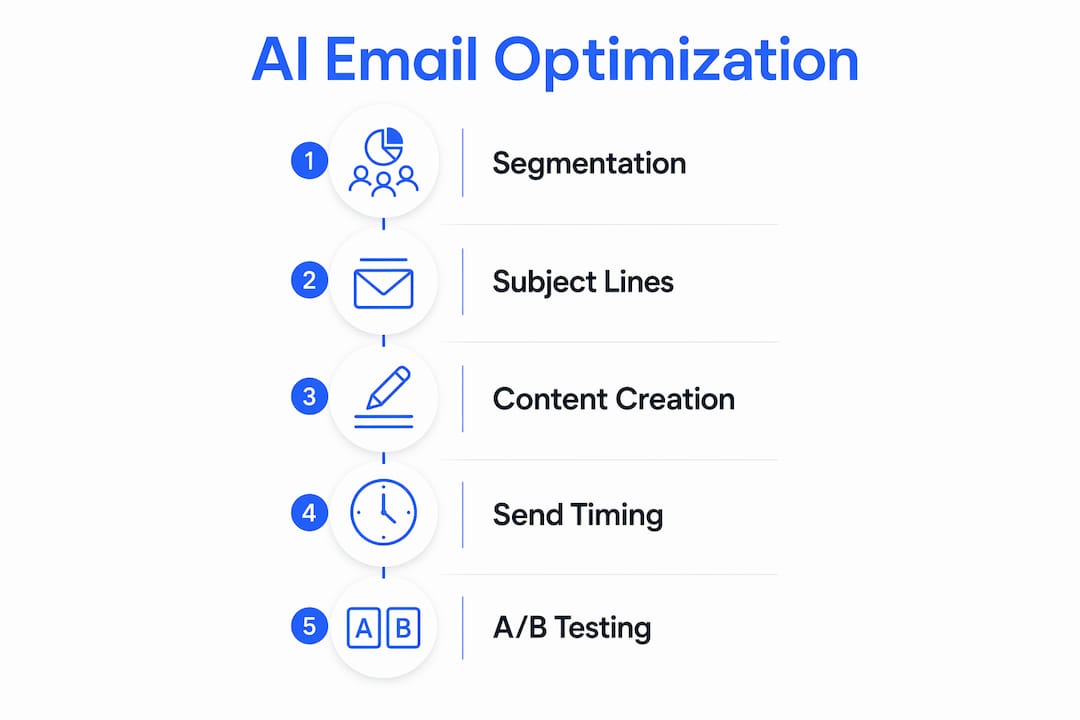
The role of AI in email marketing optimization spans every layer of a campaign:
- Personalization at scale: AI segments audiences by behavior, purchase history, and engagement signals, then tailors message content to each segment automatically.
- Dynamic content creation: AI generates subject lines, body copy, and product recommendations calibrated to individual subscriber profiles.
- Send-time optimization: Machine learning models identify the exact window each subscriber is most likely to open and act.
- Predictive segmentation: AI scores subscribers by intent, churn risk, and lifetime value, enabling precise targeting before a campaign launches.
- Workflow automation: AI maps lifecycle journeys, triggers messages based on behavioral signals, and adjusts sequences in real time.
AI amplifies what skilled marketers can execute. It does not replace the strategy, customer understanding, or judgment that makes a campaign worth sending.

How AI is being used to optimize email campaigns
The practical applications of AI in email campaigns have matured well beyond basic automation. Today’s tools address the full production and performance cycle.

Subject line optimization is where most marketers first encounter measurable AI impact. AI-optimized subject lines produce a 26% increase in open rates. Pair that with AI send-time optimization and the combined lift reaches an additional 14% on top. That is not a marginal gain for a single campaign. Across a year of sends, it compounds into a material revenue difference.
Content generation has accelerated dramatically. AI drafts body copy, rewrites product descriptions, generates benefit-led subject line variants, and summarizes customer reviews for use in testimonial-style messaging. The output is grammatically clean and structurally sound. What it lacks, without marketer guidance, is commercial edge and behavioral specificity.
Predictive analytics lets teams score subscribers before a send. AI models assess which contacts are likely to convert, which are approaching churn, and which need a re-engagement sequence rather than another promotional push. Acting on those scores before a campaign goes out is one of the clearest separators between high-performing programs and average ones.
A/B testing at scale is another area where AI earns its place. Rather than running a single subject line test per campaign, AI can simultaneously test multiple variables across segments and surface winning combinations faster than manual analysis allows.
Lifecycle journey mapping rounds out the use case list. AI identifies trigger points in the customer journey where a well-timed message can accelerate a decision, reduce friction, or prevent churn. Targeting based on engagement signals is now a primary success factor, particularly as inbox AI algorithms increasingly prioritize sender authority over volume.
Pro Tip: Before deploying AI for content generation, build a detailed prompt brief that includes your brand voice guidelines, audience segment description, and the specific behavioral trigger for the email. Vague prompts produce vague marketing.
Which AI email marketing tools lead the field in 2026?
Nine platforms define the current market for AI-powered email marketing. Each takes a different approach to where AI does the heaviest lifting.
| Platform | Key AI Features | Best For | Starting Price |
|---|---|---|---|
| Encharge | AI segmentation, behavioral automation, CDP integrations | Deep automation with AI-driven workflows | — |
| ActiveCampaign | Predictive analytics, AI personalization, sales automation | Scalable AI with CRM and sales integration | — |
| Brevo | AI content generation, send-time optimization, multi-channel | Small to mid-sized businesses, easy AI adoption | Free tier |
| MailerLite | AI subject line generation, basic personalization | Budget-conscious marketers needing core AI features | Free tier |
| Klaviyo | AI product recommendations, behavioral automation, deep analytics | Ecommerce marketers prioritizing data-driven AI | — |
| Ortto | AI journey mapping, CDP-native segmentation, predictive scoring | Integrated AI-driven CDP and email platform | — |
| HubSpot | AI content assistant, CRM-embedded automation, predictive lead scoring | Enterprises needing full CRM with AI marketing | Free CRM; Marketing Hub from $800/mo |
| GetResponse | AI subject line and content generation, adaptive send time | Easy AI content features with automation | — |
| Drip | AI segmentation, personalized campaign automation, ecommerce CRM | Online retailers focused on relational AI marketing | — |
Encharge sits at the intersection of behavioral data and automation depth. Its integration with customer data platforms means AI segmentation draws on richer signals than most mid-market tools can access. Teams running complex multi-step onboarding or lifecycle sequences will find it particularly capable.
ActiveCampaign remains the strongest all-around choice for businesses that need AI features to work alongside a functioning sales CRM. Its predictive analytics layer scores contacts by conversion likelihood, and the platform’s breadth of integrations means it fits into most existing tech stacks without friction.
Klaviyo is the default choice for ecommerce teams. Its AI product recommendation engine pulls from purchase and browse data to generate personalized content blocks at the individual subscriber level. The behavioral automation is mature and the analytics go deep enough to support serious revenue attribution.
HubSpot plays a different game. The AI features are embedded across marketing, sales, and service workflows, which means email optimization connects directly to CRM data and pipeline activity. The price reflects that scope. For teams already running HubSpot as their CRM, the email AI capabilities are a natural extension rather than a separate investment.
Brevo and MailerLite occupy the accessible end of the market. Brevo’s multi-channel AI extends beyond email into SMS and chat, which suits teams managing several communication channels from one platform. MailerLite keeps things simple: AI subject line generation and basic personalization at a price point that works for lean teams or early-stage programs.
Ortto is the most CDP-native option on the list. Its AI journey mapping is built on a unified customer data layer, which means segmentation and personalization draw on a single source of truth rather than synced data from a separate system.
GetResponse covers the content generation use case well, with AI tools for both subject lines and body copy, plus adaptive send-time logic. It suits teams that want AI to accelerate production without requiring deep technical configuration.
Drip focuses on ecommerce relational marketing. Its AI segmentation and personalized campaign automation are designed for online retailers who want to build long-term customer relationships rather than just drive single transactions.
How to use AI responsibly in email marketing and choose vendors
Responsible AI use in email marketing is not a compliance checkbox. It is the foundation of a program that performs over time without accumulating legal or reputational risk.
Human oversight is non-negotiable. AI-generated drafts require human review for brand consistency, factual accuracy, and compliance before any send. Treat AI output as a starting point, not a finished product. This applies especially to pricing claims, promotional offers, and any content that makes a factual assertion about your product or a competitor’s.
Legal compliance requires specific controls. GDPR Article 22 restricts automated decision-making that produces legal or similarly significant effects on individuals. For email marketers, this means AI-driven segmentation actions, personalized pricing, and automated suppression decisions need a human-in-the-loop review process. CCPA adds its own requirements around data use transparency. Neither regulation is optional, and neither is satisfied by a generic privacy policy.
Disclosure requirements are arriving. Starting in August 2026, EU AI Act Article 50 mandates clear disclosure of AI authorship in commercial email. Marketers serving European subscribers need to build disclosure language into their templates now. Ignoring this affects deliverability, not just legal standing, because inbox AI filtering algorithms weight transparency signals.
Vendor vetting criteria matter. When evaluating AI email platforms, ask:
- Does the vendor publish a clear AI governance policy?
- Can you audit or override AI-generated segmentation decisions?
- How does the platform handle data residency and processing under GDPR and CCPA?
- What human controls exist for AI-generated content before it reaches subscribers?
- Is the AI feature set mature, or is it a recent addition with limited track record?
Structured data and technical hygiene protect deliverability. Structured data markups improve how inbox AI systems like Gmail’s Gemini and Apple Intelligence summarize your emails. Without them, on-device AI may extract arbitrary content rather than your intended message. This is a technical configuration, not a content decision, but it directly affects whether your email registers as worth reading.
For a broader framework on deploying AI with appropriate governance controls, the AI governance guide from EverythingCloud covers organizational safeguards that apply directly to marketing technology decisions.
Pro Tip: Build a pre-send AI compliance checklist that covers: human review completed, factual claims verified, disclosure language present (for EU audiences), and segmentation logic documented. Run it before every campaign that uses AI-generated content or AI-driven targeting.
What the research says about AI’s real impact on email performance
The performance gap between full AI adopters and partial adopters is the most important number in email marketing right now. Advanced AI adopters are 75% more likely to achieve ROI exceeding 45:1. Yet only 12% of marketers have fully integrated AI across their workflows. That combination tells you exactly where the competitive opportunity sits.
41% revenue lift. Programs with full AI integration across segmentation, content, subject lines, and send-time optimization outperform non-AI programs by 41%. Partial adoption, using AI for one feature only, delivers 8–14%.
The compliance and accessibility data reinforces the ROI case. Advanced AI adopters are 54% more likely to follow accessibility guidelines and 52% more likely to comply with privacy regulations. Those are not soft benefits. Accessible, compliant programs face fewer deliverability penalties and build stronger subscriber trust over time.
Inbox AI is now a performance variable in its own right. Gmail’s Gemini-powered inbox and Apple Intelligence, which replaced sender-authored preview text for the majority of email opens beginning in late 2024, have introduced an algorithmic layer between senders and subscribers. Programs with strong engagement signals, high list hygiene, and technically authenticated sends perform better in this environment. Programs that rely on volume over quality face compounding deliverability penalties.
The research from Martech is direct on this point: AI accelerates email production but cannot replace human strategy and customer understanding. The programs generating the highest returns are not the ones producing the most AI-generated email. They are the ones using AI to think more clearly about segmentation, testing, and lifecycle logic, then executing with precision.
Scaling AI-enabled personalized flows with regular A/B testing and tight list hygiene is the primary lever separating high-performing programs from the rest. That combination, not any single AI feature, is what drives the revenue numbers at the top of the distribution.
The case for keeping human judgment at the center of AI-driven email
The most common mistake in AI-assisted email marketing is not a technical failure. It is an organizational one: teams that outsource judgment to their tools and accept whatever the AI produces as good enough.
AI can write a reactivation email. It cannot diagnose why subscribers went inactive. It can generate five subject line variants. It cannot tell you which emotional trigger is appropriate for your specific audience at this moment in their relationship with your brand. That distinction is where the real performance gap opens up, and it is entirely within the marketer’s control.
The risk of outsourcing judgment is producing campaigns that are “just fine.” Grammatically clean, structurally sound, and commercially inert. As more programs adopt similar AI tools, ask similar questions, and accept similar outputs, the average email gets more competent and less distinctive. Volume increases. Results flatten.
The marketers who will pull ahead are the ones who use AI to sharpen their thinking, not replace it. That means bringing genuine customer understanding to every prompt, defining the commercial problem before generating copy, and treating AI output as a draft that requires editorial judgment, not a finished asset. It also means investing in the skills that AI cannot replicate: behavioral insight, brand voice stewardship, and the ability to connect an email to a larger business goal.
For teams building AI-assisted outreach workflows beyond email, the AI-powered outreach guide covers how to extend these principles across channels without losing strategic coherence.
More leads, faster qualification: what Mediabloom adds to your AI stack
Email marketing optimization gets you to the inbox. What happens after the click is where Mediabloom operates.
Mediabloom’s platform combines AI voice agents, chatbots, and sales automation into a single system that qualifies leads and books appointments the moment a subscriber responds. Clients like Miracle Ear and 1-800 Accountant have used this system to generate over 10,000 monthly leads, with response times fast enough to capture intent before it cools. Where most email programs hand off to a sales team and wait, Mediabloom’s AI workforce acts immediately across SMS, email, and chat.
For teams running high-volume email campaigns, the combination of AI-optimized sends and automated lead qualification closes the gap between engagement and revenue. See how it performs in practice at Mediabloom’s case studies, or explore the chatbot solutions that integrate directly with your existing email and CRM workflows.
FAQ
How much does full AI integration improve email revenue?
Full AI integration across segmentation, content, subject lines, and send-time optimization improves campaign revenue by 41% compared to non-AI programs. Using AI for only one feature lifts revenue by 8–14%.
What is the biggest risk of using AI in email marketing?
The primary risk is outsourcing judgment to AI tools, which produces campaigns that are technically competent but commercially weak. Human oversight, strategic direction, and customer understanding remain essential for campaigns that actually drive action.
Do I need to disclose AI-generated content in emails?
For marketers serving European subscribers, EU AI Act Article 50 mandates clear disclosure of AI authorship in commercial email starting in august 2026. Failing to comply affects both legal standing and deliverability in AI-filtered inboxes.
Which AI email platform is best for ecommerce?
Klaviyo leads for ecommerce teams because its AI product recommendation engine and behavioral automation are built specifically around purchase and browse data. Drip is a strong alternative for retailers focused on long-term relational marketing over single-transaction conversion.
How does inbox AI affect email deliverability?
Inbox AI systems like Gmail’s Gemini and Apple Intelligence prioritize messages based on subscriber engagement signals, sender authentication, and content quality. Programs with strong list hygiene, double opt-in acquisition, and technically authenticated sends perform better in these environments than high-volume programs with low engagement rates.
Key Takeaways
AI-driven email programs with full integration across segmentation, content, subject lines, and send-time optimization generate 41% more revenue than non-AI programs, while using AI for just one feature lifts revenue by only 8–14%. Yet only 12% of marketers have reached that level of integration.
| Point | Details |
|---|---|
| Full integration beats partial adoption | Full AI integration across all workflow elements increases campaign revenue by 41%; using AI for a single feature lifts revenue by 8–14%. |
| Advanced adopters outperform on ROI | Marketers with deep AI integration are 75% more likely to achieve ROI exceeding 45:1. |
| Human judgment remains the differentiator | AI accelerates production but cannot replace customer understanding, strategic thinking, or editorial judgment. |
| Inbox AI changes the deliverability rules | Gmail Gemini and Apple Intelligence prioritize sender authority and engagement quality over volume, rewarding list hygiene and authentic content. |
| Mediabloom extends AI beyond the inbox | Mediabloom’s AI voice agents and chatbots qualify leads and book appointments immediately after email engagement, closing the gap between click and conversion. |