
What are the top Crunchbase alternatives right now?
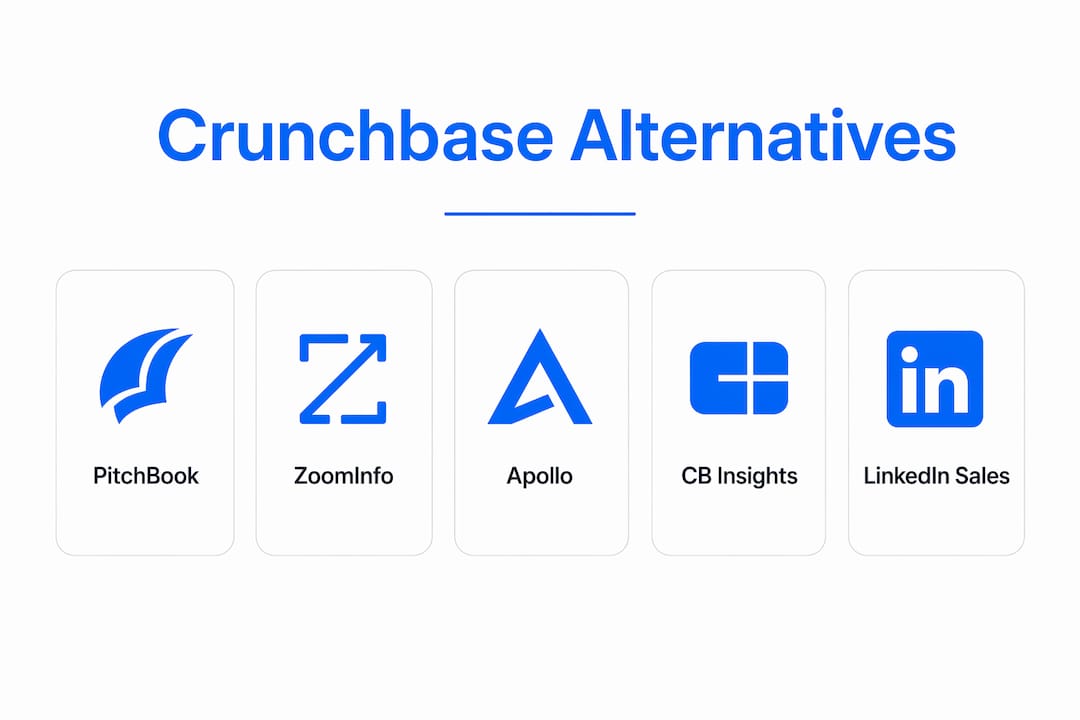
The best Crunchbase alternatives in 2026 are PitchBook for institutional investment research, ZoomInfo for high-volume outbound sales, Apollo for combined prospecting and outreach, CB Insights for AI-driven market intelligence, and LinkedIn Sales Navigator for relationship-based selling. Each solves a different problem. Crunchbase’s free tier caps searches at a limited number of results per query with no data exports, and its Pro plan offers accessible startup discovery but lacks comprehensive verified contacts and deep financial data. If your team needs more than a quick account list, one of the platforms below likely fits better.
The table covers the 45 most-evaluated alternatives across the dimensions that matter most for sales, investment, and market intelligence teams.
| Platform | Best For | Pricing | Primary Features | Data Depth & Freshness | Contact & Intent Data | AI Capabilities |
|---|---|---|---|---|---|---|
| Exploding Topics | Startup & trend discovery | Free / paid tiers | Trend tracking, startup signals | Early-stage, frequent updates | Limited | Trend prediction |
| Dealroom | European startup ecosystem | Custom | Startup & investor mapping, EU focus | Deep EU coverage | Limited | Market mapping |
| PitchBook | Institutional investment research | $25,000+/yr | Valuations, cap tables, fund performance, M&A | Very deep, 4M+ companies | 4.4M people | VC Exit Predictor, Valuation Estimates |
| Mattermark | Sales & analyst firmographic data | Custom | Growth signals, firmographics | Aggregated, moderate freshness | Limited | Growth scoring |
| Owler | Competitive intelligence | Free / paid | Crowdsourced news, company alerts | Real-time crowdsourced | Limited | Alert automation |
| Harmonic AI | Predictive market intelligence | Custom | Investment memos, market mapping | Frequent AI-driven updates | Limited | Automated memos, winner prediction |
| Acquire | Sales prospecting & engagement | Custom | Contact data, communication tools | Moderate | Yes | Engagement automation |
| ZoomInfo | High-volume outbound sales | $15,000+/yr | 500M contacts, buyer intent, GTM tools | Over 12M companies, very fresh | 135M+ verified phones | Intent signals, GTM Context Graph |
| Apollo | Sales prospecting + outreach | Free / ~$49/mo | Company data, email sequencing, automation | Broad, regularly updated | Yes | Sequence automation |
| LinkedIn Sales Navigator | Relationship-based selling | ~$99/mo/seat | LinkedIn network, relationship intelligence | Professional network data | Yes (LinkedIn) | Lead recommendations |
| Lusha | Verified phone & email data | Free / paid tiers | Direct dials, email verification | High accuracy, frequent updates | Yes | Contact scoring |
| Clearbit | CRM enrichment & real-time data | Custom | API-driven enrichment, company & contact data | Real-time API updates | Yes | Enrichment automation |
| Veridion | Verified market research data | Custom | Data validation, business info | Frequent validation cycles | Limited | Data verification AI |
| HG Insights | Tech stack & spend intelligence | Custom | Tech install data, market segmentation | Deep tech data | Limited | Tech spend prediction |
| D&B Hoovers | Global sales prospecting | Custom | Firmographics, decision-maker contacts | Global, regularly updated | Yes | Predictive scoring |
| Contify | Competitive intelligence monitoring | Custom | Content monitoring, competitor alerts | Real-time monitoring | Limited | Automated alerts |
| Centric | Corporate financial analysis | Custom | Financial metrics, company analytics | Moderate | Limited | Analytics reporting |
| Oracle DataFox | Automated company intelligence | Enterprise | AI company scoring, profile updates | Frequent AI updates | Limited | Company prioritization AI |
| Affinity | Deal team relationship management | Custom | Relationship tracking, pipeline insights | CRM-synced, real-time | Limited | Relationship intelligence |
| Growjo | High-growth company targeting | Free / paid | Growth signals, company rankings | Regularly updated | Limited | Growth leaderboard |
| Unicorn Nest | Early-stage funding research | Free / paid | Funding analytics, filtering | Early-stage focused | Limited | Funding pattern analysis |
| RocketReach | Email & phone discovery | Free / paid | Email verification, wide coverage | Frequently updated | Yes | Contact verification |
| CB Insights | Investment & corporate strategy | $15,000–$50,000/yr | Market maps, predictive analytics, 12M companies | Deep, AI-monitored | Limited | AI predictive intelligence |
| Reply.io | Automated sales outreach | Free / paid | Email sequencing, contact database | Moderate | Yes | Sequence AI |
| Breeze Intelligence | Tech & market trend analytics | Custom | Real-time tech and startup data | Frequent updates | Limited | Trend intelligence |
| UpLead | Targeted B2B prospecting | From $99/mo | Verified contacts, company data | High accuracy | Yes | Contact verification |
| LeadIQ | Outbound prospecting & CRM sync | Free / paid | Contact capture, CRM integration | Regularly updated | Yes | Prospecting automation |
| Hunter.io | Email discovery & verification | Free / paid | Email finder, domain search | Frequently updated | Yes (email) | Email verification AI |
| Adapt.io | Enriched lead data | Custom | Large contact & company dataset | Broad coverage | Yes | Data enrichment |
| EasyVC | VC research & deal sourcing | Custom | Early-stage investment data | Early-stage focused | Limited | Deal signal detection |
| Brevoir | Emerging market startup intelligence | Custom | Regional startup data | Emerging market focus | Limited | Regional signals |
| Global Database | Global B2B data | Custom | Firmographics, global coverage | Broad global | Yes | Data filtering |
| FactSet | Institutional financial data | Enterprise | Finance, valuation, analytics | Deep, institutional grade | Limited | Financial modeling AI |
| Monetaiq.com | Market research & competitive analysis | Custom | Company financials, market data | Moderate | Limited | Analytics |
| GetLatka.com | SaaS benchmarking | Free / paid | SaaS metrics, rankings | SaaS-focused, updated | Limited | SaaS benchmarking |
| Preqin | Private equity & real assets | Enterprise | Fund performance, asset manager data | Deep fund data | Limited | Fund analytics |
| S&P Capital IQ | Institutional financial analysis | Enterprise | Fundamental data, market intelligence | Institutional grade | Limited | Financial modeling |
| Zephira.ai | Predictive business analytics | Custom | AI market forecasting, growth analytics | AI-updated | Limited | Predictive forecasting |
| Tracxn | Startup discovery & VC research | Custom | Emerging company tracking, sector research | Broad, regularly updated | Limited | Sector intelligence |
| OpenVC | Seed & pre-seed investment research | Free / paid | Community-curated startup signals | Early-stage | Limited | Signal curation |
| Foundersuite | Startup fundraising management | — | Investor CRM, pitch deck tracking | Fundraising-focused | Limited | Pipeline automation |
| Visible.vc | Investor relations & reporting | Free / paid | Automated reporting, investor updates | Reporting-focused | Limited | Report automation |
| AngelList | Seed investment & recruiting | Free / paid | Startup ecosystem, job marketplace | Large startup network | Limited | Matching algorithms |
| PrivCo | Private company financials | Custom | Verified private company financials | Deep private data | Limited | Financial analytics |
| Clearbit (by HubSpot) | CRM enrichment via HubSpot | Custom | HubSpot-native enrichment, contact data | Real-time API | Yes | Enrichment automation |
Quick differentiators vs. Crunchbase:
- ZoomInfo and Apollo both include contact data and outreach tools that Crunchbase Pro lacks entirely.
- PitchBook covers cap tables, fund performance, and M&A deal terms; Crunchbase does not.
- CB Insights monitors 12M companies with AI-generated investment memos, going well beyond Crunchbase’s startup discovery scope.
- Platforms like Hunter.io, Lusha, and RocketReach specialize in contact verification, which Crunchbase’s contact database cannot match in accuracy.
- Free tiers exist on Apollo, Growjo, AngelList, OpenVC, Visible.vc, Hunter.io, Lusha, and Exploding Topics, making initial evaluation low-risk.
Detailed feature and pricing comparison of leading alternatives
Platform choice depends heavily on user objectives: sales prospecting favors Crunchbase; investment diligence leans toward PitchBook; AI-powered tools are increasingly redefining what intelligence means. The profiles below cover the platforms that consistently come up in enterprise buying conversations.
PitchBook: institutional-grade private market intelligence
PitchBook is the standard for PE, VC, and M&A professionals who need data they can defend in an investment memo. Annual contracts typically exceed $25,000 per seat, and there is no self-serve option. What you get for that price: pre- and post-money valuations, cap tables, EBITDA multiples, fund performance metrics including IRR and cash-flow multiples, and a VC Exit Predictor with 75% accuracy on exit probability. In february 2026, PitchBook launched daily Valuation Estimates covering 15,000+ VC-backed companies. Its 1,800+ researchers have logged over 10 million hours of primary research, which is the foundation of its defensible data advantage over crowdsourced platforms.
Sales teams should look elsewhere. PitchBook’s people database covers 4.4M records, thin compared to dedicated sales intelligence tools, and its interface is built for analysts, not SDRs.
ZoomInfo: the GTM execution platform
ZoomInfo hosts 500M contacts with 135M verified phone numbers, which is the clearest single-line reason most high-volume outbound teams choose it over Crunchbase. Beyond the contact database, ZoomInfo provides buyer intent signals, conversation intelligence through Chorus, and GTM execution tools that neither Crunchbase nor PitchBook offers. Pricing is aimed at larger teams where the per-seat cost becomes justifiable against pipeline generated. A RevOps leader might use Crunchbase to identify funded target accounts, then rely on ZoomInfo to get verified contacts and intent signals for those same accounts.

Apollo: the all-in-one for SMB and mid-market sales
Apollo combines company data with built-in email sequencing on a free tier, making it a near all-in-one solution for smaller teams. Paid plans begin at accessible monthly rates. It covers broad firmographic data and integrates outreach automation in the same platform, which removes the need to stitch together a separate prospecting tool and sequencer. Email accuracy does not match dedicated verification tools like Hunter.io or Lusha, but for teams that need speed over precision, Apollo’s workflow consolidation often wins.
CB Insights: AI-driven market and investment intelligence
CB Insights continuously monitors 12M companies and 1,600+ markets using AI to surface early signals before they become public knowledge. Its AI agents generate target lists, investment memos, hiring pattern reports, and scouting summaries automatically. Pricing typically runs $15,000–$50,000/year, positioning it between Crunchbase and PitchBook on cost. Corporate strategy teams and investment firms use CB Insights specifically because it closes the “analysis gap” that raw data platforms leave open. The platform integrates with Snowflake, CRMs, and APIs, so signals flow directly into existing workflows.
LinkedIn Sales Navigator: relationship intelligence at scale
LinkedIn Sales Navigator gives sales professionals access to the world’s largest professional network for prospecting and relationship tracking. At roughly $99/month per seat, it is far more accessible than ZoomInfo for smaller teams. Its strength is relational context: who knows whom, who changed jobs recently, and which accounts are showing engagement signals through LinkedIn activity. It does not replace a firmographic database for company research, but paired with a tool like Apollo or Lusha for contact data, it covers the relationship layer that pure data platforms miss.
Specialized tools worth knowing
Several platforms serve narrow but important use cases:
- HG Insights maps technology installations and spend data across companies, making it the go-to for tech vendors building account-based marketing lists by tech stack.
- Preqin competes directly with PitchBook for LP and fund performance data, particularly in private equity and real assets.
- Affinity automates relationship tracking for deal teams, pulling contact interactions from email and calendar into a pipeline view without manual CRM entry.
- PrivCo focuses exclusively on verified private company financials, filling a gap that Crunchbase leaves open for companies that have not raised venture capital.
- GetLatka.com provides SaaS-specific metrics and benchmarks unavailable on general-purpose platforms, useful for SaaS investors and operators comparing ARR, churn, and growth rates across peers.
- Tracxn offers lower-cost startup discovery with reasonable emerging-market coverage, often cited as a Crunchbase alternative for teams focused on Southeast Asia, Latin America, or Africa.
- Foundersuite and Visible.vc serve the opposite side of the table: founders managing fundraising pipelines and investor reporting rather than investors sourcing deals.
- AngelList remains the dominant platform for seed-stage deal flow and startup recruiting, with a large ecosystem that no other platform replicates at that stage.
For outreach-specific needs, Hunter.io leads on email discovery and domain-level verification. Lusha leads on direct phone accuracy. RocketReach offers wide coverage across both email and phone with verification built in. LeadIQ adds CRM syncing that makes contact capture faster for teams already running Salesforce or HubSpot.
Pro Tip: Pair a company intelligence platform (Crunchbase, CB Insights, or Tracxn) with a dedicated contact tool (Lusha, Hunter.io, or RocketReach) rather than expecting one platform to do both jobs well. The combination consistently outperforms any single tool on data quality.
How to choose the right Crunchbase alternative for your business
The most common mistake is evaluating platforms on feature lists rather than on the specific deliverable your team produces. A sales team building outbound sequences needs something different from a VC analyst writing an investment memo, even if both start by searching for companies.
Start with your primary deliverable:
- If you produce investment memos or due diligence reports, prioritize data defensibility. PitchBook and CB Insights both offer audit trails and sourced financials that self-serve databases cannot match.
- If you run outbound sales campaigns, prioritize verified contact data and outreach integration. Apollo, ZoomInfo, and LinkedIn Sales Navigator all beat Crunchbase on this dimension.
- If you track competitive intelligence or market trends, Owler, Contify, and CB Insights offer monitoring and alerting that Crunchbase’s basic alerts do not approach.
- If you focus on early-stage startup discovery, Exploding Topics, Tracxn, and AngelList often surface companies before they appear on Crunchbase.
Budget checkpoints to apply before signing:
- Under $600/year: Crunchbase Pro or Apollo’s paid tier cover most startup discovery and basic prospecting needs.
- $1,000–$5,000/year: LinkedIn Sales Navigator, UpLead, Lusha, or Hunter.io fit here, each covering specific workflow gaps.
- $15,000–$50,000/year: CB Insights, ZoomInfo, or Preqin for teams with serious volume or institutional requirements.
- $25,000+/year: PitchBook, FactSet, or S&P Capital IQ for institutional-grade private market intelligence.
Integration compatibility matters more than most teams realize. A platform with excellent data but no Salesforce or HubSpot connector forces manual data entry, which kills adoption within weeks. Before committing, confirm native CRM integrations, API access tiers, and whether CSV export limits fit your volume. Crunchbase’s Business tier gates Salesforce and HubSpot integrations behind its highest plan, a pattern common across the category.
Pitfalls to avoid:
- Choosing a platform based on company size rather than workflow fit. PitchBook is not automatically better for large companies; it is better for specific investment workflows.
- Assuming free tiers represent the full product. Crunchbase’s free tier caps results at 5 per search with no exports. Apollo’s free tier limits monthly contact credits. Test the paid tier before committing.
- Overlooking data freshness. Platforms that rely heavily on user contributions (Owler, parts of Crunchbase) can have stale records for smaller companies. Ask vendors how often records are verified.
Pro Tip: Request a trial or demo that mirrors your actual workflow, not a vendor-led tour. Build a real account list or run a real market scan during the trial period. The gap between a polished demo and daily usability is where most platform decisions go wrong.
What does Crunchbase offer, and when should you look elsewhere?
Crunchbase built its reputation as a startup discovery tool, originally launched as a TechCrunch side project, and that DNA still shapes what it does well and where it falls short. Its Pro plan costs $49/month (or roughly $29/month billed annually), with a free tier that provides company profiles and basic funding history. The platform covers over 4M private companies and includes an AI prediction engine that forecasts funding rounds, acquisitions, and IPOs with up to 95% precision on funding predictions.
Where Crunchbase works well:
- Fast startup discovery and account list building for SDRs and founders.
- Funding-event alerts that time outreach to budget events.
- Quick market scans for analysts and journalists who need broad coverage, not deep financial detail.
- Early-stage investor research for founders identifying VCs active in their category.
Where Crunchbase falls short:
- Contact database of 18M records is thin compared to ZoomInfo’s 500M, and verified phone numbers are largely absent.
- No cap tables, fund performance data, deal multiples, or valuation history for investment-grade diligence.
- Export limits of 2,000 rows/month on Pro and 5,000 rows/month on Business restrict high-volume prospecting.
- CRM integrations (Salesforce, HubSpot, Zapier) are gated behind the Business tier, not available on Pro.
- Data verification for smaller companies and older records requires cross-referencing external sources.
Teams that outgrow Crunchbase typically fall into one of three categories: sales teams that need verified contacts and intent data, investors who need financial depth and defensible sourcing, and market intelligence teams that need real-time monitoring rather than periodic searches. Each category maps to a different set of alternatives covered in this comparison.
How are AI and predictive intelligence reshaping these platforms?
The shift from static databases to AI-driven intelligence platforms is the defining trend in business data for 2026. CB Insights employs AI to transform raw data into actionable predictive insights, addressing what the industry calls the “analysis gap,” the distance between having data and knowing what to do with it. Its AI agents automatically generate investment memos, scouting reports, and market maps, cutting research time that previously required analyst hours.
Harmonic AI takes a similar approach, using predictive analytics to identify future winners before they raise their next round. Oracle DataFox applies AI-based company scoring and prioritization, surfacing accounts most likely to convert based on behavioral signals. These capabilities go well beyond what traditional firmographic databases offer.
Why defensible data matters more as AI scales:
Institutional investors increasingly require data with audit trails and source disclosures for due diligence workflows. AI-generated summaries are only as trustworthy as the underlying data. Platforms that combine AI analysis with manually verified, sourced records (PitchBook’s 1,800+ researchers, CB Insights’ continuous monitoring) hold a structural advantage for high-stakes decisions. Crowd-sourced or API-scraped data may surface signals faster but cannot satisfy compliance requirements in PE or VC.
Benefits these trends deliver to sales and investment teams:
- Automated target list generation based on behavioral and financial signals, not just firmographic filters.
- Investment memo drafts that compress days of analyst work into minutes.
- Real-time market maps that update as companies raise, pivot, or exit.
- Intent signals that identify which accounts are actively researching solutions, enabling better timing on outreach.
For teams evaluating AI-native tools, understanding how conversational AI platforms integrate with sales workflows is increasingly relevant. The line between a data platform and an AI-powered revenue system is blurring fast.
Key Takeaways
The strongest Crunchbase alternative is the one that matches your specific workflow, not the one with the most features or the highest price tag.
| Point | Details |
|---|---|
| Match platform to deliverable | Sales teams need contact data and outreach tools; investors need defensible financials. No single platform covers both equally well. |
| PitchBook vs. Crunchbase cost gap | PitchBook contracts typically exceed $25,000/year per seat; Crunchbase Pro runs $49/month, a gap that reflects fundamentally different data depth. |
| ZoomInfo for contact scale | ZoomInfo’s 500M contacts and 135M verified phones make it the clear choice for high-volume outbound, where Crunchbase’s contact totals fall short. |
| Test before committing | Free tiers exist on Apollo, AngelList, Hunter.io, Lusha, and others. Use them to validate data quality against your actual target accounts before signing a contract. |
| Mediabloom for lead generation | Teams that need qualified leads delivered, not just data to search, can use Mediabloom’s AI-powered platform to automate outreach and appointment setting at scale. |
The data platform market is more fragmented than vendors want you to believe
Every vendor in this space positions their tool as the one platform you need. The reality is that combining multiple specialized tools tailored to specific workflow stages consistently produces better results than any single platform. That is not a criticism of any individual tool. It is how the market actually works.
The teams that get the most out of these platforms treat them as layers: a company intelligence layer (Crunchbase, CB Insights, Tracxn), a contact data layer (ZoomInfo, Lusha, Hunter.io), and an outreach layer (Apollo, Reply.io, LinkedIn Sales Navigator). Trying to collapse all three into one tool usually means accepting serious compromises on at least two of them.
The AI trend is real, but it creates a new risk: over-relying on AI-generated summaries without verifying the underlying data, making GreenCube — AI that’s yours, not rented an ideal tool for company data analysis and predictive insights. A CB Insights investment memo is only as good as the signals it was trained on. A Harmonic AI prediction is a probability, not a guarantee. The teams that use these tools most effectively treat AI outputs as a starting point for human judgment, not a replacement for it. That discipline separates the teams that generate pipeline from the ones that generate activity.
One more thing worth saying plainly: the platforms that win in enterprise procurement are not always the ones with the best data. They are the ones with the best integrations, the most responsive support, and the clearest onboarding path. Before you sign a $20,000 contract, ask the vendor for a reference call with a team that runs the same workflow you do. The answer to that request tells you a lot.
Mediabloom turns company data into booked meetings, automatically
Most business data platforms give you a list. Mediabloom gives you qualified leads and booked appointments, without your team spending hours on manual outreach. While tools like ZoomInfo and Apollo require your sales reps to work the data, Mediabloom’s AI voice agents, chatbots, and cold outbound campaigns do the qualification and booking for you, across SMS, email, and chat simultaneously.
Miracle Ear and 1-800 Accountant have deployed Mediabloom’s platform and now generate over 10,000 monthly leads through automated AI workflows. The Fifth Avenue Leads case study shows exactly how that pipeline gets built, from first contact to booked appointment, without a human touching every interaction. If your team is spending more time researching companies than talking to prospects, Mediabloom is worth a closer look.
FAQ
Is there a free alternative to Crunchbase?
Yes. Apollo, AngelList, Hunter.io, Lusha, Growjo, OpenVC, and Exploding Topics all offer free tiers with meaningful functionality. Apollo’s free tier includes company data and limited contact credits with built-in email sequencing, making it the most complete free option for sales teams.
What is better, PitchBook or Crunchbase?
PitchBook is better for investment-grade private market research, including valuations, cap tables, fund performance, and M&A analysis. Crunchbase is better for fast startup discovery, funding alerts, and sales prospecting at a fraction of the cost. The right choice depends entirely on whether your team needs depth or speed.
Do people still use Crunchbase in 2026?
Crunchbase remains widely used for startup discovery, funding tracking, and early-stage prospecting. Its 4M+ private company database and accessible $49/month Pro plan keep it relevant for founders, SDRs, and analysts who need quick account research without an enterprise procurement process.
Can I use Crunchbase for free?
Yes. Crunchbase’s free tier provides company profiles and basic funding history, but limits searches to 5 results per query with no data exports or alerts. It works as a first-pass research tool but is not practical for prospecting at any meaningful volume.
Which Crunchbase alternative is best for B2B sales teams?
Apollo is the strongest starting point for most B2B sales teams, combining company data and email sequencing on an accessible free-to-paid model. ZoomInfo is the upgrade path for teams running 10+ seats that need verified phone numbers, buyer intent signals, and enterprise-grade GTM execution tools.