For B2B revenue teams, an all-in-one AI platform combining voice agents, chatbots, and deep CRM integration is the most effective choice among automated customer response tools. Three reasons drive that verdict: speed-to-lead (response within 30 seconds versus the industry average of hours), deep stack access that lets the AI validate contracts, billing tiers, and account history in real time, and ROI measured in closed-won revenue per dollar rather than conversation volume.
- Speed-to-lead: AI responds to inbound demo requests in under 30 seconds, before a human SDR could open the CRM.
- Deep stack access: Integration with CRM, ERP, and contract engines lets the platform apply customer-specific context, not generic scripts.
- Measurable ROI: Closed-won per dollar is the only metric that separates real pipeline impact from activity theater.
Mediabloom delivers exactly this: an all-in-one platform with AI voice agents, chatbots, omnichannel automation, and 600+ CRM integrations, built for B2B revenue teams that need to scale without adding headcount.
Pro Tip: Before you evaluate any vendor, define your baseline: current response time, meetings booked per week, and cost per qualified opportunity. Without that baseline, you cannot prove ROI after deployment.

Table of Contents
- What do automated customer response tools actually do for B2B revenue?
- What features should you require from an automated response solution?
- How deployment models, timelines, and costs actually break down
- What integration and compliance checks can break a deployment?
- What results should you realistically expect?
- How to run demos and write RFPs that separate real from theater
- Key Takeaways
- Why the conventional wisdom on AI adoption gets the order wrong
- Mediabloom gives B2B revenue teams a faster path to qualified pipeline
- Useful sources
- FAQ
What do automated customer response tools actually do for B2B revenue?
The category covers any software that handles prospect and customer interactions without a human initiating each exchange. For B2B lead generation and appointment setting specifically, that means voice agents (inbound and outbound), AI chatbots, multi-channel follow-up sequences, and automated booking. Think of it as an AI workforce that qualifies, nurtures, and books, while your account executives focus on closing.
Mission-critical outcomes these tools must deliver:
- Speed-to-lead: Respond to inbound inquiries in under 30 seconds—well before a human SDR could open the CRM.
- 24/7 qualification: Score and route leads around the clock, including weekends.
- Meeting confirmation and no-show reduction: Automated reminders cut no-show rates materially.
- Pipeline reactivation: Re-engage dormant contacts at low per-touch cost.
- CRM enrichment: Write qualification data, call summaries, and meeting status back to the record automatically.
Multi-channel sequences yield significantly higher response rates compared to email-only outreach, which is why omnichannel is a requirement, not a nice-to-have. Stateless chatbots that cannot check billing history or contract tiers fail in B2B contexts because they cannot answer the account-specific questions that actually gate a buying decision.
Pro Tip: Disclose AI use upfront. Industry evidence shows disclosure does not harm conversion rates, and it builds the trust that complex B2B deals require.
What features should you require from an automated response solution?
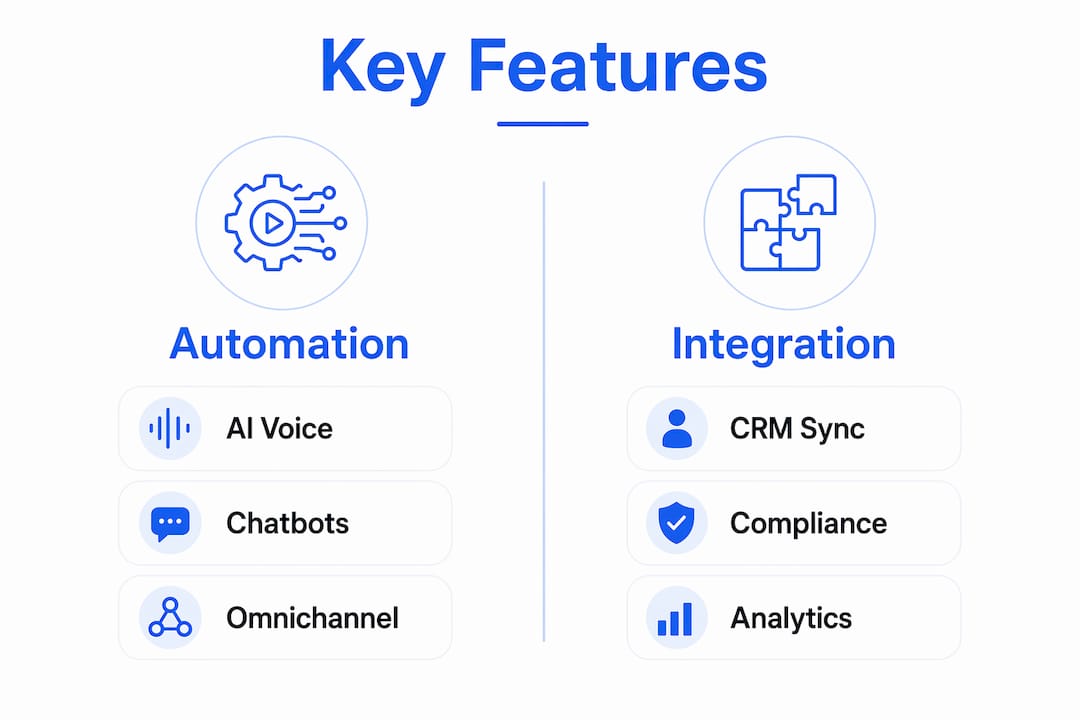
Evaluate vendors across five capability classes, not marketing bullet points.
Conversation quality: End-to-end latency under 600ms at the 95th percentile, interruption handling above 92%, and task completion approaching junior SDR levels. Anything slower degrades perceived quality fast.
Context and grounding: The platform must query your CRM, ERP, and contract engine in real time. LLMs that generate pricing answers from memory hallucinate; grounded lookups do not.
Orchestration: Warm handoffs to human reps, configurable routing rules, and fallback paths when the AI reaches its confidence threshold.
Omnichannel sequencing: Voice, SMS, email, and chat coordinated in one workflow. Explore types of lead generation automation to understand how inbound, outbound, and reactivation flows differ structurally.
Analytics: Closed-won revenue per dollar is the north star. Vanity metrics like dials per hour tell you nothing about pipeline impact.
Integration requirements: API-first CRM connectors, bi-directional sync, enrichment webhooks, and documented data-write guarantees.
Compliance: TCPA consent handling, SOC 2 controls, HIPAA readiness where protected health information may appear, audit logs, and role-based access controls.
Commercial checklist: Understand whether pricing is per-minute, per-conversation, or seat-plus-managed-services. Confirm SLA terms, scalability ceilings, and the vendor’s weekly optimization cadence.
| Capability class | What to compare |
|---|---|
| Entry-level field apps | Basic chatbot, limited CRM sync, no voice |
| Mid-market automation platforms | Omnichannel, moderate CRM depth, some analytics |
| Enterprise orchestration platforms | Full voice + chat, deep stack access, SOC 2, managed ops |
Pro Tip: Never accept a demo that only shows dials per hour. Require the vendor to show you a closed-won-per-dollar report from a live customer account.
How deployment models, timelines, and costs actually break down
Three deployment paths exist, each with different cost and time-to-value profiles.
Hosted SaaS (self-serve): Fastest to start, lowest up-front cost, but requires your team to configure integrations, build conversation flows, and manage iteration. Best for teams with RevOps bandwidth.
Managed deployment (done-for-you): The vendor handles onboarding, CRM schema mapping, conversation design, and ongoing optimization. Mediabloom operates this way, which compresses time-to-value significantly for teams without dedicated AI ops staff.
Custom stacks: Higher build cost, but unit economics improve at very high volume. Latency can reach sub-400ms with co-located inference, which matters for high-concurrency outbound.
Typical 30/60/90-day pilot milestones:
- Days 1–14: Data audit, CRM schema mapping, TCPA consent verification, and failure taxonomy definition.
- Days 15–30: Inbound speed-to-lead pilot live; baseline metrics collected (response time, meetings booked, show rate).
- Days 31–60: Meeting confirmation and reactivation sequences activated; first weekly conversation review completed.
- Days 61–90: Optimization cadence established; closed-won-per-dollar calculated against human SDR baseline.
Operational prerequisites before launch:
- Clean CRM data with verified contact fields
- Documented ICP and qualification criteria (see AI lead qualification criteria)
- Defined handoff triggers and escalation paths
- Observability stack: call recording, ASR accuracy monitoring, latency dashboards
Well-run AI voice deployments reduce cost per conversation substantially compared to human SDRs, which makes the managed-deployment fee recoverable quickly when volume is sufficient.
What integration and compliance checks can break a deployment?
Most proofs-of-concept fail in production, not in demos. 60% of AI voice agent failures trace back to the demo-to-production gap: latency increases 40–120% under concurrent load, and STT accuracy drops 10–25% in real call conditions.
Integration must-haves:
- Bi-directional CRM sync with field-level write guarantees
- Contract engine lookup for pricing and tier validation
- Billing system access for account status checks
- Identity mapping to prevent duplicate or misrouted records
Compliance checklist:
- TCPA: documented consent capture, opt-out processing, and call-time restrictions
- SOC 2 Type II attestation from the vendor
- HIPAA readiness if any protected health information may appear in conversations
- Audit logs with retention policy aligned to your legal requirements
- Role-based access controls for conversation data
Production stacks must stream ASR to LLM to TTS with an integration abstraction layer. Factual answers, such as pricing and contract tiers, must come from database lookups, not LLM generation. Target end-to-end latency under 600ms; above 800ms, call quality degrades noticeably.
Pro Tip: Ask every vendor for their p95 latency under concurrent load, not just their demo latency. Those two numbers are rarely the same.
What results should you realistically expect?
Companies report multiple-fold demo-to-show improvements when an AI voice agent qualifies inbound demo requests within 30 seconds and books meetings automatically. McKinsey documented a 90% decrease in resolution time for a CRM-integrated chatbot deployment, from 15 minutes to under one minute per interaction.
| KPI | Benchmark range |
|---|---|
| Inbound response time | Under 30 seconds (AI) vs. hours (human) |
| Demo-to-show improvement | 3–5x with AI qualification + confirmation |
| Cost per conversation reduction | 60% vs. human SDR |
| Multi-channel response rate | significantly higher response rates vs. email-only |
| STT accuracy drop under load | 10–25% (design SLAs accordingly) |
Mediabloom clients including Miracle Ear and 1-800 Accountant have reached large volumes of leads generated monthly. Variance drivers include data quality, ICP definition precision, handoff design, and how quickly the team iterates on conversation flows. AI productivity gains for agencies follow a similar pattern: results compound when the system is tuned weekly, not set-and-forgotten.
How to run demos and write RFPs that separate real from theater
Demo tests to run:
- Speed-to-lead: submit an inbound form and time the response in seconds.
- Multi-turn discovery: ask an account-specific question that requires a CRM lookup.
- Interruption handling: talk over the agent mid-sentence and observe recovery.
- Warm handoff: trigger an escalation and verify the human rep receives full context.
- Failure recovery: give a nonsensical input and check the fallback path.
RFP requirements to include:
- API call latency SLAs at p95 under concurrent load.
- Named integration adapters for your CRM (Salesforce, HubSpot, or equivalent).
- SOC 2 and TCPA compliance attestation documents.
- Production observability: call recording, latency dashboards, ASR accuracy logs.
- Weekly iteration cadence: who owns prompt updates and how fast they deploy.
Scoring rubric:
| Criterion | Weight |
|---|---|
| Integration depth | 30% |
| Conversation quality | 25% |
| Security and compliance | 15% |
| Support and ops cadence | 10% |
Red flags in demos: stateless answers to account-specific questions, vague “we integrate with everything” claims without named adapters, no observability dashboard, and model drift with no weekly review process.
Pro Tip: Run a blind 30-day pilot: give the AI the same inbound queue a human SDR handles and compare closed-won revenue per dollar at the end. That single comparison cuts through every marketing claim.
Key Takeaways
AI-powered automated customer response tools deliver measurable B2B pipeline results only when they combine deep CRM integration, omnichannel sequencing, and a weekly iteration cadence tied to closed-won-per-dollar ROI.
| Point | Details |
|---|---|
| Start with inbound speed-to-lead | The fastest, lowest-risk pilot: qualify demo requests in under 30 seconds and book meetings automatically. |
| Require deep stack access in demos | Any platform that cannot query your CRM and contract engine in real time will fail on account-specific questions. |
| Measure closed-won per dollar | Dials per hour is a vanity metric; revenue per dollar versus your human SDR baseline is the only number that matters. |
| Design for production from day one | Plan for 40–120% latency increases under load and 10–25% STT accuracy drops; build SLAs around those realities. |
| Mediabloom for managed deployment | Mediabloom’s done-for-you platform covers voice agents, chatbots, 600+ CRM integrations, and compliance, with clients reaching 10,000+ leads monthly. |
Why the conventional wisdom on AI adoption gets the order wrong
Most teams make the same mistake: they buy an AI platform and immediately try to automate the full outbound motion. That approach front-loads complexity and delays the proof point that earns internal buy-in.
The smarter sequence is the reverse. Start with inbound speed-to-lead and meeting confirmation. These are bounded workflows with clear success metrics and fast feedback loops. Once those are running and producing measurable lift, expand to reactivation sequences, then to full outbound. Each stage funds the next with demonstrated ROI.
Change management matters as much as the technology. Human-AI handoffs need explicit triggers: define exactly when the AI escalates, what context it passes, and how the rep picks up without starting over. Weekly playbook reviews, where the team reviews failed conversations and updates scripts, are what separate deployments that compound from ones that plateau. Improving sales team efficiency with AI follows this same incremental logic. The teams that win are the ones that treat AI as a capacity-multiplier for their best reps, not a replacement for the whole function.
Mediabloom gives B2B revenue teams a faster path to qualified pipeline
Mediabloom’s all-in-one platform covers every capability on the buyer checklist: AI voice agents (inbound and outbound), AI chatbots, omnichannel automation across voice, SMS, email, and chat, lead scoring, appointment booking, and 600+ CRM integrations. Compliance is built in: TCPA posture, SOC 2 controls, and HIPAA-ready configurations for regulated industries.
Clients like Miracle Ear and 1-800 Accountant have used Mediabloom to generate over 10,000 leads monthly. The platform is deployed as a managed service, meaning Mediabloom handles onboarding, CRM schema mapping, conversation design, and ongoing weekly optimization. You get production-ready results without building an internal AI ops team. Review the appointment setting case studies to see deployment timelines and outcomes across verticals, or explore the Fifth Avenue Leads case study for a detailed look at lead generation results. Ready to see it in action? Request a demo and get a pilot scoped to your CRM and ICP within days.
Useful sources
- AI Voice Agents for B2B Sales: How to Boost Conversion 36% While Cutting Cost 60% in 2026 — supports capacity-multiplier framing, disclosure best practice, and cost-per-conversation benchmarks.
- Why B2B Chatbots Fail and What Actually Works — explains stateless bot failure modes and the case for deep stack access.
- Why Your AI Voice Agent Demo Worked Perfectly But Production Failed — documents demo-to-production gap, latency degradation, and model drift data.
- AI Voice Agents for B2B Sales: 2026 Latency, Quality, and ROI Benchmarks — latency targets, interruption handling thresholds, and custom stack benchmarks.
- Lead Generation Appointment Setting Services: 2026 Guide — multi-channel vs. email-only response rate data.
- AI Voice Agent Challenges: 10 Real Problems and How to Solve Them — streaming architecture best practices and hallucination prevention.
- Five Ways B2B Sales Leaders Can Win with Tech and AI — McKinsey data on resolution time improvement and CRM-integrated chatbot outcomes.
- Mediabloom AI Appointment Setting Case Studies — client outcomes across verticals including Miracle Ear and 1-800 Accountant.
FAQ
What are the best automated customer response tools for B2B?
All-in-one platforms that combine AI voice agents, chatbots, omnichannel sequencing, and deep CRM integration outperform single-channel tools for B2B lead generation and appointment setting. Mediabloom is built specifically for this use case, with 600+ CRM integrations and a managed deployment model.
How fast should an AI voice agent respond to inbound leads?
Target under 30 seconds for inbound qualification. Companies report 3–5x demo-to-show improvements when an AI voice agent qualifies inbound demo requests within 30 seconds and books meetings automatically. End-to-end call latency should stay under 600ms to maintain natural conversation quality.
What compliance requirements apply to AI customer response tools in the US?
TCPA governs outbound call and text consent; SOC 2 Type II covers data security controls; HIPAA readiness applies when protected health information may appear in conversations. Verify each attestation before signing a contract.
Why do most AI chatbot deployments fail in B2B?
Stateless bots cannot access CRM records, contract tiers, or billing data, so they cannot answer the account-specific questions that gate B2B decisions. Deep stack integration is the fix.
How should you measure ROI from automated response tools?
Measure closed-won revenue per dollar spent versus your human SDR baseline. Dials per hour and conversation volume are activity metrics; only revenue-per-dollar tells you whether the platform is generating real pipeline.