AI customer service for small business means deploying intelligent automation, including chatbots, AI voice agents, and automated scheduling tools, to handle lead qualification, appointment booking, and routine customer inquiries without requiring a human agent for every interaction. The goal is not to replace your team. It is to make them faster, more available, and more effective.
Small businesses adopting these tools gain three immediate advantages:
- 24/7 availability: Leads that arrive at 11 PM get an instant response instead of a next-morning email they have already forgotten.
- Faster first response: Leads contacted within 5 minutes are 21 times more likely to convert than those reached after 30 minutes.
- Scalable lead qualification: AI screens prospects by need, urgency, and budget before a human ever picks up the phone.
The industry best practice is a hybrid AI-human model: AI handles volume and speed, humans handle nuance and closing. That balance is where trust and conversion rates hold.
Table of Contents
- How AI customer service benefits small businesses
- How to implement a hybrid AI-human model effectively
- What Mediabloom delivers for lead generation and scheduling
- Key success factors and challenges you need to know
- Mediabloom puts your lead pipeline on autopilot
- FAQ
- Key Takeaways
How AI customer service benefits small businesses
AI chatbots handle a majority of routine customer inquiries for small businesses, freeing staff for complex, high-value interactions. The operational impact compounds quickly.
Core benefits:
- Cost reduction: AI-powered chatbots cut customer service costs significantly after implementation.
- Higher satisfaction: Customer satisfaction scores improve notably when AI handles first-contact resolution, achieving high resolution rates for routine queries.
- Increased engagement: AI chatbots increase customer engagement substantially, which translates to measurable sales growth.
- After-hours lead capture: A significant portion of leads arrive after hours for businesses using chatbots, captured automatically instead of lost to a competitor.
- Conversion lift: Chatbots convert at a multiple higher than static forms by delivering value before asking for contact information.
High-impact use cases for lead generation and scheduling:
- Website chatbots that qualify visitors instantly and route hot leads for immediate human follow-up
- AI phone answering that captures caller intent, books callbacks, and escalates urgent requests
- Appointment booking automation that syncs with your calendar and confirms without staff involvement
- FAQ deflection that handles pricing, hours, and policy questions so your team focuses on revenue conversations
Expert guidance consistently points to hybrid deployment as the model that prevents trust erosion. AI handles the volume; humans handle the judgment calls.
Pro Tip: Treat lead qualification as a triage process. Route high-intent leads to a human within minutes. Enroll warm leads in automated nurture sequences. The two tracks run simultaneously and produce better long-term results than a single linear funnel.

How to implement a hybrid AI-human model effectively
Deployment works best when you define the boundary between AI and human responsibility before you configure anything. Here is a practical sequence:
1. Select tools grounded in your business data. Generic large language models hallucinate. An AI trained on your actual pricing pages, service descriptions, and FAQs gives accurate answers and builds visitor trust. Grounding your chatbot on verified company documents is the single highest-leverage configuration decision you can make.
2. Configure escalation paths before launch. Every AI deployment needs a clear handoff rule. Define triggers: high purchase intent, emotional language, pricing negotiations, or any request the AI cannot confidently answer. Transcript visibility and instant human notifications are non-negotiable features, not nice-to-haves.
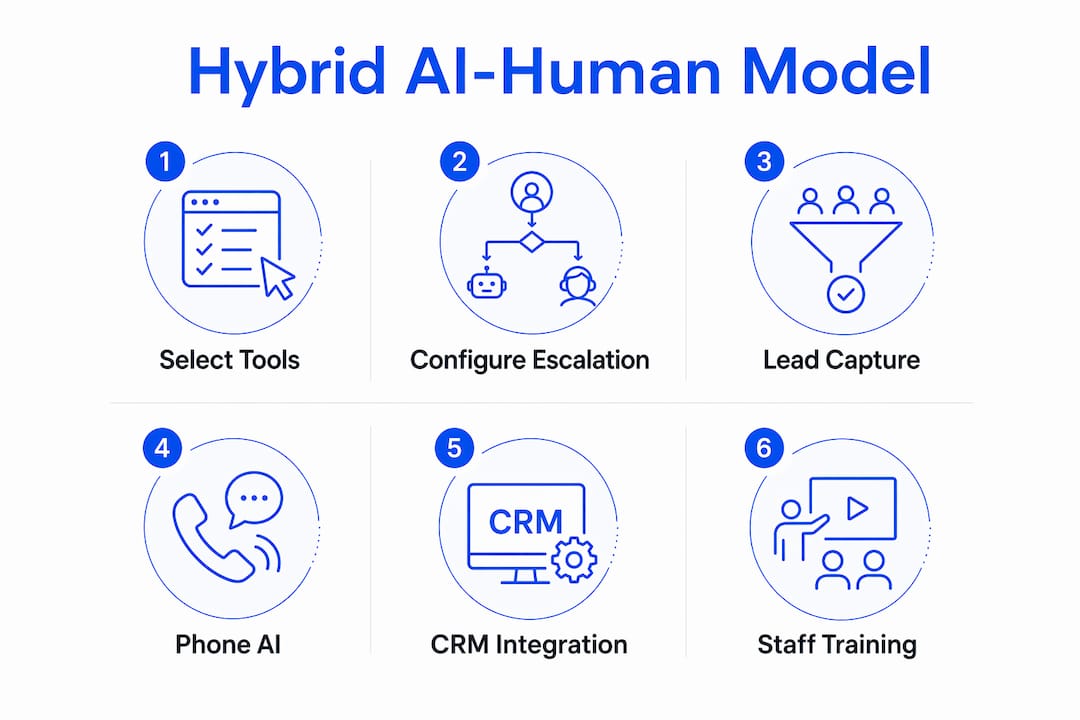
3. Apply progressive lead capture. Asking too many questions at once kills conversion. Capture only 3–5 qualifying questions in the first interaction. Returning visitors can provide additional detail in subsequent sessions, reducing abandonment while improving data quality. You can read more about structuring this in Mediabloom’s guide to chatbots in the sales pipeline.
4. Use narrow autonomy for phone AI. Unlike email, a phone call cannot wait for human approval. Phone-based AI agents should operate within a tight scope: answer, capture the request, book a callback, and escalate everything else. Broad autonomy on voice channels creates errors that damage trust fast.
5. Integrate with your CRM and communication stack. AI that does not write to your CRM creates data silos. Lead data, conversation transcripts, and qualification scores should flow automatically into your existing system. For a deeper look at AI integration challenges and how to avoid them, Mediabloom’s 2026 guide covers the most common failure points.
6. Train staff on the new workflow. Phased rollouts with staff training reduce resistance and improve oversight quality. Start with low-stakes channels like FAQ and after-hours coverage. Expand to phone and appointment booking once the team is comfortable reading AI transcripts and acting on escalations.
Pro Tip: For email, use draft-and-approve mode. The AI writes the reply; a human reviews and sends it. This maintains quality control without adding significant time, and it is the safest way to introduce AI into customer-facing email workflows.
What Mediabloom delivers for lead generation and scheduling
Mediabloom operates as an all-in-one platform combining AI voice agents, chatbots, and sales automation across SMS, email, and chat. Clients like Miracle Ear and 1-800 Accountant have used the platform to generate over 10,000 monthly leads. The architecture is built for the hybrid model: AI qualifies and books, humans close.
| Platform Capability | Business Impact |
|---|---|
| AI voice agents | Capture caller intent and book callbacks 24/7 |
| Omnichannel chatbots | Qualify leads across web, SMS, and email simultaneously |
| Appointment booking automation | Reduce no-shows and eliminate manual scheduling |
| CRM integration | Sync lead data and transcripts to existing workflows |
| Rapid response engine | Sub-second first response to inbound inquiries |
Mediabloom’s clients report consistent lead volume growth without proportional increases in headcount. The platform’s AI chatbot solutions are purpose-built for businesses that need qualification and booking automation without building a custom tech stack.
Over 10,000 monthly leads generated for clients including Miracle Ear and 1-800 Accountant using Mediabloom’s omnichannel AI platform.
Key success factors and challenges you need to know
61% of small businesses have adopted at least one AI tool, and businesses using AI report an average 3.8x return on investment. But deployment quality determines whether you land in that group or the one that churns out after 90 days.
Success factors:
- Clear policy documentation so the AI answers accurately and consistently
- Defined escalation paths with instant human notification for hot leads
- Staff buy-in built through phased rollouts, not forced adoption
- ROI tracking tied to lead volume, conversion rate, and cost per lead
Common challenges:
- Over-automation: Removing humans too early from complex interactions erodes trust and drops conversion. The hybrid model exists precisely to prevent this.
- Data privacy compliance: Chatbots collecting personal information must comply with applicable U.S. privacy regulations. Clear consent language, limited data collection, and opt-out mechanisms are required, not optional. Review your state’s requirements alongside federal standards before launch.
- Integration friction: AI tools that do not connect to your CRM create manual work that offsets the efficiency gains. Prioritize platforms with native integrations or documented API access.
Measuring performance: Track chatbot engagement rate, lead capture rate, qualification rate, human handoff rate, and cost per lead weekly. Small adjustments to welcome messages and qualification flows produce measurable conversion improvements. For AI lead qualification frameworks that tie these metrics to revenue outcomes, structured scoring models give your team a consistent basis for prioritizing follow-up.
Pro Tip: Start your rollout with FAQ deflection and after-hours coverage. These are low-risk, high-volume channels where AI performs reliably and staff can build confidence reviewing transcripts before the system handles more complex interactions.
Mediabloom puts your lead pipeline on autopilot
Most small businesses lose qualified leads to slow response times and after-hours gaps, not to competitors with bigger budgets. Mediabloom closes both gaps with a platform that qualifies leads, books appointments, and escalates high-intent prospects to your team, all without adding headcount.
Where other approaches require stitching together separate tools for chat, voice, and CRM, Mediabloom delivers a single system with omnichannel coverage from day one. Clients like Miracle Ear have scaled past 10,000 monthly leads on this infrastructure. The Fifth Avenue Leads case study shows exactly how the platform performs under real lead volume conditions. Ready to see it in action? Watch the AI voice agent demo and book a call with the Mediabloom team.
FAQ
What is AI customer service for small businesses?
It is the use of chatbots, AI voice agents, and automation tools to handle lead qualification, appointment booking, and routine inquiries without requiring a human agent for every interaction. The most effective deployments pair AI with human oversight.
How much do AI chatbots reduce customer service costs?
AI-powered chatbots cut customer service costs significantly after implementation and handle a majority of routine customer inquiries automatically.
What is the hybrid AI-human model?
It is a deployment approach where AI handles high-volume, routine tasks like FAQ responses and appointment booking, while human agents manage complex, emotional, or high-value interactions. This model protects conversion rates and customer trust.
How does Mediabloom support small business lead generation?
Mediabloom combines AI voice agents, chatbots, and sales automation in one platform, generating over 10,000 monthly leads for clients across multiple industries. The system qualifies leads, books appointments, and routes hot prospects to human agents automatically.
What data privacy rules apply to AI chatbots in the U.S.?
Businesses must provide clear consent language, limit data collection to what is necessary, and offer opt-out mechanisms. Requirements vary by state, so review both federal standards and applicable state privacy laws before deploying a lead capture chatbot.
Key Takeaways
AI customer service for small business delivers the strongest results when AI handles volume and speed while humans manage judgment and closing, a model that drives measurable gains in lead conversion, response time, and cost efficiency.
| Point | Details |
|---|---|
| Hybrid model is the standard | AI handles routine tasks; humans manage complex cases to protect trust and conversion rates. |
| Response speed drives conversion | Leads contacted within 5 minutes convert 21 times better than those reached after 30 minutes. |
| Chatbots cut costs and lift CSAT | AI reduces customer service costs significantly after implementation and improves satisfaction scores notably on average. |
| Privacy compliance is mandatory | U.S. deployments require clear consent, limited data collection, and opt-out options before launch. |
| Mediabloom unifies the stack | Mediabloom’s omnichannel platform combines voice agents, chatbots, and CRM integration to generate 10,000+ monthly leads for clients. |