
AI-powered outreach automation is the practice of using artificial intelligence to handle every step of prospect outreach, from researching leads to writing personalized messages, optimizing send timing, and sequencing follow-ups. The industry term for this practice is intelligent outreach automation, though “AI-powered outreach automation” is the phrase most sales and marketing professionals use when searching for solutions. AI automates and enhances every stage from research to follow-up, replacing hours of manual work with systems that act on data in real time. Adoption is accelerating fast. Sales teams that once spent half their day on prospecting tasks now deploy AI to handle that work at scale, freeing reps to focus on conversations that close deals. Understanding what this technology does, and where it falls short, is the starting point for any team serious about outreach efficiency in 2026.
What is AI-powered outreach automation?
AI-powered outreach automation is a system where artificial intelligence performs the research, writing, timing, and follow-up tasks that sales reps traditionally do by hand. The core difference from older automation tools is intelligence. Traditional tools send pre-written emails on a schedule. AI tools analyze prospect data, generate personalized messages, and adapt sequences based on how prospects respond.

Intelligent outreach workflows unify prospecting, research, messaging, and follow-up into a single system that mirrors what top-performing reps do, then scales that behavior across an entire team. That means a five-person sales team can execute outreach at the volume and quality of a team three times its size.
The technology draws on natural language processing to write messages, machine learning to predict optimal send times, and intent data analysis to rank leads by likelihood to convert. Mediabloom, for example, integrates AI voice agents, chatbots, and sales automation into one platform that manages prospect interactions across SMS, email, and chat simultaneously. Companies like Miracle Ear and 1-800 Accountant have used this approach to generate over 10,000 monthly leads.
How does AI-powered outreach automation work step by step?
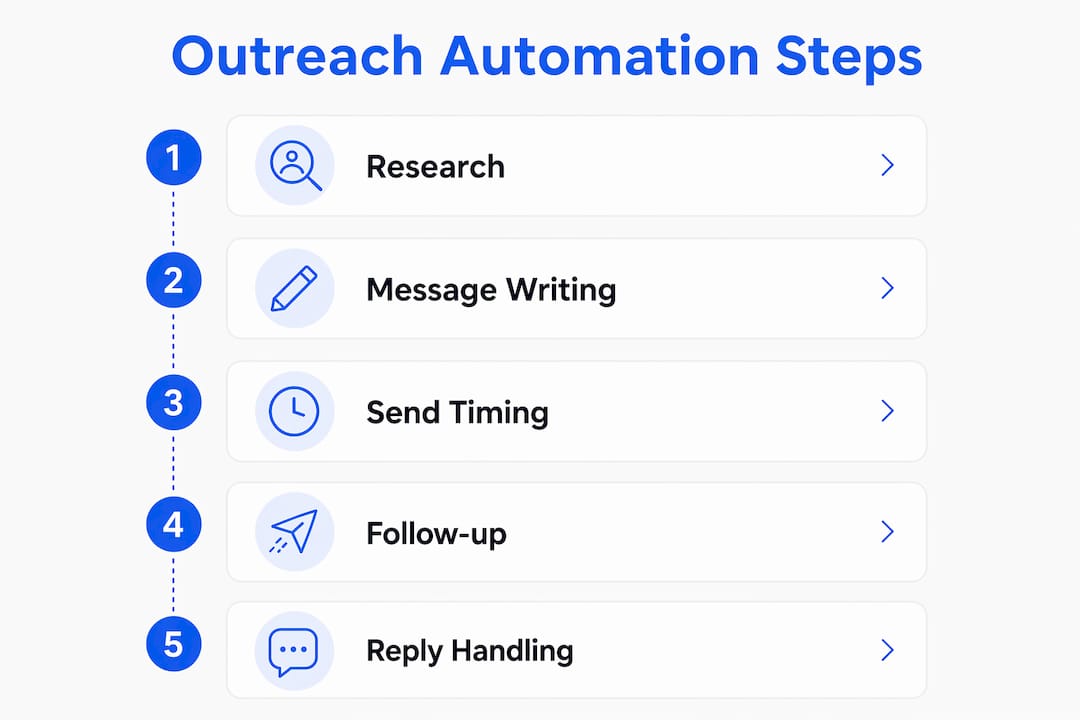
The workflow breaks into five distinct stages. Each stage builds on the last, creating a feedback loop that gets sharper with every campaign.
-
Lead research and enrichment. AI scans data sources to build detailed prospect profiles. It pulls job titles, company size, recent news, technology usage, and behavioral signals. This process takes seconds per lead instead of the 15–20 minutes a rep would spend manually.
-
Personalized message generation. AI uses the enriched profile to write opening lines, subject lines, and full email copy tailored to each prospect. The message references specific details, such as a recent funding round or a product launch, that make it feel written by a human who did their homework.
-
Timing and sequence optimization. AI analyzes historical engagement data to determine when each prospect is most likely to open and reply. It schedules sends accordingly and spaces follow-ups based on prospect behavior, not a fixed calendar.
-
Reply classification and routing. When a prospect responds, AI reads the reply and classifies it: interested, not interested, out of office, or needs more information. Interested replies route immediately to a rep. Others trigger the appropriate automated response or pause the sequence.
-
Adaptive follow-up. AI platforms prioritize leads and adjust outreach based on real-time prospect responses. A prospect who opens three emails but never replies gets a different follow-up than one who clicked a link and visited the pricing page.
Pro Tip: Keep a human in the loop at the reply classification stage. AI reads intent well, but a rep reviewing borderline replies catches nuance that prevents a warm lead from being marked as uninterested.
The human-in-the-loop model is not a workaround. It is the design. AI augments specific tasks but requires human judgment for targeting decisions and actual sales conversations. The best teams treat AI as a research and writing assistant, not an autonomous sales rep.
What are the main benefits of AI outreach automation for sales teams?
The outreach campaign automation benefits fall into five clear categories, each with a direct impact on pipeline and revenue.
-
Speed at scale. AI processes hundreds of leads simultaneously. A rep who manually researches and writes 20 personalized emails per day can, with AI assistance, send 200 without sacrificing message quality.
-
Deeper personalization. Modern buyers expect personalization at a level that manual outreach cannot sustain. AI enables that depth across every contact in a list, not just the top 10 accounts a rep has time to research.
-
Higher reply rates. Personalized, well-timed messages outperform generic blasts. When AI matches message content to prospect context and sends at the right moment, reply rates climb.
-
Better lead prioritization. AI reads intent signals, such as website visits, content downloads, and job change alerts, to rank leads by buying readiness. Reps spend their time on prospects most likely to convert, not whoever is next on a spreadsheet.
-
Reduced manual workload. Prospect research, data entry, follow-up scheduling, and reply sorting are time sinks. AI handles all of them, cutting the administrative burden that keeps reps from selling.
The efficiency gain is not just about volume. It is about quality. AI enables personalization at scale without requiring additional headcount, which means growing teams can expand their outreach without proportionally growing their payroll. For marketing teams running outreach campaigns, the same principle applies: more contacts reached, more consistently, with messages that actually reflect what each prospect cares about.
What are the challenges and best practices for adopting AI outreach automation?
The biggest mistake teams make is deploying AI to run full campaigns autonomously from day one. End-to-end autonomous AI outreach frequently produces high-volume, low-quality messaging that damages sender reputation and books near-zero meetings. The technology is not ready to replace human judgment across an entire campaign. It is ready to replace human effort on specific tasks within a campaign.
Best practices that actually work:
-
Layer AI on top of proven infrastructure. The most effective adoption model uses AI for research and personalization while relying on established outreach platforms for deliverability and sequencing. Do not rebuild your entire stack. Add AI where it creates the most lift.
-
Protect sender reputation. High-volume AI outreach can trigger spam filters if not managed carefully. Warm up new sending domains, monitor bounce rates, and keep daily send volumes within safe limits for each domain.
-
Test before scaling. Run AI-generated messages against human-written controls on a small segment first. Measure open rates, reply rates, and meeting bookings. Scale only what the data confirms is working.
-
Audit AI outputs regularly. AI-generated copy can drift toward generic phrasing over time. A monthly review of message samples catches quality issues before they affect campaign performance.
-
Match AI features to specific tasks. AI works best for research, personalization, reply classification, and list enrichment. It works poorly as a fully autonomous sales agent. Choose tools based on the specific task you need to improve, not the broadest feature set.
Pro Tip: When evaluating AI outreach tools, ask vendors for reply rate benchmarks from accounts similar to yours in size and industry. Generic benchmarks hide the variance that matters for your specific use case.
The teams that get the most from AI outreach treat it as an intent-based lead generation system. They feed it quality signals, review its outputs, and refine the process based on results. That iterative approach compounds over time.
How does AI outreach automation compare to traditional outreach tools?
Traditional sales automation handles mechanics. AI automation handles intelligence. That distinction determines everything about how each approach performs.
Traditional tools execute tasks on a fixed schedule: send email on day one, send follow-up on day four, send final email on day eight. The content is static. The timing is fixed. The system does not know or care whether the prospect opened the first email, visited the pricing page, or just changed jobs.
AI automation reads all of those signals and acts on them. A prospect who opened the first email twice but did not reply gets a follow-up that references the email’s topic and adds new information. A prospect who visited the pricing page gets a message that addresses common objections at that stage of the buying process. Traditional automation handles repetitive tasks; AI automation adds intelligence to research, messaging, and prioritization, adapting strategy in real time.
| Feature | Traditional automation | AI-powered automation |
|---|---|---|
| Message content | Static, pre-written templates | Dynamically generated per prospect |
| Send timing | Fixed schedule | Optimized by engagement data |
| Lead prioritization | Manual or rule-based | Intent signal analysis in real time |
| Follow-up logic | Linear sequence | Adaptive based on prospect behavior |
| Personalization depth | Merge fields (name, company) | Context-specific references and copy |
| Learning capability | None | Improves with campaign data over time |
The practical implication is that AI-powered tools do not just do more. They do different work. Traditional tools automate the when and who of outreach. AI tools automate the what and why, which is where conversion happens. For teams exploring AI-driven sales integration, the shift from mechanical to intelligent automation is the defining upgrade of 2026.
Key takeaways
AI-powered outreach automation delivers the highest results when AI handles specific tasks like research, personalization, and reply classification, while human judgment guides targeting, strategy, and sales conversations.
| Point | Details |
|---|---|
| AI automates intelligence, not just mechanics | AI writes, times, and adapts messages based on prospect data, not fixed templates. |
| Human oversight is non-negotiable | Fully autonomous AI outreach damages sender reputation and produces poor meeting rates. |
| Layer AI on proven infrastructure | Add AI for research and personalization on top of existing platforms handling deliverability. |
| Personalization at scale is the core benefit | AI enables message depth across hundreds of prospects without adding headcount. |
| Intent signals drive lead prioritization | AI ranks leads by real-time behavioral data, so reps focus on the most ready buyers. |
Mediabloom’s perspective on AI outreach in 2026
The conversation around AI outreach has a recurring blind spot. Most teams ask, “How do we automate more?” The better question is, “Where does AI create the most leverage for our specific team?”
Working with companies across industries, the pattern is consistent. Teams that deploy AI across their entire outreach workflow at once see mixed results. Teams that identify two or three high-friction tasks, such as prospect research, opening line generation, or reply sorting, and apply AI precisely to those tasks, see measurable gains within the first 30 days.
The reason is simple. AI performs best when it has a clear, bounded task and quality data to work with. Prospect research is bounded. Writing a personalized first line based on a LinkedIn profile is bounded. Running an entire sales conversation autonomously is not bounded, and the results reflect that.
The future of outreach is not AI replacing sales reps. It is AI handling the work that keeps reps from selling. Research, writing, scheduling, sorting. When those tasks are automated well, reps spend their time on the conversations that actually require human judgment: understanding a prospect’s real problem, navigating objections, and building the trust that closes a deal.
For teams starting this transition, the advice is practical. Pick one task. Automate it well. Measure the result. Then expand. That approach compounds faster than any full-stack deployment, and it builds the internal knowledge to use AI effectively as the technology continues to advance.
— Mediabloom
How Mediabloom’s AI platform accelerates outreach results
Mediabloom builds AI systems that handle the full outreach and appointment-setting workflow, from first contact to booked meeting, across email, SMS, chat, and voice.
The platform integrates AI voice agents, chatbots, and cold outbound campaigns into a single system that qualifies leads and books appointments without manual intervention at each step. Miracle Ear and 1-800 Accountant both run on this infrastructure, generating over 10,000 monthly leads combined. The Fifth Avenue Leads case study shows exactly how that pipeline scales in practice. If your team is ready to move from manual outreach to a system that runs at scale, Mediabloom’s team is available to walk you through a build tailored to your sales process.
FAQ
What is AI-powered outreach automation in simple terms?
AI-powered outreach automation uses artificial intelligence to research prospects, write personalized messages, optimize send timing, and manage follow-ups automatically. It replaces manual prospecting tasks with systems that act on real-time data.
How does AI outreach automation differ from email marketing automation?
Email marketing automation sends pre-built sequences to large lists on a fixed schedule. AI outreach automation generates personalized messages per prospect, adapts follow-ups based on behavior, and prioritizes leads using intent signals.
What tasks should AI handle in an outreach campaign?
AI works best for prospect research, personalized opening lines, reply classification, and list enrichment. Human judgment remains necessary for targeting strategy, sales conversations, and final message review.
Can AI outreach automation hurt sender reputation?
Yes. High-volume autonomous AI outreach frequently triggers spam filters and damages domain reputation. Controlled send volumes, domain warm-up, and human oversight prevent this outcome.
What results can teams expect from AI outreach automation?
Results vary by implementation quality, but teams using AI for research and personalization consistently report higher reply rates and faster pipeline growth compared to static template-based outreach.


