

Gartner forecasts that conversational AI will slash contact center labor costs by $80 billion in 2026 alone. This massive shift isn't happening because of simple, scripted buttons; it's being driven by sophisticated systems that actually understand human intent. If you're still relying on basic logic trees, you're likely losing leads to slow response times and clunky user experiences. Understanding the nuances of chatbot vs conversational ai is no longer a technical curiosity. It's a strategic necessity for any enterprise looking to build a scalable, autonomous sales workforce.
You probably already know that traditional bots often fail when a conversation veers off-script. We'll show you how to move beyond these limitations to build a high-performance revenue engine that delivers human-parity communication at a fraction of the cost. This guide breaks down the technical architecture and strategic logic required to integrate intent-driven AI directly into your CRM. Discover how to transform your digital infrastructure from a passive FAQ tool into an execution layer that facilitates decisions and closes deals.
Key Takeaways
- Distinguish between rigid, rule-based digital decision trees and dynamic conversational AI systems powered by Natural Language Understanding (NLU).
- Analyze how machine learning creates a self-optimizing intelligence layer that improves communication accuracy with every customer interaction.
- Evaluate the total cost of ownership and long-term scalability when comparing a chatbot vs conversational ai to ensure your infrastructure supports rapid revenue growth.
- Audit your current communication volume to map specific technology choices to critical business outcomes like lead qualification and CRM synchronization.
- Architect a high-performance autonomous sales workforce by leveraging AI voice agents and custom automations to achieve human-parity communication.
Decoding the Interface: Chatbot vs. Conversational AI in 2026
The 2026 business landscape demands more than just a digital answering machine. It requires a high-performance execution layer. While many leaders use the terms interchangeably, the distinction between a chatbot vs conversational ai is the difference between a static blueprint and a self-evolving skyscraper. One follows a rigid, linear path; the other navigates the complexities of human intent to drive measurable growth. Understanding this gap is critical for architecting a scalable revenue engine that functions without constant human intervention.
To understand the evolution of these systems, we must first look at the foundational definition of what is a chatbot. Historically, these tools served as the first line of defense in customer service, but their architecture is fundamentally limited. Modern enterprises are now pivoting toward conversational AI to build autonomous revenue operations that don't just talk, but execute. This shift represents the transition from simple software to a sophisticated workforce.
To better understand this concept, watch this helpful video:
The Legacy of Rule-Based Chatbots
Traditional chatbots function as digital decision trees. They rely on "if-then" logic to route users through pre-defined scripts. If a customer uses a specific keyword, the bot triggers a specific response. When evaluating chatbot vs conversational ai, the limitations of the former become clear in high-stakes environments. This rigid framework lacks the cognitive flexibility needed for modern sales. When a prospect deviates from the script, the engine stalls. This leads to user frustration, high drop-off rates, and lost revenue opportunities. These legacy systems are often expensive to maintain and impossible to scale because every new scenario requires a manual update to the code.
The Rise of Intent-Driven Conversational AI
Conversational AI represents a fundamental shift in digital architecture. It synthesizes Natural Language Understanding (NLU), Large Language Models (LLMs), and machine learning to create a fluid interaction layer. Instead of matching keywords, these systems perform deep intent recognition. They understand "why" a user is asking a question, not just "what" they typed. By June 2026, the industry has moved beyond simple Q&A. The focus is now on outcome-oriented dialogue that connects user intent directly to business workflows.
Frontier models allow these agents to generate human-parity responses in real-time. They don't just follow a path; they build it as the conversation unfolds. This intelligence allows for seamless CRM integration and complex problem-solving that traditional bots simply cannot replicate. Businesses seeking to stay competitive are moving toward advanced AI solutions that function as autonomous members of their sales team. This is the foundation of a modern, scalable revenue engine.
The Technical Engine: NLU, LLMs, and the Anatomy of Intelligence
The core of the chatbot vs conversational ai debate lies within the underlying architecture. Legacy bots are typically stateless, meaning they treat every interaction as an isolated event. Modern conversational AI is powered by a sophisticated stack designed for deep comprehension. Natural Language Understanding (NLU) serves as the foundational brain of this system. It doesn't just parse text; it extracts intent, entities, and sentiment from every user input. This allows the engine to move past simple keyword matching toward true comprehension of human needs.
Machine learning adds a layer of continuous optimization. Every interaction feeds back into the model, allowing the AI to refine its accuracy over time. It identifies patterns that lead to successful conversions and flags friction points that cause drop-offs. By analyzing the capabilities and limitations of chatbots from previous generations, technical architects can build systems that don't just respond but evolve. This self-optimizing nature is what transforms a communication tool into a high-performance revenue engine.
Brand safety and compliance require a balance between fluid generation and deterministic logic. You cannot allow an AI to hallucinate pricing or deviate from regulatory requirements like the California Companion Chatbot Law. Deterministic logic acts as a set of guardrails. It ensures that high-risk responses remain within pre-approved parameters while the AI manages the nuance of the conversation. This hybrid approach guarantees that your automated workforce remains professional, accurate, and legally compliant at all times.
Contextual Memory and Multi-Turn Logic
Context is the currency of high-value sales. A stateful AI agent maintains contextual memory across different sessions and channels. It remembers that a user asked about integration requirements three days ago and can reference those specific details today. This multi-turn logic allows the system to handle interruptions and topic shifts without losing the primary sales objective. It mirrors the way a human sales professional tracks a prospect's journey, ensuring the dialogue always moves toward a logical conclusion.
Integrating LLMs for Natural Fluency
Large Language Models (LLMs) provide the natural fluency required for human-parity communication. We've moved beyond the era of pre-written templates and rigid scripts. Modern systems use real-time synthesis to maintain a consistent corporate tone while providing personalized answers. This technical bridge transforms raw CRM data into persuasive communication. It ensures your brand voice is never compromised by robotic phrasing or irrelevant answers. If you're ready to upgrade your digital infrastructure, you can speak with a strategic architect to map out your custom deployment.
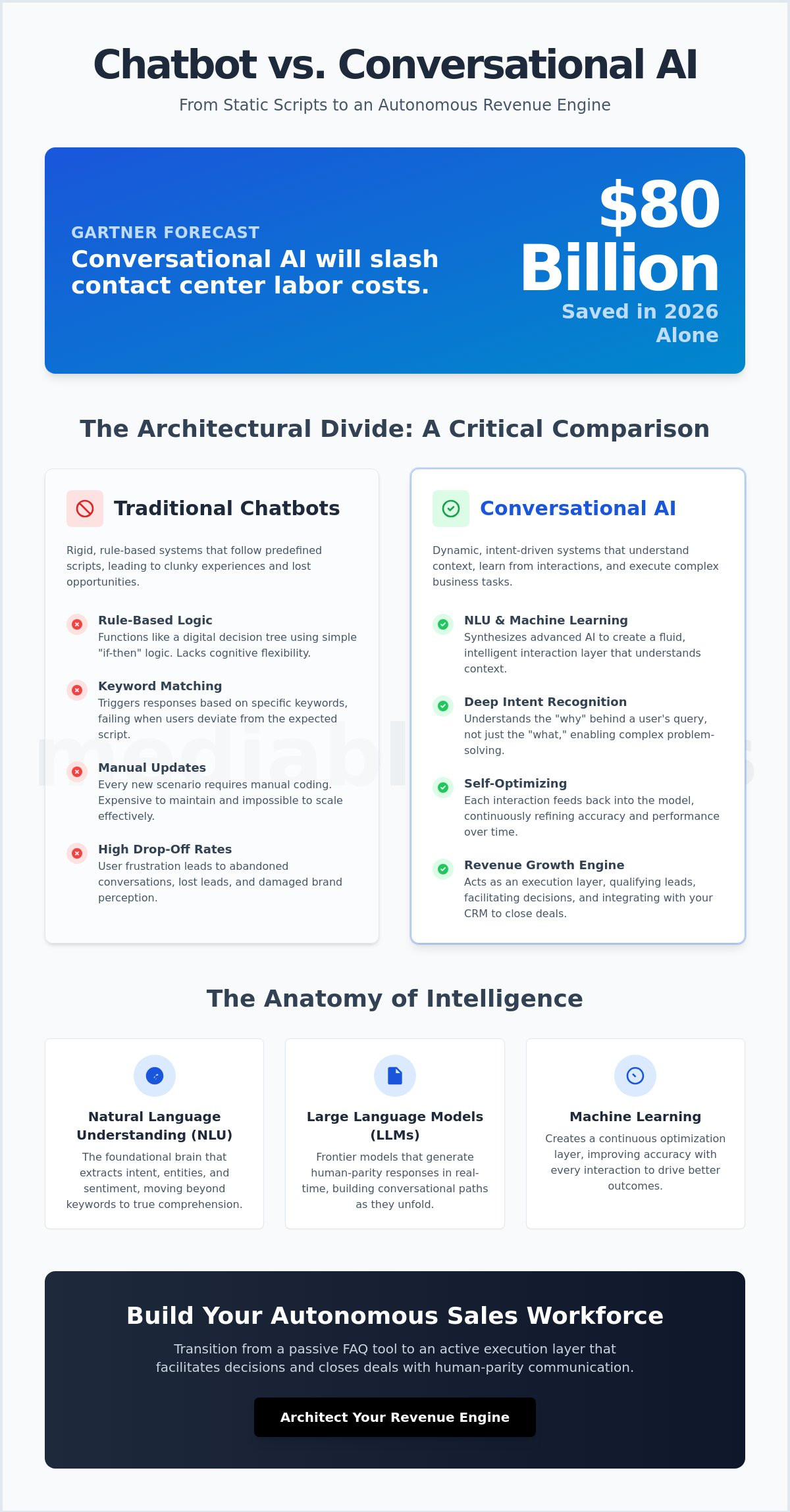
Critical Comparison: Scripted Responses vs. Dynamic Problem Solving
Choosing between a chatbot vs conversational ai is a strategic decision that dictates the trajectory of your revenue operations. While traditional chatbots offer a low barrier to entry, their long-term Total Cost of Ownership (TCO) often exceeds their initial value. Every update to your product line or service logic requires manual script revisions. This creates a maintenance bottleneck that drains internal resources. Conversational AI functions as a self-correcting system. It requires a more intensive initial architectural setup but offers infinite scalability without the need for constant human oversight.
The most glaring difference appears during error handling. A legacy bot hits a wall when a user's phrasing deviates from pre-programmed keywords. The resulting "I don't understand" loop is a conversion killer. Proactive problem solving is the hallmark of intent-driven AI. Instead of failing, these systems use reasoning to clarify user needs and provide relevant solutions. This capability ensures that the dialogue remains productive, moving the prospect closer to a transaction rather than a dead end. It transforms a simple interaction into a sophisticated sales consultation.
Scalability and Operational Efficiency
Operational excellence requires a system that handles growth without a linear increase in headcount. Conversational AI is the primary driver behind the massive reduction in contact center labor costs projected for 2026. It effectively replaces high-cost, human-operated BPO services with a digital workforce capable of managing thousands of simultaneous inquiries. Unlike scripted bots that grow more fragile as complexity increases, AI agents become more robust over time. They integrate directly with your CRM to automate lead qualification and nurture sequences, ensuring your sales pipeline remains full at a fraction of the traditional cost.
User Experience and Brand Perception
Your communication interface is often the first touchpoint for a potential client. Interacting with a fluid, intelligent agent builds immediate brand authority and trust. It signals that your organization values the customer's time and is at the forefront of technical innovation. Reducing friction through instant, accurate answers improves the overall psychological experience of the buyer journey. You can see the tangible impact of this architecture by reviewing MediaBloom case studies, where autonomous systems have transformed standard interactions into high-performance revenue engines. Seamlessly integrating these tools into your stack doesn't just improve efficiency; it redefines your brand's competitive edge.
Choosing the Right Architect for Your Revenue Engine
Audit your communication infrastructure before committing to a technical stack. It's not just about volume; it's about the complexity of the intent you handle daily. If your organization manages hundreds of interactions across Web, Email, SMS, and Voice, a fragmented approach is a liability. You need a unified execution layer. When evaluating the chatbot vs conversational ai dilemma, the goal isn't just to answer questions. It's to drive revenue. High-performance organizations map their technology choices directly to growth targets, such as reducing lead response times to under 60 seconds.
Adopting these systems is no longer a luxury for the distant future. Gartner forecasts that conversational AI will reduce contact center labor costs by $80 billion in 2026. With 80% of businesses planning to integrate AI voice technology by the end of the year, waiting to upgrade is a calculated risk you can't afford. You must architect a system that scales autonomously while maintaining the precision required for enterprise-level operations.
Identifying Your Business Complexity
Simple chatbots can be detrimental to your sales funnel. They often trap high-value prospects in dead-end logic loops, creating friction that erodes brand authority. Investing in custom AI logic provides a significantly higher ROI because it adapts to the user's specific context rather than forcing them into a rigid script. The complexity threshold for AI adoption is crossed the moment your business requires dynamic reasoning to qualify a lead or execute a multi-step workflow. If your sales process involves more than three qualifying questions, a basic bot will likely fail your prospects.
Integrating AI into CRM Workflows
Effective automation requires seamless data flow. Conversational AI doesn't just talk; it listens, analyzes, and records. It feeds high-quality, structured data directly into your CRM, ensuring your human sales team has the intelligence they need to close deals. By utilizing MediaBloom solutions, you can architect frameworks that automate the entire transition from an initial chat interaction to a booked meeting on a calendar. This eliminates manual entry errors and ensures no lead is left to go cold. If you're ready to build a scalable, autonomous workforce, connect with our team today to start your architectural audit.
Beyond the Bot: MediaBloom’s Autonomous Sales Workforce
The transition from a basic chatbot vs conversational ai culminates in a single, definitive objective: the creation of a fully autonomous sales workforce. MediaBloom does not just deploy software. We architect complex revenue engines that function as the central nervous system of your business. This infrastructure integrates every touchpoint of the customer journey into a singular, high-velocity system. By moving beyond text-based interfaces, we empower enterprises to deploy intelligence that thinks, speaks, and executes with absolute precision.
Modern revenue operations require a strategic architect to build the foundation for long-term scalability. We specialize in synthesizing advanced AI logic with existing business systems to ensure your digital workforce is an asset, not a liability. This approach transforms communication from a cost center into a high-performance engine that generates consistent, predictable growth. It is the final step in moving from reactive support to proactive market dominance.
AI Voice Agents and Human-Parity Interaction
AI voice agents represent the pinnacle of conversational AI technology in 2026. We have broken the robotic barrier by utilizing advanced vocal synthesis that delivers human-parity interaction in real-time. These agents manage both high-volume cold calling and complex inbound lead qualification without the fatigue or overhead of a traditional call center. They navigate nuances, handle objections, and maintain a consistent corporate tone across every call. For a deeper technical analysis of this infrastructure, consult our Definitive Guide to AI Voice Agents. This technology ensures your brand is represented with technical mastery at every point of contact.
Architecting the Future of Lead Nurturing
True efficiency is found in the synergy between automated lead nurturing and intelligent interaction. MediaBloom combines elite ad management with autonomous AI follow-up to create a sales machine that never sleeps. While your competitors lose leads to slow response times, our systems engage prospects instantly across SMS, email, and voice. This multi-channel approach ensures that your CRM is constantly populated with high-intent, pre-qualified opportunities. We build the systems that allow your human closers to focus entirely on high-value strategy while the AI manages the repetitive heavy lifting. It's time to see the technical engine in motion. Watch a demo of our AI in action to witness the future of autonomous revenue operations.
Build Your High-Performance Execution Layer
The strategic choice between a chatbot vs conversational ai determines the ultimate velocity of your sales pipeline. Legacy scripted bots are rapidly becoming operational liabilities. They lack the intent-driven reasoning required for complex revenue operations in 2026. True conversational AI functions as a self-optimizing engine that understands the "why" behind every user interaction. This intelligence is the foundational layer of a scalable, autonomous workforce that drives growth without increasing headcount.
MediaBloom provides the technical blueprint for this transformation. We deliver human-parity AI voice and chat technology designed to synchronize perfectly with your CRM and lead nurturing workflows. Our frameworks offer proven ROI in high-growth sales pipelines by eliminating manual friction and capturing every opportunity. Stop managing fragmented tools and start architecting a unified revenue engine that executes with precision. Architect Your Autonomous Revenue Engine Today and secure your competitive edge. The future of business communication is autonomous; it's time to lead the shift.
Frequently Asked Questions
What is the main difference between a chatbot and conversational AI?
The fundamental difference lies in the underlying decision-making architecture. Traditional chatbots operate on rigid logic trees and pre-defined scripts. Conversational AI utilizes Natural Language Understanding (NLU) to interpret human intent. This allows the system to manage fluid, non-linear dialogues that mirror actual human reasoning rather than just matching keywords.
Can a chatbot be considered conversational AI?
No, these technologies represent distinct generations of digital infrastructure. A chatbot is a static tool for simple task automation. Conversational AI is a dynamic intelligence layer. When analyzing a chatbot vs conversational ai, think of the former as a static script and the latter as a trained agent capable of real-time synthesis and autonomous problem solving.
Is conversational AI more expensive to implement than a standard chatbot?
Implementation requires a higher initial investment in custom logic and system architecture. However, the long-term total cost of ownership is significantly lower. AI agents scale without a linear increase in maintenance or human oversight. They eliminate the recurring costs associated with manual script updates and the high turnover rates of human-operated services.
How does conversational AI improve lead qualification in sales?
It automates the extraction of high-value data from every interaction. Instead of asking basic questions, the AI parses complex responses to identify budget, authority, and timeline. It then categorizes leads in your CRM with absolute precision. This ensures your human sales team only focuses on prospects with the highest probability of closing.
Does conversational AI require a human to monitor every interaction?
Modern systems are designed for full autonomy. They operate as an independent execution layer that handles thousands of concurrent interactions without fatigue. Human intervention is only necessary during the initial architectural setup or when the system identifies an edge case that falls outside of its deterministic guardrails. This allows your workforce to scale rapidly.
Can conversational AI integrate with my existing CRM like Salesforce or HubSpot?
Seamless integration with enterprise CRMs like Salesforce and HubSpot is a foundational requirement. The AI acts as a data bridge, recording interactions and updating lead statuses in real-time. This creates a unified record of the buyer journey. It ensures that your revenue operations remain synchronized across all digital channels without manual data entry.
What industries benefit most from conversational AI over simple chatbots?
Sectors with high inquiry volume and complex sales cycles see the greatest impact. Real estate, financial services, healthcare, and enterprise SaaS are prime examples. These industries require deep intent recognition and rapid response times. Conversational AI outperforms simple bots by managing the technical nuances and regulatory compliance specific to these high-stakes fields.
How do I know if my business is ready for conversational AI?
Your business is ready if your current communication volume causes lead leakage or if your sales process requires dynamic reasoning. If you find that scripted bots are frustrating users or failing to qualify leads accurately, it is time to upgrade. A high-performance revenue engine requires an architecture that can handle the complexity of modern buyer intent.


