AI-driven customer feedback analysis is the end-to-end application of artificial intelligence to collect, structure, and interpret what customers say, converting unstructured input into prioritized, actionable intelligence without manual coding. The industry term for this discipline is “AI-powered Voice of Customer” (VoC) analysis, and it spans three functional layers:
- Collection: Conversational AI agents and passive channels (support tickets, app reviews, chat logs, call transcripts) gather input in customers’ own words rather than forcing them into dropdown fields.
- Analysis: Natural language processing (NLP) and machine learning read unstructured text to surface themes, sentiment, intent, and churn signals across thousands of responses simultaneously.
- Action: Insights route automatically to the teams that can act on them, closing the loop between what customers say and what the business delivers.
Traditional survey methods flatten nuanced customer language into a 1-to-5 score before any meaning is captured. AI-driven analysis inverts that order: capture natural language first, structure it second. The result is richer, more representative insight at a speed manual methods cannot approach.
Table of Contents
- Why AI-powered feedback analysis is now a business imperative
- Key benefits AI analysis delivers over traditional methods
- How AI technologies actually work on customer feedback
- Practical applications across business functions
- Challenges and best practices for sustainable implementation
- How Mediabloom puts AI feedback intelligence to work
- Key Takeaways
- FAQ
Why AI-powered feedback analysis is now a business imperative
The volume and variety of customer feedback have outpaced what any analyst team can process manually. Customers leave input across surveys, support tickets, social reviews, chat transcripts, and call recordings simultaneously. Manual synthesis introduces selection bias (analysts read samples, not everything), slow turnaround (weeks, not hours), and inconsistency across reviewers.
The adoption gap tells the story clearly. Many CX leaders rank AI-powered feedback analytics as a top priority, yet only a small portion report mature implementations. That gap is not a technology problem. It reflects how difficult it is to move from purchasing a tool to embedding AI insights into real business decisions.
- Scale: Modern feedback volumes make full manual coverage impossible. AI reads every response, not a sample.
- Speed: Delayed insight is discarded insight. By the time a quarterly report surfaces a satisfaction decline, the window to intervene has often closed.
- Bias reduction: AI applies consistent classification rules across every comment, removing the fatigue and subjective drift that affect human coders over time.
- Competitive advantage: Organizations that act on feedback faster than their competitors retain customers at higher rates and ship product improvements that reflect actual user pain points.
Linking feedback themes directly to business metrics like NPS, churn, and revenue is what converts analysis from a reporting exercise into a decision-making asset. Insights disconnected from KPIs get dismissed as noise by executive teams.
Key benefits AI analysis delivers over traditional methods
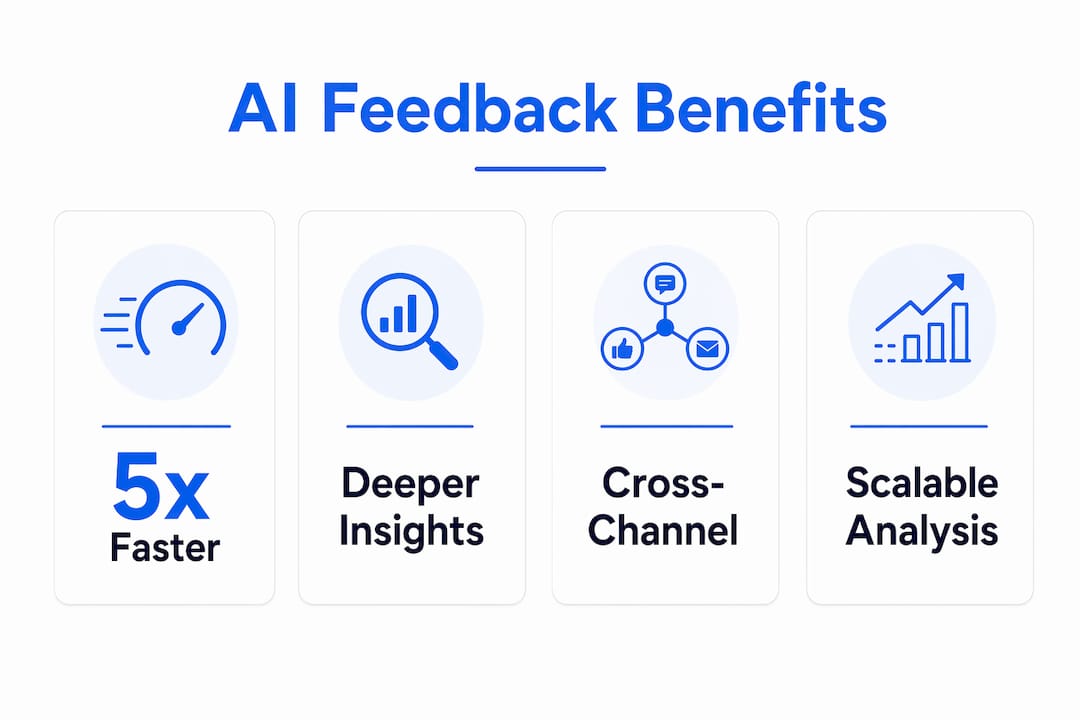
AI-driven feedback analysis does not just speed up the old process. It replaces the process entirely, delivering advantages that compound across the organization.
| Benefit | What it means in practice |
|---|---|
| Synthesis speed | Teams compress feedback review from weeks to hours, enabling same-sprint decisions |
| Full coverage | Every response analyzed, not a sampled subset, producing statistically representative themes |
| Consistent scoring | Sentiment and theme classification apply the same rules at response 1 and response 10,000 |
| Emerging issue detection | Predictive models flag rising complaint clusters before they appear in support queues |
| Channel unification | Surveys, tickets, reviews, and call transcripts feed a single analytics layer |
| KPI linkage | Themes connect directly to NPS movement, churn rate, and revenue impact |
| Executive reporting | Role-based dashboards surface the signals each team needs without manual filtering |

AI analysis compresses synthesis from weeks to hours while improving depth and reducing churn by enabling faster action. A team can launch hundreds of conversational interviews in an afternoon and receive a first-pass theme report the next morning, ready for a decision meeting within the same sprint.
The scalability benefit extends to data types. Unstructured text, voice transcripts, and open-ended survey responses are the richest feedback sources available, and they are precisely what manual teams skip because coding them is too time-consuming. AI decodes them automatically. For decision-makers tracking customer satisfaction metrics, that shift from sampled structured data to full unstructured coverage changes the quality of every downstream decision.
How AI technologies actually work on customer feedback
Understanding the mechanics helps you evaluate platforms and set realistic expectations. Six core techniques drive most production feedback analysis systems.
Natural language processing
NLP is the foundation. It parses raw text to extract meaning, identifying topics, entities, and relationships within a comment without requiring predefined keyword lists. Modern NLP models trained on large corpora understand context, not just word frequency.
Sentiment analysis
Advanced LLM-powered sentiment analysis detects intensity (mild frustration versus urgent anger), identifies mixed sentiment within a single comment, and tracks shifts over time by segment, location, or product line. A naive tool scores “I guess it works” as neutral. A well-trained model recognizes resignation.
Topic modeling and clustering
Topic modeling discovers recurring themes from the feedback itself without requiring a predefined tag list. The taxonomy is persistent and auto-evolving: new themes get added as they emerge, and existing ones stay consistent across time periods and channels. This matters because customer issues evolve. Fixed categories miss new problems that appear after earlier ones are resolved.
Entity recognition
Entity recognition maps feedback to specific business objects automatically. “The downtown branch” is a location entity. “The new reporting dashboard” is a product entity. When AI tags these, every theme and sentiment score can be filtered by entity, enabling location-level or agent-level accountability that anonymous dashboards cannot provide.
Predictive analytics
Predictive models analyze the trajectory of feedback themes, not just the current snapshot. When “checkout friction” mentions increase week over week across multiple locations, that is a signal before it becomes a churn driver. Teams see the early pattern forming and intervene while it is still manageable.
Intent classification
Intent classification detects what the customer wants to happen next and routes the feedback to the team that can act on it. A complaint routes to support. A feature request routes to product. An advocacy signal routes to marketing. The routing is automatic, based on detected intent and configured workflows.
Practical applications across business functions
AI feedback analysis is not a single-department tool. Its value compounds when deployed across multiple functions simultaneously.
Product management: Theme clustering surfaces which feature gaps appear most frequently among high-value accounts, giving product managers a data-backed prioritization framework instead of relying on the loudest internal voice.
Customer service: Intent-based routing directs high-urgency feedback to the right agent or queue automatically, reducing handle time and preventing escalations. AI-driven customer service platforms that integrate feedback signals can resolve tier-1 issues before they reach a human agent.

Marketing: Sentiment trend tracking across channels reveals how campaign messaging lands with different customer segments. A shift in language around a product feature, detected in real time, lets marketing teams adjust positioning before the next campaign cycle.
Operations: Entity-level analysis flags location-specific or agent-level issues that aggregate scores would mask. A single branch generating disproportionate negative sentiment around wait times is invisible in a company-wide NPS score but obvious in an entity-filtered dashboard.
Quality assurance: Automated theme tracking across product releases or service campaigns measures whether a fix actually resolved the complaint it targeted. Outcome measurement connects identified issues to initiatives and monitors post-implementation feedback to confirm that changes reduced the problems customers reported.
Closed-loop feedback programs: The most mature implementations treat feedback as the start of a workflow, not the end of a survey. Insights route to an owner, get tracked to resolution, and trigger a customer notification about what changed. That closed loop is what builds the trust that sustains response rates over time.
Pro Tip: Reserve AI automation for signal surfacing and routing. When feedback carries high emotional stakes, such as a complaint about a medical billing error or a service failure affecting a long-term account, route it to a human agent for personalized handling. Over-automation in follow-up erodes customer trust faster than a slow response does.
Challenges and best practices for sustainable implementation
Purchasing an AI tool and pointing it at feedback data rarely produces useful results. The gap between a working dashboard and a system that actually changes decisions comes down to strategy and ongoing discipline.
Data quality sets the ceiling. Input data quality sets an upper limit on AI insight reliability. Feedback that is too brief, disorganized, or mostly non-feedback content reduces accuracy regardless of model sophistication. Before configuring any platform, audit your feedback sources for volume, clarity, and channel coverage.
Define objectives before selecting technology. Teams that skip this step implement AI successfully from a technical perspective but generate insights that never influence decisions. Start with the questions you need answered, then configure the system to answer them.
Model hygiene is ongoing work. Monthly accuracy reviews and taxonomy updates are necessary to maintain analysis quality over time. Failure to maintain models degrades accuracy and causes valuable signals to get lost in noise.
AI-native versus AI-assisted architecture matters. AI-native platforms autonomously discover and update feedback themes from raw data, eliminating manual taxonomy maintenance. AI-assisted platforms apply machine learning to categories you have already defined, which requires continuous upkeep as your product and customer base evolve. For teams evaluating which architecture to buy, onboarding timeline is a reliable proxy: AI-assisted platforms typically require several weeks of taxonomy setup before producing reliable analysis at scale.
Human oversight prevents automation bias. AI can misclassify nuanced, sarcastic, or minority feedback without human review. Automation bias, where teams rely blindly on AI outputs, is a common implementation failure. Validate a sample of feedback within each AI-identified theme before building decisions on the results.
Integrate with CRM and business systems. Insights that live only in a feedback dashboard rarely change decisions. Connecting analysis outputs to your CRM, product management tools, and service operations platforms is what converts a reporting function into an operating system.
Protect data privacy. Feedback analysis ingests personal customer communications. Compliance with applicable privacy regulations, including data minimization, consent management, and retention policies, is not optional. Teams building unified data pipelines should consult guidance on protecting against AI-related risks as part of their governance framework.
Measure impact with CX KPIs. Link AI analytics investments to tangible outcomes: improved NPS or CSAT, reduced churn, faster resolution times, or documented cost savings from fewer escalations. Track these metrics rigorously over time so the program can demonstrate ROI and earn continued investment.
How Mediabloom puts AI feedback intelligence to work
Mediabloom’s AI platform does more than generate leads. It captures customer interaction data across voice agents, chatbots, and omnichannel conversations, creating a continuous stream of feedback signals that feed directly into business intelligence. When a voice agent handles an inbound inquiry or a chatbot resolves a support request, every interaction becomes structured data that reveals intent, sentiment, and unmet needs at scale.
For decision-makers who want to see what AI-driven customer intelligence looks like in production, Mediabloom’s real-world case studies show how companies like Miracle Ear and 1-800 Accountant have deployed AI to generate over 10,000 monthly leads while maintaining high customer satisfaction. The same infrastructure that qualifies leads and books appointments also surfaces the feedback patterns that drive continuous improvement.
Watch a live demo to see how Mediabloom’s AI agents collect, route, and act on customer signals in real time.
Key Takeaways
AI-driven customer feedback analysis delivers its full value only when collection, analysis, and action operate as a connected system rather than isolated tools.
| Point | Details |
|---|---|
| Three-layer discipline | Effective programs combine conversational collection, NLP-based analysis, and closed-loop action routing. |
| Adoption gap is real | 81% of CX leaders prioritize AI analytics, but only 7% report mature implementations. |
| Architecture determines ROI | AI-native platforms auto-discover themes; AI-assisted platforms require 4–8 weeks of manual taxonomy setup. |
| Human oversight is required | AI misclassifies nuanced or sarcastic feedback without regular validation and monthly model reviews. |
| KPI linkage drives buy-in | Feedback themes must connect to NPS, churn, and revenue to influence executive decisions. |
FAQ
What is AI-driven customer feedback analysis?
AI-driven customer feedback analysis is the automated process of using artificial intelligence, specifically NLP and machine learning, to collect, classify, and interpret unstructured customer input from surveys, tickets, reviews, and conversations. It converts raw customer language into prioritized themes, sentiment scores, and recommended actions without manual coding.
What is the main benefit of using AI to analyze customer reviews?
The primary benefit is full coverage at speed. AI reads every response rather than a sample, compresses synthesis from weeks to hours, and surfaces emerging issues before they appear in support queues or quarterly reports.
Which AI technique is most commonly used for customer sentiment analysis?
Large language model (LLM) powered sentiment analysis is the current standard for production systems. Unlike basic positive/negative classifiers, LLM-based models detect sentiment intensity, identify mixed sentiment within a single comment, and track shifts by segment or location over time.
How does AI-driven analysis differ from traditional survey methods?
Traditional surveys force customers into predefined fields, flattening nuance before it is ever recorded. AI-driven analysis captures natural language first and structures it afterward, preserving context and enabling theme discovery that fixed-category surveys cannot produce.
What does successful implementation require?
Success requires clear objectives defined before any tool is selected, consolidated feedback sources across all channels, validated model accuracy through regular human review, and integration with CRM and business systems so insights route to the people who can act on them.