Automatically send an immediate SMS reply to every missed inbound call. That single action captures contact intent before the caller dials a competitor, moves the conversation to a channel with higher reply rates, and keeps your pipeline moving after hours. Here is what you need to do right now:
- Enable a timeout or after-hours trigger on your business phone number that fires an SMS the moment a call goes unanswered.
- Use a compliant, personalized template that offers a clear next step (book an appointment, request a callback, or get a quote).
- Register your number for 10DLC A2P messaging before sending at volume.
- Connect your SMS flow to your CRM so every reply is logged and routed automatically.
- Contact Mediabloom for a done-for-you setup if you want the full stack running in days, not weeks.
Key Takeaways
Missed call text back is the highest-ROI automation most SMBs are not running correctly: the trigger, the compliance layer, and the CRM integration must all work together before you send at volume.
| Point | Details |
|---|---|
| Enable the trigger first | Configure a timeout or after-hours rule that fires an SMS within 30 seconds of a missed call. |
| Register 10DLC before sending | Brand approval takes 2–3 business days; campaign approval takes 3–5 more — start registration early. |
| Use a compliant template | Include your business name, a clear next step, and opt-out language in every first message. |
| Sync suppression lists in real time | Opt-outs must propagate across CRM, SMS provider, and dialer immediately to avoid TCPA exposure. |
| Mediabloom manages the full stack | Mediabloom handles 10DLC registration, CRM integration, compliance monitoring, and ongoing optimization for SMBs that need a production-ready flow fast. |
Table of Contents
- What is missed call text back and how does it work?
- Why instant SMS recovers missed callers and drives appointments
- How to set up missed call text back in your stack
- SMS templates and reply flows that convert missed callers
- U.S. compliance and carrier rules you must follow
- What does missed call text back cost and how long does setup take?
- How do you measure whether missed call text back is working?
- Pre-launch checklist before you enable automated missed-call texts
- Mediabloom client outcomes: lead recovery in action
- Mediabloom handles the full setup for you
- The honest trade-off between DIY and managed missed-call SMS
- Sources
- FAQ
What is missed call text back and how does it work?
Missed call text back is the industry term for an automated SMS dispatched the moment an inbound call goes unanswered. The formal category is A2P (application-to-person) messaging triggered by a telephony event. Most platforms support several implementation models, and choosing the right one depends on your call volume and conversion goal.
The four common implementation types
One-time auto-reply. A single SMS fires on a missed-call event and delivers a fixed message. Simple to configure, low maintenance, and sufficient for businesses that just need to acknowledge the caller.
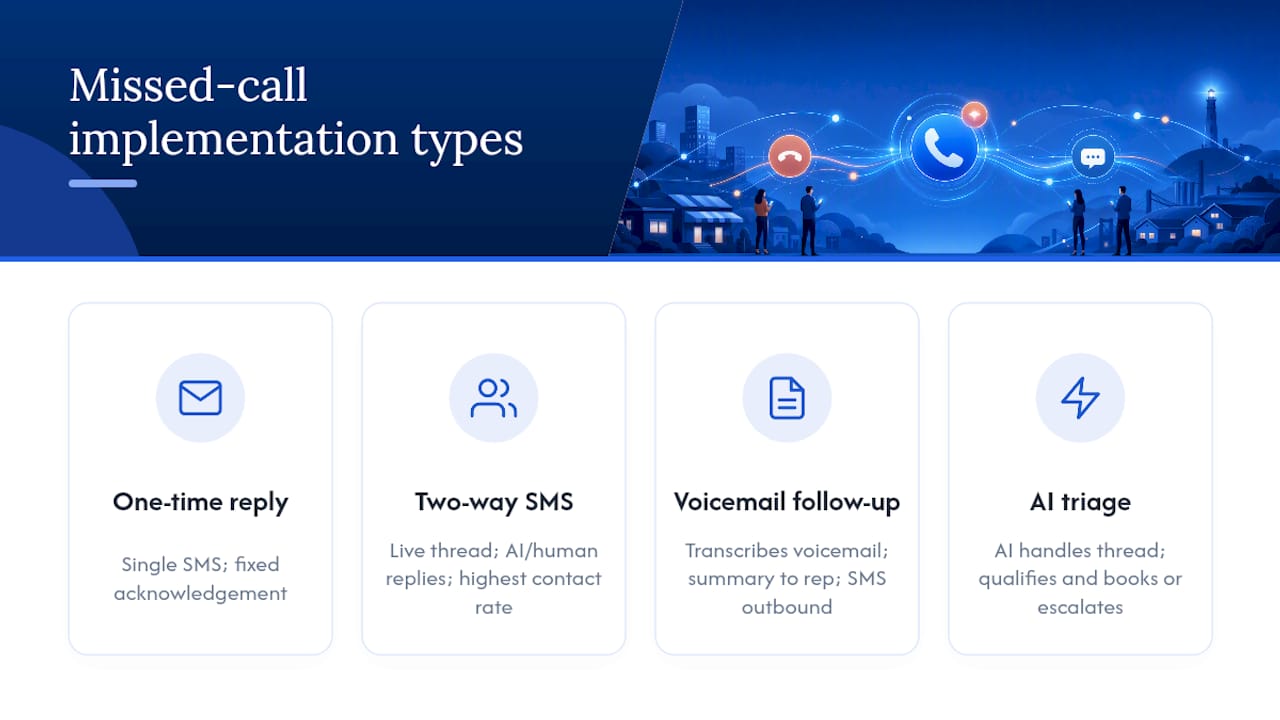
Two-way SMS conversation. The auto-reply opens a live text thread. The caller responds, and either an AI agent or a human rep continues the conversation to qualify the lead and book an appointment. This model produces the highest contact rates because it meets callers where they already are.
Voicemail-to-text follow-up. The system transcribes the voicemail and routes a summary to the rep alongside an outbound SMS to the caller. Useful for high-volume inbound lines where voicemail screening is already part of the workflow.
AI triage via SMS. An AI agent handles the reply thread, asks qualification questions, scores the lead, and either books the appointment directly or escalates to a human. Mediabloom’s platform operates at this tier, combining AI voice agents with SMS automation for end-to-end lead qualification.
How triggers and routing work
The trigger is typically a timeout event: the call rings for a configured number of seconds with no answer, and the telephony platform fires a webhook or native automation to the SMS provider. Business-hours rules let you differentiate responses. A caller who rings at 2:00 PM on a Tuesday gets a different message than one who calls at 11:00 PM on a Sunday. IVR handoffs add another layer: if a caller abandons during a menu, the IVR can pass the event downstream and trigger the SMS flow. The phone number must be linked to the SMS campaign before any of this works, which is why 10DLC registration is a prerequisite, not an afterthought.

Why instant SMS recovers missed callers and drives appointments
Callers who reach voicemail rarely leave a message, and those who do rarely wait for a callback. An immediate text reply changes that dynamic. It acknowledges the caller within seconds, lowers the friction of re-engaging, and moves the conversation to SMS, where response rates consistently outpace email and voicemail callbacks.

The business impact concentrates in three areas. First, contact rate climbs because the caller is still holding their phone when the text arrives. Second, qualification accelerates: a two-way SMS thread can surface intent, budget, and timing in under three minutes without a rep dialing back. Third, after-hours lead loss drops sharply. Appointment-driven businesses lose a disproportionate share of leads outside business hours, and an automated text reply is the only practical way to capture that intent before the next business day.
The use cases where this matters most include:
- Appointment businesses (salons, med spas, dental practices): a missed call is a missed booking; an instant text with a scheduler link recovers it.
- Home services (HVAC, plumbing, roofing): urgency is high and callers move fast; the first business to reply usually wins the job.
- Legal and financial intake: callers are evaluating multiple firms; a fast, professional text reply signals responsiveness and builds early trust.
Follow-up texts drive measurable rebooking rates across service industries, making the auto-reply one of the highest-ROI automations an SMB can deploy.
How to set up missed call text back in your stack
- Assign a dedicated business number. Use a 10-digit long code (10DLC) number tied to your business. Shared short codes are not suitable for personalized missed-call flows.
- Complete 10DLC brand and campaign registration. Brand approval typically takes 2–3 business days; campaign approval takes an additional 3–5 business days. Submit your sample messages with opt-out language and your legal entity name during registration. Generic placeholders are a common rejection cause.
- Configure the missed-call trigger in your PBX or phone platform. Set the timeout threshold (typically 20–30 seconds), define business-hours rules, and map the trigger to your SMS provider via webhook or native integration. Platforms like CallRail support automated responses for missed calls natively.
- Connect your SMS provider to your CRM. Every inbound reply must create or update a contact record, log the conversation, and trigger the next step in your pipeline. Without this, replies fall into a black hole.
- Build your message templates and reply flows. Write the initial auto-reply, the qualification sequence, and the booking confirmation. Keep the first message under 160 characters and include your business name and an opt-out instruction.
- Test the full flow in production. Call your business number from a test phone, let it ring to timeout, and confirm the SMS arrives within 30 seconds. Verify the CRM logs the event and the opt-out keyword (“STOP”) removes the contact from the active list.
Pro Tip: Test your SMS delivery across at least three carriers (AT&T, T-Mobile, Verizon) before going live. Carrier filtering rules differ, and a message that delivers cleanly on one network may be flagged on another. Run a suppression-list check at the same time to confirm opted-out contacts are excluded.
SMS templates and reply flows that convert missed callers
The first message carries the most weight. It needs to arrive fast, identify your business, offer a clear next step, and include an opt-out path. Keep it under 160 characters.
Appointment businesses (salons, med spas, dental): Home services (HVAC, plumbing, roofing): Legal intake: Financial services: Once the caller replies, the two-way flow takes over:
- Qualification step: “What brings you in today? (1) New appointment (2) Existing client (3) Quick question”
- Booking confirmation: “Great — here is a link to pick your time: [scheduler link]. We will confirm within 24 hours.”
- Agent takeover trigger: If the caller’s reply does not match a menu option or signals urgency, route immediately to a live rep.
A few notes on compliance and tone. Keep the first message informational rather than promotional. The FCC consumer guide is clear that commercial texts require consent, and a missed-call auto-reply sits in a gray zone unless the caller has previously opted in or the message is purely transactional. Including your business name, a clear opt-out path, and no promotional offer in the first message reduces TCPA exposure. Campaign reviewers also expect sample messages to include your legal entity name and linkable terms. Generic copy gets rejected.
U.S. compliance and carrier rules you must follow
The regulatory framework
The FCC treats text messages sent via an autodialer as “calls” under the TCPA, which means the same consent and revocation standards that govern automated voice calls apply to your SMS flows. That order also clarifies that a one-time confirmation text acknowledging an opt-out is permitted, provided it contains no marketing content.
TCPA statutory damages run $500 per message for negligent violations and $1,500 per message for knowing or willful violations, with no statutory cap on class actions. At scale, a misconfigured suppression list is not a minor operational issue.
Compliance floor for missed-call SMS: Prior consent, a clear opt-out path in every message, and a suppression list that syncs across your CRM, dialer, and SMS platform in real time. Miss any one of these and carrier filtering or TCPA exposure follows.
Mandatory operational controls
- Centralize your suppression list. Opt-outs must propagate immediately across your SMS provider, CRM, and dialer. Siloed lists are the most common compliance gap SMBs face. A real-time API sync or centralized suppression service is the practical fix.
- Handle opt-out keywords automatically. “STOP,” “CANCEL,” “UNSUBSCRIBE,” “QUIT,” and “END” must trigger immediate removal. Your platform should handle this natively; verify it does before launch.
- Send only one post-opt-out confirmation. The FCC permits a single acknowledgment text after an opt-out request, but it must contain no promotional content. Configure your platform to send exactly one and then suppress all further messages.
- Identify your business in every message. The FCC’s Text Blocking Order requires terminating providers to block numbers identified as sending illegal texts. Carriers flag messages that lack sender identification as a spoofing signal.
- Register before you send at volume. 10DLC brand and campaign registration is required for application-based 10-digit long code SMS. Unregistered numbers face carrier filtering and potential blocking.
| Control | Requirement | Risk if skipped |
|---|---|---|
| 10DLC registration | Brand + campaign approved before sending | Carrier filtering, message blocking |
| Opt-out keyword handling | Automatic removal on STOP/CANCEL/QUIT | TCPA violation, $500–$1,500 per message |
| Suppression list sync | Real-time across CRM, SMS, dialer | Texting opted-out contacts, class action exposure |
| Sender identification | Business name in every message | Carrier blocking, spoofing flags |
| Post-opt-out confirmation | One message, no marketing content | TCPA violation if promotional content included |
What does missed call text back cost and how long does setup take?
Costs break into three layers: platform fees, carrier fees, and optional managed-service fees.
Platform fees vary by vendor and typically include a monthly subscription plus per-message charges. Entry-level SMS platforms charge a small fraction of a cent per outbound message; managed AI platforms with CRM integration and compliance tooling carry higher monthly fees reflecting added operational overhead.
Carrier fees include 10DLC registration costs (a one-time brand registration fee and a recurring monthly campaign fee) plus standard per-message surcharges, which are minor but accumulate with volume.
Managed-service fees apply when using providers handling registration, integration, template creation, compliance monitoring, and ongoing optimization. These fees reflect expedited setup and reduced risk, not just software usage.
| Cost layer | Typical structure | Notes |
|---|---|---|
| Platform subscription | Monthly recurring | Varies by feature tier and message volume |
| Per-message carrier fee | Per outbound SMS | Set by carriers; applies to all A2P traffic |
| 10DLC brand registration | One-time fee | Paid to The Campaign Registry |
| 10DLC campaign fee | Monthly recurring | Per campaign, per carrier |
| Managed setup/service | One-time or monthly | Covers onboarding, compliance, optimization |
On timing: brand registration takes 2–3 business days and campaign approval takes 3–5 business days after brand approval clears. Once your campaign is approved and your number is associated, messages typically deliver within minutes of the trigger firing. Budget about a couple of weeks from kickoff to reliable production delivery when doing this yourself, accounting for back-and-forth on sample message rejections.
How do you measure whether missed call text back is working?
Track these five metrics from day one:
- SMS contact rate: the percentage of missed-call events that generate at least one inbound reply. This is your primary signal that the auto-reply is reaching callers and prompting engagement.
- Reply-to-booking conversion rate: of the callers who reply, how many complete a booking or appointment. Low conversion here points to a weak qualification flow or a friction-heavy scheduler link.
- Booked-appointment rate: total appointments booked via the SMS flow divided by total missed calls. This is the ROI metric your leadership team cares about.
- Time-to-contact: median time from missed-call event to first inbound reply. Shorter is better; anything over 10 minutes suggests a trigger delay or delivery issue.
- Opt-out rate: if this climbs above 2–3%, your message copy, frequency, or targeting needs adjustment. A high opt-out rate also signals carrier filtering risk.
Instrument tracking by mapping CRM events to each stage of the flow: missed-call trigger fired, SMS sent, reply received, qualification completed, appointment booked. Add UTM parameters to every scheduler link so you can attribute bookings back to the SMS channel in your analytics platform. Review the full funnel weekly for the first 30 days, then monthly once the flow stabilizes. The AI lead qualification playbook covers how to move SMS replies into booked appointments efficiently.
Pre-launch checklist before you enable automated missed-call texts
Run through every item before flipping the switch.
Technical:
- Business number assigned and linked to SMS campaign
- 10DLC brand and campaign registration approved
- Missed-call trigger configured with correct timeout and business-hours rules
- CRM integration tested (contact creation, conversation logging, pipeline stage update)
- Message templates finalized and loaded into platform
- Scheduler link tested end-to-end on mobile
Compliance:
- Opt-out keywords (STOP, CANCEL, QUIT, UNSUBSCRIBE, END) handled automatically
- Opt-out language included in every outbound template
- Suppression list synced in real time across CRM, SMS provider, and dialer
- Post-opt-out confirmation message configured (one message, no marketing content)
- Business name and legal entity included in sample messages submitted to carrier
Operational:
- Staffing plan in place for inbound SMS replies that escalate to a human
- Monitoring alerts configured for delivery failures and carrier filtering reports
- Test calls completed across AT&T, T-Mobile, and Verizon
Mediabloom client outcomes: lead recovery in action
Mediabloom has deployed missed-call text-back flows across legal, medical, and home-services clients, combining AI voice agents, SMS automation, and CRM integration into a single managed workflow. The outcomes below reflect real client deployments.
- My Legal Coach used Mediabloom’s automated messaging and appointment workflows to increase lead intake and reduce manual follow-up. The My Legal Coach case study details how the SMS and AI voice combination shortened time-to-contact and improved booking rates for legal consultations.
- Commserve Connect deployed Mediabloom’s integration stack to manage carrier and CRM routing at scale. The Commserve Connect case study shows how 10DLC compliance and CRM automation were implemented together to maintain deliverability.
- Across Mediabloom’s client base, including companies like Miracle Ear and 1-800 Accountant, the platform generates over 10,000 monthly leads by combining inbound SMS recovery with AI qualification and outbound follow-up.
Mediabloom’s approach to missed-call recovery pairs the auto-reply trigger with an AI qualification layer that scores the lead, routes it to the right rep, and books the appointment without human intervention. The result is a contact rate that captures callers who would otherwise be lost to voicemail or a competitor’s faster response.
For med spas and aesthetics practices specifically, AI speed-to-lead automation pairs missed-call SMS with instant AI follow-up to convert inbound interest into booked consultations before the caller considers another provider.
Mediabloom handles the full setup for you
Most SMBs lose leads not because they lack the right idea but because the implementation takes longer than expected and compliance gaps surface mid-launch. Mediabloom eliminates that delay.
The platform covers every layer of a production-ready missed-call text-back deployment: A2P 10DLC registration, SMS and phone routing integration, CRM and appointment scheduler connection, live suppression sync, and ongoing compliance monitoring. Onboarding is managed end-to-end, with a typical timeline from kickoff to live production of days rather than weeks. You get a configured, tested, and compliant flow without building it yourself.
Clients across legal, medical, home services, and financial verticals use Mediabloom to recover missed-call leads and convert them into booked appointments at scale. Review the AI appointment setting case studies to see documented outcomes, then Mediabloom to see the platform configured for your specific use case.
The honest trade-off between DIY and managed missed-call SMS
The DIY path is viable if you have a developer comfortable with webhook configuration, a CRM admin who can map events correctly, and someone on your team who will own the 10DLC registration process and monitor carrier filtering reports on an ongoing basis. That is three distinct skill sets, and most SMBs do not have all three in-house.
Where DIY breaks down is compliance maintenance. The TCPA landscape shifts. Carrier filtering rules update. Suppression lists drift out of sync when CRM integrations are not actively maintained. A missed-call text-back flow that was compliant at launch can develop gaps within 90 days if no one is watching it. The comparison between Mediabloom’s managed AI approach and basic cloud-phone providers illustrates exactly where that maintenance gap shows up in practice.
Managed makes sense when speed-to-live matters, when your industry carries elevated TCPA risk (legal, medical, financial), or when your team’s time is better spent on the leads the flow generates rather than the infrastructure that generates them. The cost of a managed provider is almost always lower than the cost of a single TCPA enforcement action.
DIY makes sense when you have a small, predictable call volume, a technically capable team, and the bandwidth to own compliance monitoring. Start with a marketing automation checklist to confirm your stack is ready before building the SMS layer on top of it.
The practical advice: if you are unsure whether your suppression list is syncing correctly across all three systems (CRM, SMS provider, dialer), you are not ready to go live at volume. That single gap is where most TCPA exposure originates.
Sources
- Apply for 10DLC Brand Registration and Campaign Registration - An Azure Communication Services article | Microsoft Learn
- Federal Communications Commission FCC 24-24
- Stop Unwanted Robocalls and Texts | Federal Communications Commission
- TCPA Compliance for SMS in 2026: The Complete Guide for US Businesses - IDT Express
FAQ
What is the missed call text back feature?
Missed call text back is an automated SMS sent to a caller the moment their inbound call goes unanswered. It captures contact intent immediately, before the caller reaches a competitor, and opens a text conversation that can qualify the lead and book an appointment without a rep dialing back.
Is missed call text back legal in the United States?
Yes, with the right setup. The FCC treats automated texts as calls under the TCPA, so prior consent, a clear opt-out path, and a synced suppression list are required. Violations carry statutory damages of $500 per message for negligent violations and $1,500 per message for willful violations.
How do you set up missed call text back?
Assign a 10DLC number, complete brand and campaign registration (allow 2–3 business days for brand approval and 3–5 for campaign approval), configure a missed-call timeout trigger in your phone platform, connect your SMS provider to your CRM, and load compliant message templates before going live.
How do you text back when you missed a call?
For a single missed call, reply manually with a brief, professional message identifying your business and offering a next step. At any volume above a handful of calls per day, configure an automated trigger so the reply fires within seconds of the missed-call event rather than waiting for a rep to notice.
How does Mediabloom handle missed call text back for SMBs?
Mediabloom deploys a fully managed flow that covers 10DLC registration, SMS and phone routing, CRM integration, live suppression sync, and AI-driven lead qualification. Clients get a production-ready missed-call text-back system without building or maintaining the infrastructure themselves.