
Artificial intelligence reduces customer service costs by automating high-volume, repetitive inquiries and augmenting human agents for complex issues. This is the proven mechanism behind what the industry formally calls AI-driven contact center automation. AI-handled tickets cost $0.50–$2.37 per resolution compared to $8–$13 for human agents. That gap is not theoretical. It is the financial reality driving adoption across financial services, SaaS, insurance, and home services. This guide gives business leaders the data, benchmarks, and implementation frameworks to act on that reality in 2026.
How AI reduces customer service costs: the core mechanisms
AI cuts service costs through two primary levers: direct task automation and workforce augmentation. Direct automation removes human labor from repetitive, low-complexity interactions entirely. Workforce augmentation reduces the time human agents spend on each interaction by surfacing answers, routing tickets, and drafting responses automatically.

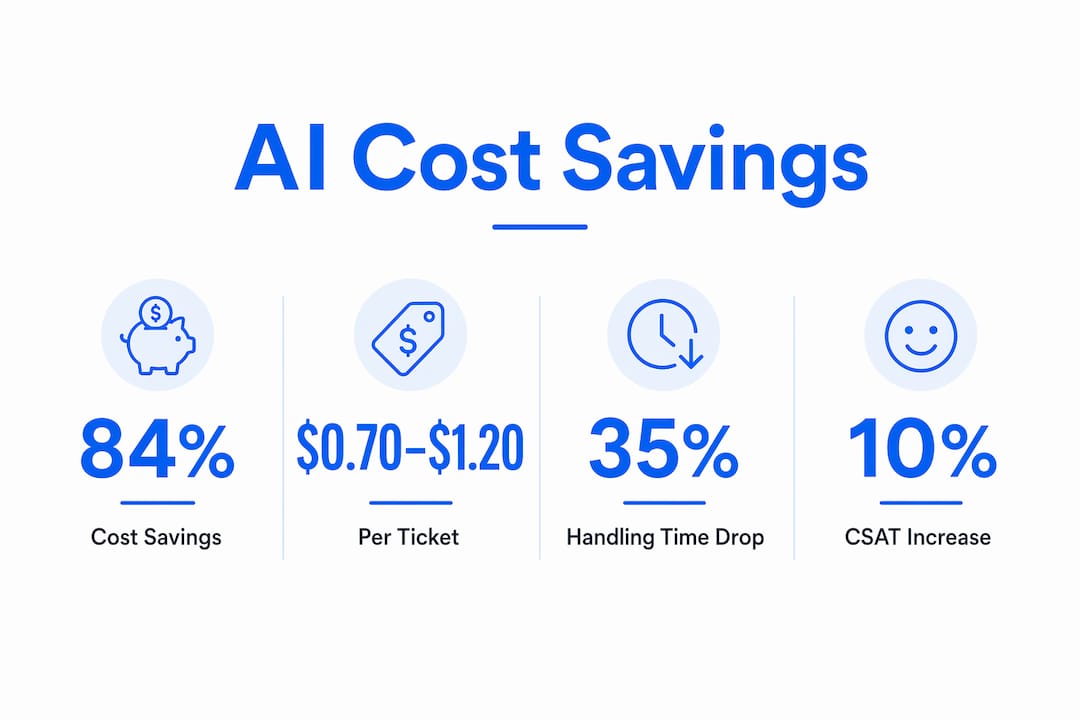
84% of service organizations using AI report measurable cost savings within the first year. That figure reflects organizations that deployed AI on the right task types, not those that bolted a chatbot onto a broken process. The distinction matters because AI’s cost impact is highly dependent on where you deploy it first.
The net savings after licensing and infrastructure fees average $0.70–$1.20 per resolved ticket. Across thousands of monthly interactions, that arithmetic compounds quickly. A team handling 50,000 tickets per month at a $10 average human cost saves between $35,000 and $60,000 monthly at a 70% AI deflection rate.
Which customer service tasks are most cost-effectively automated by AI?
The highest-value automation targets are routine, high-volume, and low-judgment tasks. These interactions follow predictable patterns, require no empathy, and have clear resolution criteria. AI handles them faster and at a fraction of the cost.
The task categories that deliver the strongest AI customer service savings include:
- FAQ responses: Product specs, return policies, shipping timelines, and billing explanations. These account for a large share of total ticket volume in most organizations.
- Password resets and account unlocks: Fully automatable with identity verification. Zero human judgment required.
- Order status and tracking: AI pulls live data from order management systems and delivers it instantly.
- Ticket triage and routing: AI classifies incoming requests by intent and urgency, then routes them to the correct team or queue without human review.
- Appointment scheduling: AI voice agents and chatbots book, reschedule, and confirm appointments across SMS, email, and chat channels.
AI chatbots handle 65%–80% of repetitive tasks effectively when implementation is well-executed. That deflection rate is the primary driver of cost reduction. Every ticket deflected to AI is a ticket that does not consume a human agent’s time.
Pro Tip: Start your automation program with password resets and order status inquiries. These two categories typically represent 25%–40% of tier-1 volume and require zero customization to automate reliably.
AI voice agents extend this automation to phone channels, which traditionally carry the highest cost per contact. Mediabloom’s AI voice agent platform handles tier-1 phone inquiries end-to-end, 24 hours a day, without staffing a night shift. That capability alone eliminates a significant fixed cost for organizations with after-hours call volume.
What are the realistic cost savings and ROI benchmarks for AI in customer service?
The financial case for AI in customer support is now data-rich. Business leaders no longer need to rely on vendor projections. Independent benchmarks from 2025 and 2026 provide clear ranges.
Cost per resolution by model
| Resolution model | Cost per ticket | CSAT impact |
|---|---|---|
| Human agents only | $7.40–$13.00 | Baseline |
| Pure AI (no escalation) | $0.62–$2.37 | Lower on complex issues |
| Hybrid AI and human | $2.10–$3.50 | Near-equal to human-only |
The blended hybrid model costs approximately $2.10 per resolution versus $7.40 for human-only support. That calculation assumes a 22% escalation rate from AI to human and a $52-per-hour loaded agent cost. The numbers shift based on your escalation rate and agent compensation, but the directional advantage of hybrid models holds across industries.
First-year ROI expectations
Hybrid AI-human policies yield a 71% lower blended cost-per-resolution at CSAT scores nearly equal to all-human teams. Typical first-year ROI lands between 2.6x and 4.4x. Realistic net cost reductions across a full support organization average 20%–35% within the first year.
The cost components that affect your ROI timeline include:
- Licensing fees: Most enterprise AI platforms charge per seat or per resolution. Model your costs against projected deflection volume before signing.
- Implementation and integration: CRM connections, knowledge base migration, and workflow redesign typically require 6–12 weeks of professional services time.
- Supervision and coaching: Human agents must review AI outputs and flag errors. Budget 10%–15% of agent time for this function in year one.
- Infrastructure: Cloud compute and API costs scale with volume. These are predictable and manageable but often underestimated in initial business cases.
40% of AI investments do not show positive ROI within 12 months due to poor content and data integration. That failure mode is avoidable. Organizations that update their knowledge bases before deployment consistently achieve higher deflection rates and faster payback periods.
What implementation strategies maximize AI-driven cost reductions?
The organizations that achieve the highest AI customer service savings share a common approach: they deploy narrowly, measure aggressively, and expand only after proving results. The organizations that fail deploy broadly, skip process redesign, and treat AI as a technology project rather than an operational change.
Only 26% of companies move from proof-of-concept to tangible AI value. The gap between the 26% and the rest is not technology quality. It is process discipline and change management.
A phased deployment approach that works
- Audit your ticket volume by category. Pull 90 days of ticket data. Identify the top five categories by volume. Rank them by resolution complexity. Your first automation targets are high-volume and low-complexity.
- Update your knowledge base before you deploy. Updated help centers correlate with 45% deflection versus 18% with outdated documentation. Clean content is the single highest-leverage pre-deployment action.
- Integrate AI with your CRM and product data. AI that cannot access customer history, order data, and account status cannot resolve tickets. Successful AI deployment relies on data integration across CRM, knowledge base, and product telemetry. This is not optional.
- Appoint an internal CX champion. This person owns change management, agent training, and AI coaching. Organizations with a dedicated champion accelerate adoption and improve ROI measurably.
- Run a 30-day pilot on one ticket category. Measure deflection rate, resolution accuracy, and CSAT. Use the data to refine before expanding.
- Expand to adjacent categories in 60-day cycles. Each cycle should include a review of AI coaching logs, escalation patterns, and customer feedback.
Pro Tip: Treat your AI coaching log as a product backlog. Every escalation is a signal that the AI failed to resolve something it should handle. Prioritize those failure patterns in your next training cycle.
Teams with continuous AI coaching see average handling times drop 35% and CSAT increase by 10%. That result requires a structured feedback loop, not occasional review. Tools like Interval AI focus specifically on automating information retrieval for human agents, which accelerates this coaching cycle by surfacing the right answers faster.
70% of AI value comes from people and process changes, not the algorithm alone. Business leaders who treat AI deployment as a technology project consistently underperform those who treat it as an organizational change program.
How do hybrid human-AI workflows balance cost savings with customer experience?
The pure-AI model is the cheapest per ticket. It is also the riskiest for customer satisfaction on anything beyond the simplest interactions. The hybrid model is the practical answer for most organizations. It captures most of the cost savings while preserving the human judgment that complex issues require.
How hybrid workflows operate in practice
Effective hybrid workflows follow a clear escalation logic:
- AI handles the first contact for all incoming requests.
- Intent classification determines whether the issue falls within AI’s resolution capability.
- Issues within scope are resolved end-to-end by AI, with a transcript logged to the CRM.
- Issues outside scope are escalated to a human agent with full context, conversation history, and a suggested resolution pre-populated by AI.
- Human agents review AI-generated responses for borderline cases before sending.
This structure means human agents spend their time on genuinely complex issues, not on password resets. That shift in task mix reduces burnout, improves agent retention, and raises the quality of human interactions.
Industry-specific results
Financial services organizations using AI achieved a 10% cost reduction within 6 months, scaling to a 45% total reduction by optimizing workforce management and automating information retrieval. Average handling time dropped 15% within 100 days. That trajectory is achievable in SaaS and insurance environments with comparable ticket structures.
AI-enhanced workforce management frees 5%–10% of capacity through optimized scheduling and task assignments. That freed capacity can be redeployed to proactive outreach, upsell conversations, or quality assurance, generating revenue rather than just reducing cost.
53% of consumers worry about privacy when interacting with AI-powered service. Transparent disclosure and effortless escalation paths address this concern directly. Organizations that make it easy to reach a human agent report higher trust scores and lower abandonment rates than those that obscure the escalation path.
| Workflow model | Cost per resolution | CSAT vs. human baseline | Best fit |
|---|---|---|---|
| Human only | $7.40–$13.00 | Baseline | Complex, high-empathy issues |
| Pure AI | $0.62–$2.37 | Lower on complex issues | Simple, high-volume, low-stakes |
| Hybrid AI and human | $2.10–$3.50 | Near-equal | Most enterprise support operations |
Mediabloom’s AI customer support for SaaS companies deploys this hybrid model with voice agents, chatbots, and human escalation built into a single workflow. The result is consistent cost reduction without sacrificing the service quality that retains customers.
Key Takeaways
AI reduces customer service costs most effectively when deployed on high-volume, low-complexity tasks within a hybrid workflow that preserves human judgment for escalations.
| Point | Details |
|---|---|
| AI ticket cost advantage | AI resolves tickets at $0.50–$2.37 versus $8–$13 for human agents, a gap that compounds at scale. |
| Hybrid model is the practical standard | Blended AI-human workflows cost ~$2.10 per resolution and match human-only CSAT scores. |
| Knowledge base quality drives deflection | Updated documentation produces 45% deflection rates; outdated content drops that to 18%. |
| Process change delivers 70% of AI value | Technology alone does not produce ROI. People and process redesign are the primary value drivers. |
| Continuous coaching sustains savings | Teams with structured AI coaching see handling times drop 35% and CSAT rise 10% over time. |
The uncomfortable truth about AI cost reduction in customer service
At Mediabloom, we have worked with organizations across insurance, home services, and SaaS that came to us with the same expectation: deploy AI, cut headcount, reduce costs. That framing produces the worst outcomes. It creates agent resistance, degrades service quality, and often results in AI rollbacks within 12 months.
The organizations that achieve sustained cost reductions treat AI as an augmentation tool, not a replacement strategy. Their agents become more productive, not redundant. Their CSAT scores hold or improve. Their AI systems get better over time because agents are invested in coaching them rather than resisting them.
The metric that separates successful deployments from failed ones is not deflection rate. It is agent adoption rate. When agents trust the AI, they coach it. When they coach it, it improves. When it improves, deflection rates rise and costs fall. That virtuous cycle does not start with technology. It starts with culture.
Governance matters more than most leaders expect. Organizations that appoint a dedicated CX champion, establish monthly AI review cycles, and tie AI performance metrics to business outcomes consistently outperform those that treat deployment as a one-time project. The business case for AI support has shifted from theoretical to proven. The remaining variable is execution discipline.
— Mediabloom
Mediabloom’s AI platform for measurable service cost reduction
Mediabloom deploys AI voice agents, chatbots, and sales automation in a single platform built for organizations that need results, not experiments.
Clients like Miracle Ear and 1-800 Accountant generate over 10,000 monthly leads through Mediabloom’s omnichannel AI workflows. The same infrastructure that drives lead generation also powers tier-1 customer service automation, handling inquiries across SMS, email, phone, and chat without adding headcount. If you want to see the cost model applied to your ticket volume, watch the AI voice agent demo or review the case studies to see documented results from live deployments.
FAQ
How much can AI reduce customer service costs?
AI-fully-handled workflows reduce cost per ticket by 30%–45% versus live agents. Hybrid AI-human models lower blended costs by up to 71% while maintaining CSAT scores near human-only levels.
What types of customer service tasks should AI handle first?
Deploy AI first on FAQs, password resets, order status inquiries, and ticket triage. These high-volume, low-complexity tasks produce the fastest deflection rates and the clearest ROI.
How long does it take to see ROI from AI in customer service?
84% of organizations report measurable cost savings within the first year. First-year ROI typically lands between 2.6x and 4.4x for hybrid deployments.
Does AI reduce customer satisfaction scores?
Hybrid AI-human workflows produce CSAT scores nearly equal to all-human teams. Pure AI models score lower on complex issues, which is why most enterprise deployments use a hybrid model with clear escalation paths.
What is the biggest risk in AI customer service deployment?
Poor data integration and skipped process redesign are the primary failure modes. 40% of AI investments fail to show positive ROI within 12 months due to outdated knowledge bases and inadequate CRM integration.


