


AI identifies sales-ready prospects by synthesizing behavioral, firmographic, and intent signals through machine learning models that rank leads by their likelihood to convert. This process, formally known as AI-powered lead scoring or automated prospect analysis, goes far beyond simple demographic filters. Platforms like 6sense, Mediabloom, and AI SDR systems now process millions of data points per account to detect buying intent before a prospect ever fills out a form. Understanding how AI identifies sales-ready prospects gives your sales team a structural edge: you stop guessing and start engaging the right accounts at exactly the right moment.
What data and signals does AI use to identify sales-ready prospects?
AI sales prospect identification starts with data. The more diverse the signal mix, the more accurate the output. Modern AI platforms pull from five distinct signal categories to build a complete picture of buying readiness.
First-party behavioral signals are the most direct evidence of intent. These include website visits to pricing pages, demo requests, content downloads, and email click patterns. A prospect who visits your pricing page three times in a week is sending a clear signal. AI captures that pattern and weights it heavily.

Third-party intent data comes from publisher networks and research platforms. When a prospect researches competitors or reads industry comparison articles outside your website, data providers like Bombora and G2 capture that activity and feed it into your scoring model. This gives you visibility into buying behavior you would otherwise never see.
Firmographic and technographic data round out the picture. Company size, industry vertical, revenue range, and current technology stack all determine whether a prospect fits your ideal customer profile (ICP). A company running Salesforce and HubSpot signals a certain level of sales maturity and budget.
| Signal Type | Primary Source | Impact on Lead Score |
|---|---|---|
| Behavioral (first-party) | Website analytics, CRM activity | High (50% weight typical) |
| Intent (third-party) | Bombora, G2, publisher networks | Medium (20% weight typical) |
| Firmographic | ZoomInfo, LinkedIn, Clearbit | Medium (30% weight typical) |
| Technographic | BuiltWith, HG Insights | Supplementary qualifier |
| Lifecycle/Relationship | CRM history, past engagement | Contextual modifier |
Sales signals derived from company activity and behavior patterns indicate readiness to buy, enabling earlier detection and prioritized outreach. That means your team is not just reacting to inbound requests. You are identifying accounts before they raise their hand.
How do AI lead scoring frameworks prioritize prospects?
AI lead scoring frameworks assign numeric scores to prospects by combining multiple signal types into a weighted model. The standard weighting breakdown places behavioral engagement at 50%, firmographic fit at 30%, and intent signals at 20%. That weighting reflects a core truth: what a prospect does matters more than who they are on paper.
The algorithms powering these models are not simple rule sets. Machine learning models like XGBoost and Random Forest process evolving behavioral patterns continuously, enabling more accurate propensity scores than static historical assumptions. These models retrain on new conversion data, so scores improve over time as your pipeline grows.
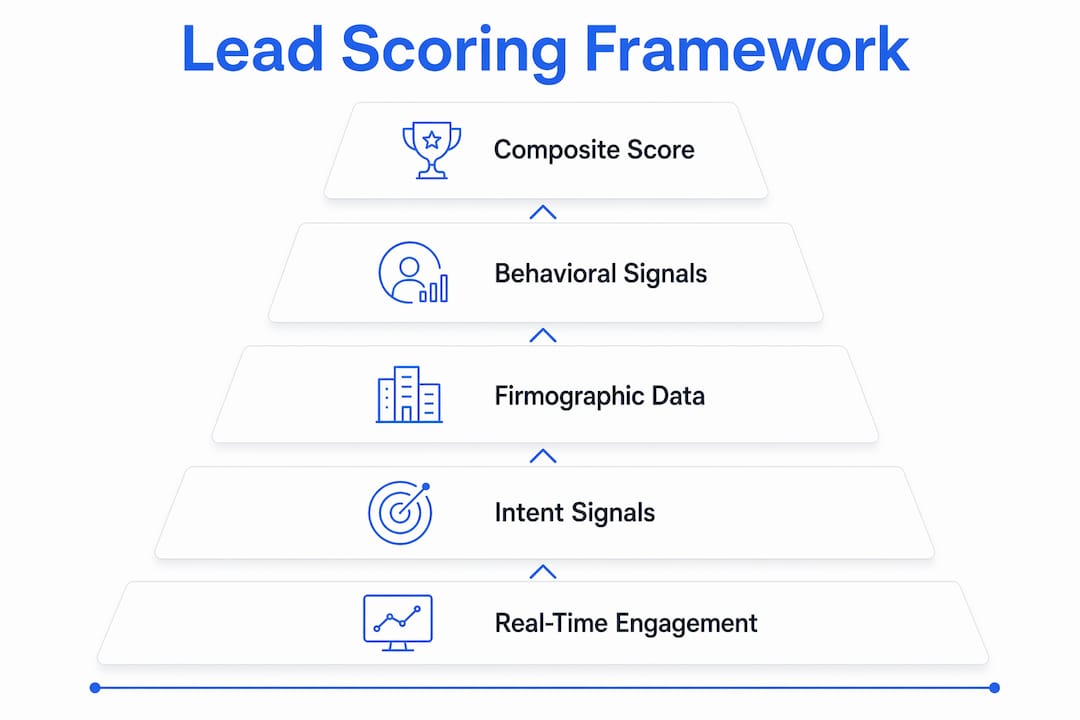
The results are significant. Companies using a lead scoring framework combining behavioral, firmographic, and intent signals see 30% higher conversion and 138% better ROI. That is not a marginal improvement. It is the difference between a sales team that struggles to hit quota and one that consistently exceeds it.
| Scoring Approach | Methodology | Best Use Case | Outcome |
|---|---|---|---|
| Rule-based scoring | Manual thresholds and point assignments | Simple funnels, small teams | Predictable but inflexible |
| ML propensity modeling | XGBoost, Random Forest on historical data | Complex B2B sales cycles | High accuracy, improves over time |
| Hybrid behavioral + firmographic | Weighted multi-signal fusion | Mid-market and enterprise | 30%+ conversion lift |
| Real-time engagement scoring | Live response and click tracking | High-volume outbound | Fastest prioritization signal |
Pro Tip: Data quality determines score quality. Audit your CRM for duplicate records, missing firmographic fields, and stale contact data at least once per quarter. A scoring model built on dirty data will consistently surface the wrong accounts.
What role does real-time behavioral engagement play in prospect prioritization?
Predictive lead scoring tells you who might buy. Real-time behavioral engagement tells you who is buying right now. The distinction matters enormously for how you prioritize outreach.
AI SDR agents autonomously research accounts, personalize outreach, run sequences, handle replies, qualify leads, and hand off to human reps when appropriate. This is not a simple email automation tool. It is a full outbound cadence system that operates without manual intervention at every step.
The key mechanism is what practitioners call the “handoff rule.” AI agents conduct the first several touches and monitor reply patterns. Behavioral filtering based on real-time engagement is stronger intent evidence than predictive scoring alone. When a prospect replies with a question about pricing or asks for a meeting, that response is a self-identification event. The AI flags the account and routes it to a human rep immediately.
Here is how the AI-driven outreach and qualification process works in practice:
-
Account research: The AI pulls firmographic, technographic, and intent data to build a prospect profile.
-
Contact selection: The system identifies the right decision-maker based on title, seniority, and past engagement history.
-
Sequence design: Personalized multi-touch sequences are generated based on the prospect’s industry and signal profile.
-
Execution: Emails, follow-ups, and LinkedIn touches go out automatically on an optimized schedule.
-
Reply handling: The AI reads and categorizes responses, separating genuine interest from out-of-office replies and objections.
-
Qualification: Prospects who engage meaningfully are scored upward and flagged for human review.
-
Handoff: Reps receive a warm, context-rich handoff with full conversation history and a qualification summary.
This process eliminates the manual list review that consumes hours of a rep’s week. Your team focuses exclusively on conversations that are already moving forward.
Pro Tip: Set your handoff threshold at two or more meaningful replies, not just one. A single reply can be a polite brush-off. Two replies with substantive content signal genuine interest and justify rep time.
How does signal-based selling reshape AI prospect identification?
Signal-based selling is the practice of using real-time data to detect when prospects are in-market, focusing on timing instead of volume. Signal-based selling turns prospecting from a numbers game into a precision exercise. You engage fewer accounts but close more of them because you reach them at the exact moment they are evaluating solutions.
The signals that trigger outbound actions fall into four categories. Behavioral signals include content consumption and website activity. Firmographic change signals include new funding rounds, leadership hires, and office expansions. Technographic signals include new software purchases or contract renewals. Relationship signals include past customers joining new companies or referrals from existing accounts.
Agent loops transform these signals into personalized, context-aware outbound messaging that improves reply rates. An agent loop works like this: a trigger fires when a target account hits a signal threshold, the AI generates a personalized message referencing the specific signal, and the outbound sequence launches automatically. The prospect receives a message that feels timely and relevant because it is.
Key benefits of adopting signal-based selling in your outreach program:
-
Earlier detection: Identify accounts entering buying cycles weeks before they contact you directly.
-
Prioritized account lists: Focus rep time on accounts showing multiple converging signals.
-
Dynamic CRM enrichment: Automatically update contact records with new firmographic and behavioral data as signals fire.
-
Higher reply rates: Context-aware messaging outperforms generic cold outreach by a measurable margin.
-
Reduced wasted outreach: Stop sending sequences to accounts with no active buying signals.
Combining multiple intent and behavioral signals using multimodal AI architectures achieves intent classification accuracy up to 92%. That level of accuracy means your outbound list is not a guess. It is a ranked queue of accounts most likely to convert this quarter.
Pro Tip: Never rely on a single signal to trigger outreach. A prospect visiting your pricing page once could be a competitor doing research. Wait for two or more converging signals before launching a sequence. The combination of intent data plus behavioral activity is far more reliable than either signal alone.
Key takeaways
AI identifies sales-ready prospects most effectively when behavioral signals, firmographic fit, and real-time engagement data are combined into a single weighted scoring model that updates continuously.
| Point | Details |
|---|---|
| Multi-signal scoring drives results | Combining behavioral, firmographic, and intent data produces 30% higher conversion and 138% better ROI. |
| Real-time engagement beats prediction | Behavioral filtering based on live replies is stronger intent evidence than predictive scores alone. |
| Signal-based selling improves timing | Detecting in-market accounts early lets reps engage at the optimal buying moment, not after the decision is made. |
| AI SDRs automate the full cadence | AI agents handle research, sequencing, reply handling, and qualification before a human rep is ever involved. |
| Data quality determines score accuracy | Clean, complete CRM data is the foundation of any reliable AI lead scoring system. |
Mediabloom’s take on AI prospecting as an operating model
Most sales teams buy an AI prospecting tool and expect results within 30 days. That expectation sets them up for frustration. The teams that see lasting gains treat AI prospect identification as an operating model change, not a software purchase.
From what we have seen working with companies across industries, the biggest failure point is not the technology. It is governance. Effective teams build governance layers that log why AI-triggered actions occur. When a rep can see exactly which signals caused an account to surface, they trust the system. When the logic is a black box, adoption stalls and reps revert to manual lists.
There is also a real tension between automation and human judgment that most vendors will not acknowledge. AI SDRs are excellent at scale and consistency. They are not good at reading emotional subtext in a reply or knowing when a prospect needs a phone call instead of another email. The best-performing teams we observe use AI to qualify and warm up accounts, then deploy their best reps for the conversations that require genuine human empathy and negotiation skill.
The other pattern worth noting: teams that iterate on their scoring models quarterly outperform teams that set and forget. Your ICP evolves. Your market shifts. A scoring model calibrated on last year’s closed-won data may be optimizing for a customer profile that no longer represents your best opportunities. Build a review cycle into your process from day one.
AI prospect identification is not a destination. It is a continuous feedback loop between data, scoring, outreach, and results. The teams that treat it that way are the ones consistently filling pipeline.
— Mediabloom
Put AI prospect identification to work for your pipeline
Mediabloom’s AI lead generation platform combines voice agents, chatbots, and sales automation into a single system built for the exact workflows described in this article. From behavioral scoring to automated outreach sequences and real-time handoffs, Mediabloom handles the full qualification cycle so your reps spend time closing, not prospecting.
Companies like Miracle Ear and 1-800 Accountant have used Mediabloom to generate over 10,000 monthly leads through omnichannel AI outreach across SMS, email, and chat. If you want to see how AI appointment setting performs in your specific industry, the results speak for themselves. Book a demo and see the system qualify and route a live lead in real time.
FAQ
What is a sales-ready prospect?
A sales-ready prospect is a lead that meets your ICP criteria and has demonstrated active buying intent through behavioral signals like demo requests, pricing page visits, or direct replies to outreach. AI systems identify these prospects by scoring them against weighted firmographic and behavioral data.
How does AI prioritize sales outreach?
AI prioritizes outreach by ranking prospects based on composite scores that weight behavioral engagement at 50%, firmographic fit at 30%, and intent signals at 20%. Accounts with the highest scores and the most recent signal activity receive outreach first.
How accurate is AI at identifying high-intent prospects?
Multimodal AI architectures that combine behavioral and intent signals achieve intent classification accuracy up to 92%. That accuracy depends on data quality and the diversity of signals feeding the model.
How do AI sdrs differ from traditional lead scoring tools?
Traditional lead scoring tools assign static scores based on profile data. AI SDR agents go further by executing full outbound sequences, handling replies, and qualifying leads through actual conversation before handing off to a human rep.
Can AI prospecting replace human sales reps?
AI prospecting automates research, sequencing, and initial qualification, but human reps remain critical for complex negotiations and relationship-driven conversations. Organizations using AI-scored prospect lists achieve conversion rates up to 203 times better than manual outreach, precisely because reps focus only on the highest-value interactions.


