
Sales AI integration best practices are defined as the structured methods revenue teams use to deploy artificial intelligence across lead generation, qualification, and appointment booking without disrupting existing workflows. The industry standard term for this discipline is AI-augmented selling, and it covers everything from CRM data governance to pilot design and ongoing model calibration. Teams that follow a deliberate integration path report up to 30% better quota attainment compared to those that deploy AI tools without a structured plan. This guide gives you the exact sequence to follow.
1. What are the best practices for sales AI integration?
The most effective sales AI integration strategy starts with one high-impact sales stage, not the entire funnel. Trying to automate everything at once is the single fastest way to produce noisy outputs, confuse your team, and burn budget. Staged rollout lowers failure rates and improves adoption across the board.

Before you deploy any AI tool, your CRM must be clean and standardized. That means consistent stage definitions, required fields completed, and activity logging in place. AI outputs become unreliable without standardized stage definitions and activity tracking. Garbage in, garbage out is not a cliché here. It is a technical reality.
The qualification stage is the best starting point for most B2B sales teams. It is high volume, rule-based enough for AI to handle reliably, and directly tied to revenue. Once qualification runs cleanly for four to eight weeks, you have the data and team confidence to expand.
Pro Tip: Allow 4–8 weeks of editorial calibration on your first AI layer before adding a second. Stacking tools before the first one is stable multiplies your failure surface.
2. Which AI tools are best suited for sales teams?
The choice between CRM-native agents and standalone API agents depends on your existing stack and how clean your data already is. Native agents deploy faster but lock you into one vendor’s ecosystem. Standalone agents give you more flexibility but require more technical resources to maintain.
Here is how the three main categories compare:
| Agent Type | Examples | Deployment Speed | Flexibility | Maintenance Load | Best For |
|---|---|---|---|---|---|
| CRM-native | HubSpot Breeze, Salesforce Agentforce, monday AI | Fast (days) | Low | Low | Teams already on one CRM platform |
| Standalone API | Apollo, Outreach | Medium (weeks) | High | Medium | Multi-tool stacks needing custom logic |
| Custom-built | Purpose-built via OpenAI, Anthropic APIs | Slow (months) | Very High | High | Enterprise teams with dedicated AI engineers |
Key factors to weigh before choosing:
- Data cleanliness: CRM-native agents require your CRM data to already be standardized. If it is not, native agents will surface bad recommendations faster than standalone tools.
- Integration depth: Standalone tools like Apollo connect across multiple data sources, which matters when your lead data lives outside your CRM.
- Budget for maintenance: Custom-built agents require ongoing prompt tuning and API maintenance. Plan for it before you build.
- Team technical capacity: If your sales ops team has no engineering support, CRM-native is the safer starting point.
The right tool is not the most advanced one. It is the one your team will actually use and maintain.
3. What proven strategies maximize sales performance gains with AI?
AI-driven pipeline management produces 15–20% higher forecast accuracy and 25% shorter sales cycles for teams that implement it correctly. Those numbers reflect disciplined deployment, not just tool adoption. The strategy behind the gains matters as much as the technology itself.
Automate pipeline cleaning first
AI can flag stale deals automatically using engagement decay signals and activity thresholds. This frees your reps from manual pipeline reviews and sharpens forecast accuracy. Automating pipeline cleanup improves both rep focus and the reliability of your revenue projections.
Deploy AI for lead scoring and appointment booking
Lead scoring is one of the highest-return AI use cases in sales. AI models analyze firmographic data, behavioral signals, and historical win rates to rank prospects by conversion probability. Pair that with an AI-powered appointment booking system that responds to inbound leads in under 60 seconds, and you eliminate the response-time gap that kills conversion rates.
Track revenue-attributable metrics from week one
Successful AI sales integrations prioritize use cases that show measurable revenue impact within 6–12 weeks. That means tracking pipeline velocity, meeting-booked rate, and quota attainment from the start. Teams that track these metrics quarterly are the ones that sustain gains over time.
The core strategies that drive measurable results:
- Use AI to score and prioritize inbound leads by conversion probability
- Automate follow-up sequences triggered by engagement signals
- Deploy conversation intelligence tools to analyze call recordings and surface coaching cues
- Integrate intent data from platforms like G2 or Bombora to time outreach precisely
- Set AI confidence thresholds conservatively so reps review borderline decisions
AI-driven automation frees approximately 20% of sales team capacity and can boost sales by up to 20% within a month of targeted deployment. That capacity gain is not theoretical. It shows up as more calls made, more deals reviewed, and faster response times on inbound leads.
4. How to pilot and scale AI integration effectively
A controlled pilot is the safest path to AI adoption. Run your first pilot with 50–100 prospects in one ICP segment over two weeks. That sample size is large enough to generate statistically meaningful data and small enough to course-correct quickly.
Follow this sequence for a reliable pilot:
- Define your ICP segment. Pick one buyer profile with enough volume to test. Avoid mixing segments in the first pilot.
- Set your baseline metrics. Measure open rate, reply rate, and meeting-booked rate before the AI goes live. You need a comparison point.
- Deploy the AI agent on outbound or qualification only. Do not automate closing conversations in the pilot phase.
- Run for two full weeks. Resist the urge to adjust mid-pilot. Let the data accumulate.
- Review outputs daily for the first three days. Catch prompt failures, tone issues, or data errors before they reach 100 prospects.
- Score results against baseline. If meeting-booked rate improves by 15% or more, you have a green light to scale.
- Scale volume gradually. Add 25–30% more volume per week, not all at once. Immediate large-scale deployment increases spam risk and reduces personalization quality.
Pro Tip: Set your AI confidence threshold conservatively at first. A 70% confidence cutoff means the agent only acts when it is highly certain. Raise the threshold only after two weeks of clean outputs.
Budget for ongoing maintenance from day one. AI agents require 4–8 hours per month of tuning to handle API changes, prompt drift, and new data patterns. Teams that skip this budget line find their AI performance degrading quietly over 60–90 days.
5. What common pitfalls derail AI sales integration?
The top failure in AI sales integration is focusing on flashy features instead of concrete revenue constraints. Teams get excited about AI voice agents or generative email tools and deploy them before solving the underlying data and process problems. The result is an expensive tool that produces unreliable outputs and loses team trust within weeks.
The most common pitfalls to avoid:
- Skipping CRM standardization. AI cannot score leads accurately if stage names are inconsistent or fields are empty. Fix your data before you deploy.
- Implementing too many tools at once. Each new AI tool adds integration complexity and maintenance load. Add one layer at a time.
- Ignoring change management. Effective AI adoption requires embedding AI organically in sales workflows, not bolting it on as a separate system. Reps who do not trust the AI will route around it.
- Removing human oversight too early. AI agents need human review loops, especially in the first 90 days. Automate the volume, not the judgment.
- Failing to track maintenance costs. Prompt tuning, API updates, and model retraining are ongoing costs. Budget for them or performance will decay.
“The biggest mistake is treating AI as a one-time deployment. It is a system that requires continuous calibration, just like your sales process itself.”
Sustaining AI-driven improvements requires quarterly reviews of model performance, regular CRM audits, and a designated owner for AI maintenance on the sales ops team. Without ownership, no one catches the slow drift in output quality until it has already damaged pipeline health.
Key takeaways
Sales AI integration succeeds when teams prioritize CRM readiness, start with one high-impact stage, run controlled pilots, and maintain ongoing human oversight throughout the scaling process.
| Point | Details |
|---|---|
| Start with one sales stage | Target qualification first; it is high volume, rule-based, and directly tied to revenue. |
| Clean your CRM before deploying | Standardize stage definitions and required fields or AI outputs will be unreliable. |
| Run a 50–100 prospect pilot | Test one ICP segment for two weeks before scaling to validate quality and team trust. |
| Budget for ongoing maintenance | Plan 4–8 hours per month for prompt tuning, API fixes, and model calibration. |
| Track revenue metrics from week one | Measure pipeline velocity, meeting-booked rate, and quota attainment every quarter. |
Mediabloom’s take on what actually works in AI sales integration
We have seen hundreds of sales teams attempt AI integration, and the pattern is consistent. The teams that succeed are not the ones with the biggest budgets or the most advanced tools. They are the ones that start with a clear problem, a clean data set, and a willingness to move slowly before they move fast.
The hardest lesson to internalize is that AI does not fix a broken sales process. It amplifies whatever process you already have. If your qualification criteria are vague, AI will qualify the wrong leads faster. If your follow-up cadence is inconsistent, AI will automate that inconsistency at scale. The discipline has to come first.
We have also watched teams fail by chasing the most visible AI features instead of the most valuable ones. An AI voice agent that books appointments is impressive. But if your inbound lead data is incomplete, that agent will book meetings with the wrong prospects and waste your closers’ time. The sequence matters more than the technology.
For teams just starting out, the single best move is to pick one problem that costs you measurable revenue today, whether that is slow lead response, manual pipeline reviews, or inconsistent follow-up, and solve only that problem first. Get one win. Build trust with your team. Then expand. That path is slower on paper and faster in practice.
— Mediabloom
How Mediabloom helps sales teams deploy AI that books real appointments
If you are ready to move from theory to results, Mediabloom builds and deploys AI systems purpose-built for lead generation and appointment setting. Clients like Miracle Ear and 1-800 Accountant generate over 10,000 monthly leads through Mediabloom’s platform, which combines AI voice agents, chatbots, and omnichannel automation across SMS, email, and chat.
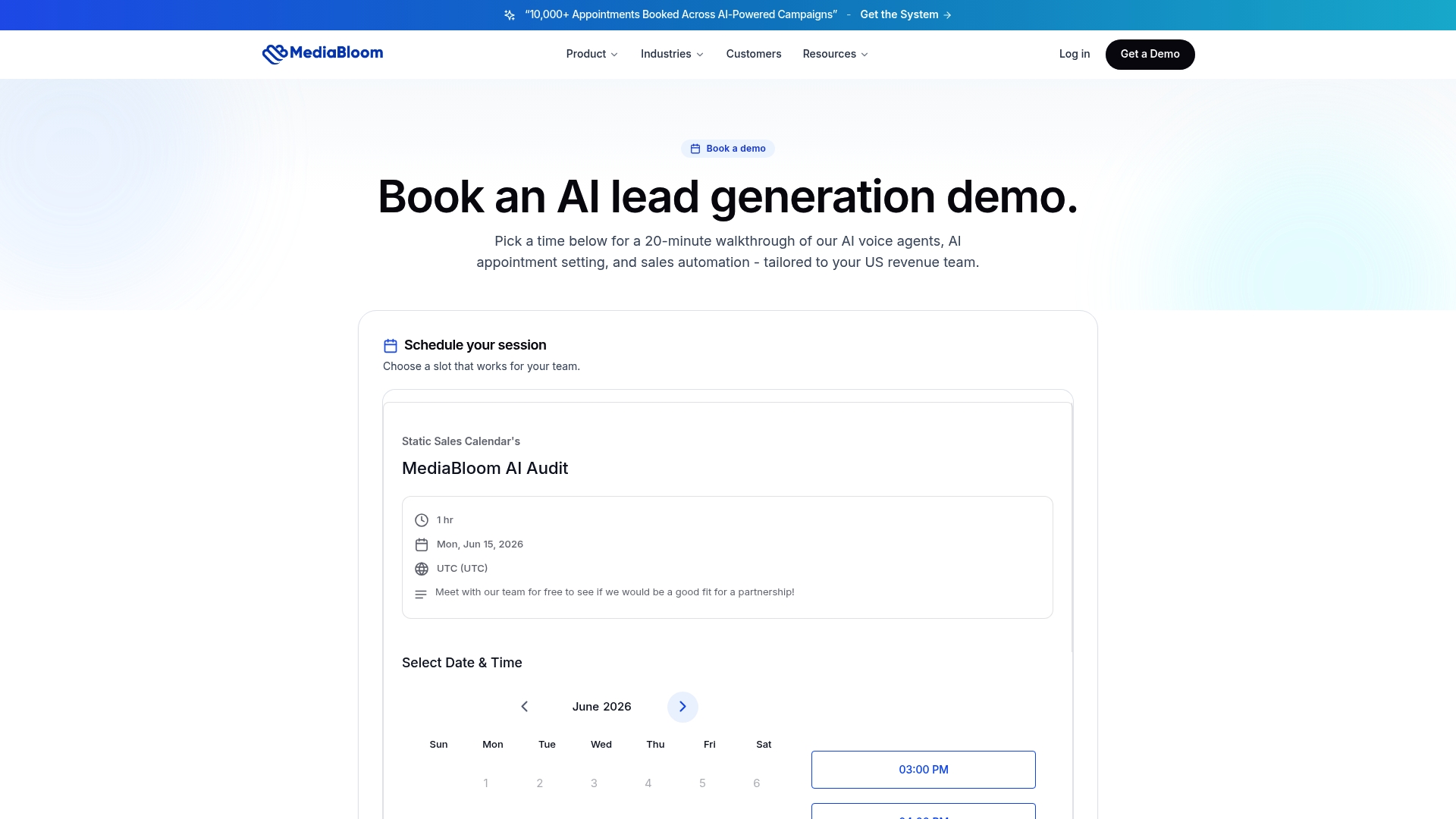
Mediabloom’s AI lead generation platform handles the full qualification-to-booking workflow so your reps spend time on deals, not data entry. Whether you need a controlled pilot or a full-scale deployment, Mediabloom configures the system to your ICP, your CRM, and your revenue targets. You can also explore AI appointment setting results across industries to see what deployment looks like in practice. The next step is a conversation about your pipeline.
FAQ
What is the first step in sales AI integration?
The first step is standardizing your CRM data, including stage definitions, required fields, and activity tracking. AI cannot produce reliable outputs without clean, consistent input data.
How long does a sales AI pilot typically take?
A well-structured pilot runs for two weeks with 50–100 prospects in one ICP segment. That timeframe generates enough data to evaluate open rate, reply rate, and meeting-booked rate before scaling.
What AI tools work best for B2B sales teams?
CRM-native tools like HubSpot Breeze, Salesforce Agentforce, and monday AI deploy fastest for teams already on a single platform. Standalone tools like Apollo and Outreach offer more flexibility for multi-stack environments.
How much maintenance does a sales AI system require?
Plan for 4–8 hours per month to handle prompt tuning, API updates, and model calibration. Teams that skip this maintenance see performance decay within 60–90 days of deployment.
What metrics should I track to measure AI sales performance?
Track pipeline velocity, meeting-booked rate, forecast accuracy, and quota attainment on a quarterly basis. These four metrics directly reflect whether your AI integration is generating revenue impact.


